You are standing on a riverbank watching the water rise after heavy rain. The soil is eroding, and the bank is collapsing. You need a solution that works fast and lasts for decades.
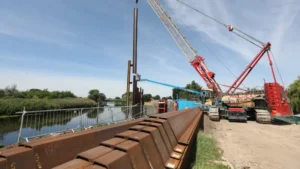
Steel sheet piles1 are ideal for riverbank protection because they provide a continuous barrier that prevents soil erosion, stabilizes the bank, and can be installed quickly. They are used for flood control, riverbank stabilization, and channel protection. U-type piles with Larssen interlocks2 are the most common choice for these projects.
](https://cnsteelplant.com/wp-content/uploads/2026/03/Article-Application-River-Embankment-4.webp)
I remember the riverbank protection project in Southeast Asia well. The river was eroding the bank at an alarming rate, threatening nearby villages. We supplied hot rolled U type steel sheet piles that were driven quickly, and the wall has held the bank stable for years. Let me walk you through how to use sheet piles for riverbank protection.
Steel sheet pile specifications
Steel sheet pile specifications for riverbank protection must account for water level variations, soil conditions, and potential flood events.
Steel sheet pile specifications for riverbank projects include the pile type (U-type is most common), steel grade (ASTM A3281 or EN 10248 S270GP for freshwater), dimensions (width and height), section modulus, interlock type (Larssen ball-and-socket for water tightness), and corrosion allowance2 for long-term durability. The wall is typically designed as a cantilever wall for moderate heights.
](https://cnsteelplant.com/wp-content/uploads/2026/03/Article-Application-River-Embankment-3.webp)
Key Specification Elements for Riverbank Projects
Let me explain the important elements of a riverbank sheet pile specification.
1. Pile Type
For riverbank protection, U-type sheet piles3 are the standard choice because:
- Symmetric shape allows installation along curved river alignments
- Larssen interlocks provide excellent water tightness
- Forgiving installation in variable soil conditions
- Proven track record in river applications
2. Steel Grade
For freshwater rivers, standard carbon steel grades are sufficient:
For brackish or tidal rivers, consider marine grade ASTM A690.
3. Dimensions
Common U-type sections for riverbanks:
- U 400 x 125-13: Moderate heights up to 6 m
- U 400 x 170-15.5: Higher walls up to 8 m
- U 600 x 180-13.4: Deep water applications
4. Interlock
Larssen ball-and-socket interlocks4 are standard for U-type piles. They tighten under soil pressure, providing water tightness without sealants.
5. Corrosion Allowance
For 50-year design life in freshwater:
- Add 1-2 mm corrosion allowance2
- For brackish water, add 2-3 mm
My Experience
For the riverbank project in Southeast Asia, we supplied U 400 x 125-13 piles to ASTM A3281. The water was fresh, and the 2 mm corrosion allowance2 provided a 50-year design life.
Steel Sheet Pile price
Steel sheet pile prices vary based on section size, steel grade, quantity, and market conditions. For riverbank projects, material cost is a significant part of the budget.
Steel sheet pile material cost1 typically ranges from $550 to $800 per ton for standard carbon steel. U 400 x 125-13 piles (60 kg/m) cost around $600-700 per ton. Total project cost includes material, shipping, and installation. Installed cost for riverbank walls ranges from $500 to $1,200 per linear meter, depending on depth and site conditions.
](https://cnsteelplant.com/wp-content/uploads/2026/03/Article-Application-River-Embankment-2.webp)
Cost Factors for Riverbank Projects
Let me break down the cost components for riverbank sheet pile projects2.
Material Cost Factors
| Factor | Impact | Notes |
|---|---|---|
| Section size | Larger sections cost more per meter | Heavier piles use more steel |
| Steel grade | +10-20% for higher strength | A572 costs more than A328 |
| Marine grade | +15-20% | A690 for brackish water |
| Quantity | Lower price per ton for larger orders | Mills offer discounts over 500 tons |
| Length | Longer piles may cost more | Handling and transport limits |
Typical Material Costs (per ton)
| Section | Grade | Typical Cost ($/ton) |
|---|---|---|
| U 400 x 100-10.5 | A328 | 550-650 |
| U 400 x 125-13 | A328 | 600-700 |
| U 400 x 170-15.5 | A328 | 650-750 |
| U 600 x 180-13.4 | A328 | 600-700 |
| U 600 x 210-18 | A328 | 650-750 |
Installed Cost Ranges
| Wall Height | Soil Conditions | Installed Cost ($/m) |
|---|---|---|
| 3-4 m | Good soil | 500-700 |
| 5-6 m | Good soil | 700-900 |
| 5-6 m | Soft soil | 900-1,200 |
| 7-8 m | Good soil | 1,000-1,500 |
Example Project Cost
For the riverbank project:
- 500 m wall length
- U 400 x 125-13 piles, 15 m length
- 500 piles × 15 m × 60 kg/m = 450 tons
- Material cost: 450 tons × $650 = $292,500
- Installation: 500 m × $800 = $400,000
- Total: $692,500
My Experience
For the riverbank project, the client chose U 400 x 125-13 piles because they provided the required strength at a competitive price. The material cost was $650 per ton, and installation was completed in 3 weeks.
Steel piles1 foundation
Steel piles1 are used for foundation support in riverbank structures, providing a stable base for walls, bridges, and other infrastructure.
Steel piles1 for riverbank foundations include sheet piles (for retaining walls) and bearing piles (for structural support). Sheet piles2 form the retaining wall that holds back the soil. Bearing piles3 (pipe piles or H-piles) support the capping beam and any structures on top of the wall. Both types are driven into the riverbed to reach stable soil layers.
](https://cnsteelplant.com/wp-content/uploads/2026/03/Article-Application-River-Embankment-1.webp)
Foundation Design for Riverbank Walls
Let me explain how steel piles work together in riverbank foundations.
Sheet Piles (Retaining Wall)
- Function: Hold back soil and water
- Type: U-type with Larssen interlocks
- Installation: Driven to required embedment depth
- Design: Cantilever or anchored depending on height
Bearing Piles (Structural Support)
- Function: Support capping beam, crane rails, or deck
- Type: Steel pipe piles (LSAW or SSAW) or H-piles
- Installation: Driven to rock or to achieve required capacity
- Design: End-bearing or friction piles depending on soil
How They Work Together
- Sheet piles2 are driven first to form the retaining wall
- Excavation proceeds behind the wall
- Bearing piles3 are driven through the excavation
- A concrete capping beam is poured over both pile types
- The capping beam ties the system together
Foundation Design Considerations4
| Factor | Consideration |
|---|---|
| Soil bearing capacity | Determines pile length and type |
| Water level | Affects driving conditions and corrosion |
| Scour | Riverbed may erode over time |
| Seismic | Required in some regions |
| Surcharge loads | From equipment or structures behind wall |
Typical Pile Types for Riverbank Foundations
| Pile Type | Function | Typical Section |
|---|---|---|
| Sheet piles2 | Retaining wall | U 400 x 125-13 |
| Pipe piles | Bearing piles3 | 400 mm diameter, 12 mm wall |
| H-piles | Bearing piles3 | HP 10 x 42 |
My Experience
For the riverbank project, we used U-type sheet piles for the retaining wall. Behind the wall, we installed concrete bearing piles to support a walking path and railings. The sheet piles were driven to 8 m depth, and the bearing piles were driven to 15 m to reach dense sand.
Steel sheet piling retaining wall
A steel sheet piling retaining wall1 is the primary structure for riverbank protection. It holds back the soil and prevents erosion.
A steel sheet piling retaining wall1 consists of interlocking U-type sheet piles driven vertically into the riverbank. The piles form a continuous barrier that resists the lateral pressure from the retained soil. For riverbanks, the wall is typically designed as a cantilever wall for heights up to 6-8 meters. A concrete capping beam2 is often added at the top to distribute loads and provide a finished edge.
[^1] along river](https://placehold.co/600x400 "Steel Sheet Piling Retaining Wall")](https://cnsteelplant.com/wp-content/uploads/2026/03/Article-Application-River-Embankment-5.webp)
Design of Riverbank Retaining Walls
Let me explain the design considerations for riverbank retaining walls.
Cantilever Wall Design
For moderate riverbank heights (up to 6-8 m), cantilever walls are common. The wall is driven deep enough to resist rotation without anchors.
- Total length = exposed height + embedment depth
- Embedment depth typically 1.0 to 1.5 times exposed height
- Section modulus based on calculated bending moment
Wall Components
| Component | Function |
|---|---|
| Sheet piles | Primary retaining structure |
| Concrete capping beam | Distributes loads, provides finished edge |
| Drainage system | Relieves water pressure behind wall |
| Scour protection | Prevents erosion at wall toe |
Construction Sequence
- Drive sheet piles along the alignment
- Install guide frames to maintain alignment
- Drive piles to required depth
- Excavate behind the wall (if needed)
- Install drainage system3
- Pour concrete capping beam2
- Install scour protection at toe
Design Example for Riverbank Wall
- Riverbank height: 5 m
- Soil: Sand, φ = 32°, γ = 18 kN/m³
- Water table: At river level
- Required embedment: 6 m
- Total pile length: 11 m
- Section: U 400 x 125-13
My Experience
For the riverbank project, we designed a cantilever retaining wall with 6 m exposed height and 7.2 m embedment. The U 400 x 125-13 piles provided ample strength, and the concrete capping beam2 tied everything together. The wall has held the bank stable through several monsoon seasons.
Conclusion
Steel sheet piles1 are the ideal solution for riverbank protection and flood control. U-type piles with Larssen interlocks provide water tightness and stability. For freshwater rivers, standard carbon steel with corrosion allowance is sufficient. For brackish water, use marine grade steel2.
-
Discover how Steel sheet piles can enhance riverbank stability and flood control, making them a top choice for environmental protection. ↩ ↩ ↩ ↩ ↩ ↩ ↩ ↩ ↩ ↩ ↩
-
Learn about the advantages of marine grade steel in preventing corrosion and ensuring durability in challenging water conditions. ↩ ↩ ↩ ↩ ↩ ↩ ↩ ↩ ↩ ↩ ↩ ↩
-
Understand the significance of drainage systems in preventing water pressure buildup behind retaining walls. ↩ ↩ ↩ ↩ ↩ ↩
-
Understand the critical factors in foundation design that ensure stability and longevity of riverbank structures. ↩ ↩