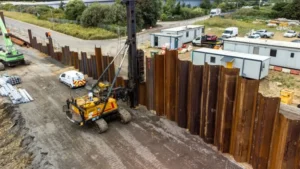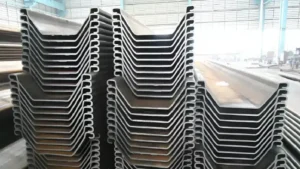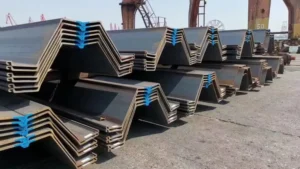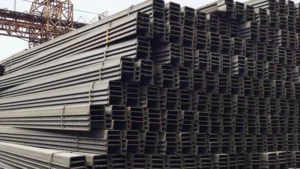
You have completed the geotechnical analysis for a retaining wall. The maximum bending moment is on your screen. Now you need to select a sheet pile section that can handle that moment. The two numbers you need are unit weight1 and section modulus2.
Unit weight (kg/m) tells you how much each meter of pile weighs for shipping and handling. Section modulus (S in cm³/m) tells you how much bending moment the wall can resist. Together, they determine the cost and performance of your wall.
[^1] and [section modulus](https://www.ggu-software.com/en/glossary/elastic-earth-support-of-retaining-walls-modulus-of-subgrade-re-action-method)[^2] comparison chart](https://placehold.co/600x400 "Steel Sheet Pile Unit Weight and Section Modulus")](https://cnsteelplant.com/wp-content/uploads/2026/03/Article-Application-City-3.webp)
I use these tables every day. For the riverbank project, we needed S = 1,450 cm³/m. The table showed U 400 x 125-13 at 60 kg/m with S = 1,590. For a port project, we needed S = 2,600 cm³/m. AZ 26 at 109 kg/m with S = 2,600 was the perfect match.
Steel Sheet pile specifications
Steel sheet pile specifications define the unit weight, section modulus, and other properties required for a project.
Steel sheet pile specifications include the pile type (U or Z), section designation, unit weight (kg/m), section modulus (S in cm³/m), steel grade, and length. The unit weight and section modulus are derived from the section dimensions and are critical for design and ordering.
](https://cnsteelplant.com/wp-content/uploads/2026/03/Article-application-4.webp)
Key Specification Elements
Let me explain the most important elements of a sheet pile specification.
1. Unit Weight (kg/m or lb/ft)1
The weight per meter of pile length. This determines:
- Shipping cost (freight is charged by weight)
- Crane requirements (heavier piles need larger cranes)
- Handling difficulty
2. Section Modulus (S in cm³/m or in³/ft)2
The key structural property. It tells you how much bending moment the wall can resist.
Required S = Mmax / σallowable
Where σallowable is the allowable stress in the steel.
3. Steel Grade
Determines the allowable stress. Higher grades allow higher stress, so you can use lighter sections.
4. Moment of Inertia (I in cm⁴/m or in⁴/ft)
Determines wall stiffness and deflection. Higher I means stiffer wall.
My Experience
When I receive a specification, I check the unit weight first. It tells me the shipping cost. Then I check the section modulus to ensure it meets the design requirements. For the riverbank project, the engineer specified U 400 x 125-13. The unit weight was 60 kg/m, and S = 1,590 cm³/m.
Sheet pile weight per meter
Unit weight per meter is the most important number for ordering, shipping, and handling. It tells you how much each meter of pile weighs.
Sheet pile unit weight ranges from 40 kg/m for light U type sections1 to 211 kg/m for heavy Z type sections2. U type ranges from 40 kg/m to 106 kg/m. Z type ranges from 58 kg/m to 211 kg/m. The unit weight determines the total tonnage3 of your project.
[^4] per meter comparison chart](https://placehold.co/600x400 "Sheet Pile Weight per Meter")](https://cnsteelplant.com/wp-content/uploads/2026/03/Article-application-5.webp)
Complete Unit Weight Table
U Type Sheet Piles – Unit Weight per Meter
| Section | Width (mm) | Height (mm) | Thickness (mm) | Unit Weight (kg/m) | Unit Weight (lb/ft) |
|---|---|---|---|---|---|
| U 400 x 100 | 400 | 100 | 8.0 | 40.0 | 26.9 |
| U 400 x 100 | 400 | 100 | 10.5 | 48.0 | 32.3 |
| U 400 x 100 | 400 | 100 | 12.0 | 54.0 | 36.3 |
| U 400 x 125 | 400 | 125 | 10.0 | 50.0 | 33.6 |
| U 400 x 125 | 400 | 125 | 13.0 | 60.0 | 40.3 |
| U 400 x 125 | 400 | 125 | 15.0 | 68.0 | 45.7 |
| U 400 x 170 | 400 | 170 | 11.0 | 55.0 | 37.0 |
| U 400 x 170 | 400 | 170 | 13.5 | 65.0 | 43.7 |
| U 400 x 170 | 400 | 170 | 15.5 | 76.1 | 51.1 |
| U 400 x 170 | 400 | 170 | 18.0 | 86.0 | 57.8 |
| U 600 x 130 | 600 | 130 | 8.0 | 50.0 | 33.6 |
| U 600 x 130 | 600 | 130 | 10.3 | 61.8 | 41.5 |
| U 600 x 130 | 600 | 130 | 12.0 | 70.0 | 47.0 |
| U 600 x 180 | 600 | 180 | 10.0 | 65.0 | 43.7 |
| U 600 x 180 | 600 | 180 | 12.0 | 75.0 | 50.4 |
| U 600 x 180 | 600 | 180 | 13.4 | 81.6 | 54.8 |
| U 600 x 180 | 600 | 180 | 15.0 | 90.0 | 60.5 |
| U 600 x 210 | 600 | 210 | 13.0 | 85.0 | 57.1 |
| U 600 x 210 | 600 | 210 | 15.0 | 95.0 | 63.8 |
| U 600 x 210 | 600 | 210 | 18.0 | 106.2 | 71.4 |
Z Type Sheet Piles (AZ Series) – Unit Weight per Meter
| Section | Width (mm) | Height (mm) | Thickness (mm) | Unit Weight (kg/m) | Unit Weight (lb/ft) |
|---|---|---|---|---|---|
| AZ 12 | 630 | 260 | 7.0 | 57.8 | 38.8 |
| AZ 13 | 670 | 305 | 7.0 | 57.8 | 38.8 |
| AZ 14 | 670 | 308 | 7.5 | 62.0 | 41.7 |
| AZ 16 | 670 | 322 | 8.0 | 66.5 | 44.7 |
| AZ 18 | 670 | 345 | 9.0 | 75.0 | 50.4 |
| AZ 20 | 670 | 358 | 10.0 | 83.5 | 56.1 |
| AZ 22 | 670 | 367 | 11.0 | 92.0 | 61.8 |
| AZ 24 | 670 | 378 | 12.0 | 100.5 | 67.5 |
| AZ 26 | 670 | 396 | 13.0 | 109.0 | 73.2 |
| AZ 28 | 670 | 408 | 14.0 | 117.5 | 79.0 |
| AZ 30 | 670 | 422 | 15.0 | 126.0 | 84.7 |
| AZ 34 | 670 | 444 | 17.0 | 143.0 | 96.1 |
| AZ 38 | 670 | 465 | 19.0 | 160.0 | 107.5 |
| AZ 42 | 670 | 487 | 21.0 | 177.0 | 118.9 |
| AZ 46 | 670 | 508 | 23.0 | 194.0 | 130.4 |
| AZ 50 | 670 | 529 | 25.0 | 211.0 | 141.8 |
Z Type Sheet Piles (PZC Series) – Unit Weight per Meter
| Section | Width (mm) | Height (mm) | Unit Weight (kg/m) | Unit Weight (lb/ft) |
|---|---|---|---|---|
| PZC 12 | 708 | 318 | 69.1 | 46.4 |
| PZC 13 | 708 | 319 | 75.0 | 50.4 |
| PZC 14 | 708 | 320 | 81.9 | 55.0 |
| PZC 17 | 635 | 386 | 69.1 | 46.4 |
| PZC 18 | 635 | 387 | 75.0 | 50.4 |
| PZC 19 | 635 | 389 | 81.9 | 55.0 |
| PZC 26 | 708 | 450 | 110.0 | 73.9 |
| PZC 28 | 708 | 457 | 119.7 | 80.4 |
| PZC 29 | 708 | 462 | 125.0 | 84.0 |
My Experience
For the riverbank project, the unit weight of 60 kg/m for U 400 x 125 meant each 15-meter pile weighed 900 kg. Total weight for 500 piles was 450 tons. That number determined the shipping method4 and crane requirements.
Sheet pile section modulus
Section modulus1 (S) is the most important structural property for sheet pile design. It tells you how much bending moment2 the wall can resist.
Section modulus1 is expressed in cm³ per meter of wall (cm³/m) or in³ per foot of wall (in³/ft). The required section modulus is calculated as Mmax divided by the allowable stress3. Higher section modulus means stronger wall.
[^2] capacity](https://placehold.co/600x400 "Sheet Pile Section Modulus")](https://cnsteelplant.com/wp-content/uploads/2026/03/Article-Application-River-Embankment-3.webp)
Complete Section Modulus Table
U Type Sheet Piles5 – Section Modulus (S)
| Section | Width (mm) | Height (mm) | Thickness (mm) | Unit Weight (kg/m) | S (cm³/m) | S (in³/ft) |
|---|---|---|---|---|---|---|
| U 400 x 100 | 400 | 100 | 8.0 | 40.0 | 900 | 5.2 |
| U 400 x 100 | 400 | 100 | 10.5 | 48.0 | 1,080 | 6.2 |
| U 400 x 100 | 400 | 100 | 12.0 | 54.0 | 1,220 | 7.0 |
| U 400 x 125 | 400 | 125 | 10.0 | 50.0 | 1,330 | 7.7 |
| U 400 x 125 | 400 | 125 | 13.0 | 60.0 | 1,590 | 9.2 |
| U 400 x 125 | 400 | 125 | 15.0 | 68.0 | 1,800 | 10.4 |
| U 400 x 170 | 400 | 170 | 11.0 | 55.0 | 1,790 | 10.3 |
| U 400 x 170 | 400 | 170 | 13.5 | 65.0 | 2,120 | 12.2 |
| U 400 x 170 | 400 | 170 | 15.5 | 76.1 | 2,470 | 14.2 |
| U 400 x 170 | 400 | 170 | 18.0 | 86.0 | 2,800 | 16.1 |
| U 600 x 130 | 600 | 130 | 8.0 | 50.0 | 1,910 | 11.0 |
| U 600 x 130 | 600 | 130 | 10.3 | 61.8 | 2,350 | 13.5 |
| U 600 x 130 | 600 | 130 | 12.0 | 70.0 | 2,680 | 15.4 |
| U 600 x 180 | 600 | 180 | 10.0 | 65.0 | 3,040 | 17.5 |
| U 600 x 180 | 600 | 180 | 12.0 | 75.0 | 3,510 | 20.2 |
| U 600 x 180 | 600 | 180 | 13.4 | 81.6 | 3,820 | 22.0 |
| U 600 x 180 | 600 | 180 | 15.0 | 90.0 | 4,210 | 24.2 |
| U 600 x 210 | 600 | 210 | 13.0 | 85.0 | 4,580 | 26.3 |
| U 600 x 210 | 600 | 210 | 15.0 | 95.0 | 5,120 | 29.4 |
| U 600 x 210 | 600 | 210 | 18.0 | 106.2 | 5,730 | 32.9 |
Z Type Sheet Piles4 (AZ Series) – Section Modulus (S)
| Section | Width (mm) | Height (mm) | Thickness (mm) | Unit Weight (kg/m) | S (cm³/m) | S (in³/ft) |
|---|---|---|---|---|---|---|
| AZ 12 | 630 | 260 | 7.0 | 57.8 | 1,200 | 6.9 |
| AZ 13 | 670 | 305 | 7.0 | 57.8 | 1,300 | 7.5 |
| AZ 14 | 670 | 308 | 7.5 | 62.0 | 1,400 | 8.0 |
| AZ 16 | 670 | 322 | 8.0 | 66.5 | 1,600 | 9.2 |
| AZ 18 | 670 | 345 | 9.0 | 75.0 | 1,800 | 10.4 |
| AZ 20 | 670 | 358 | 10.0 | 83.5 | 2,000 | 11.5 |
| AZ 22 | 670 | 367 | 11.0 | 92.0 | 2,200 | 12.7 |
| AZ 24 | 670 | 378 | 12.0 | 100.5 | 2,400 | 13.8 |
| AZ 26 | 670 | 396 | 13.0 | 109.0 | 2,600 | 15.0 |
| AZ 28 | 670 | 408 | 14.0 | 117.5 | 2,800 | 16.1 |
| AZ 30 | 670 | 422 | 15.0 | 126.0 | 3,000 | 17.3 |
| AZ 34 | 670 | 444 | 17.0 | 143.0 | 3,400 | 19.6 |
| AZ 38 | 670 | 465 | 19.0 | 160.0 | 3,800 | 21.9 |
| AZ 42 | 670 | 487 | 21.0 | 177.0 | 4,200 | 24.2 |
| AZ 46 | 670 | 508 | 23.0 | 194.0 | 4,600 | 26.5 |
| AZ 50 | 670 | 529 | 25.0 | 211.0 | 5,000 | 28.8 |
Z Type Sheet Piles4 (PZC Series) – Section Modulus (S)
| Section | Width (mm) | Height (mm) | Unit Weight (kg/m) | S (cm³/m) | S (in³/ft) |
|---|---|---|---|---|---|
| PZC 12 | 708 | 318 | 69.1 | 2,210 | 12.8 |
| PZC 13 | 708 | 319 | 75.0 | 2,500 | 14.5 |
| PZC 14 | 708 | 320 | 81.9 | 2,810 | 16.3 |
| PZC 17 | 635 | 386 | 69.1 | 3,000 | 17.4 |
| PZC 18 | 635 | 387 | 75.0 | 3,360 | 19.5 |
| PZC 19 | 635 | 389 | 81.9 | 3,740 | 21.7 |
| PZC 26 | 708 | 450 | 110.0 | 4,960 | 28.8 |
| PZC 28 | 708 | 457 | 119.7 | 5,750 | 33.4 |
| PZC 29 | 708 | 462 | 125.0 | 6,290 | 36.5 |
How to Use Section Modulus
Calculate Required Section Modulus
Srequired = Mmax / σallowable
Where:
- Mmax = maximum bending moment6t](https://www.youtube.com/watch?v=C-FEVzI8oe8)[^2] (kN-m/m)
- σallowable = allowable stress3 in steel (MPa)
For ASTM A3287 (240 MPa yield) with safety factor8 1.5:
σallowable = 240 / 1.5 = 160 MPa = 160,000 kN/m²
Example:
Mmax = 250 kN-m/m
Srequired = 250,000 / 160,000 = 1,560 cm³/m
Select a section with S ≥ 1,560 cm³/m.
My Experience
For the riverbank project, Mmax was 230 kN-m/m. Required S = 230,000 / 160,000 = 1,440 cm³/m. The U 400 x 125-13 with S = 1,590 cm³/m was more than adequate.
Nucor product data Sheet
Nucor Skyline publishes comprehensive product data sheets that provide unit weight1, section modulus2, and other properties for their sheet pile sections.
Nucor product data sheets3 include the PZC series5 (ball-and-socket interlock), the PZ series (hook-and-grip interlock), and U-type sections. Each data sheet lists unit weight1 (lb/ft and kg/m), section modulus2 (in³/ft and cm³/m), moment of inertia, and dimensions.
[^1] and [section modulus](https://en.wikipedia.org/wiki/Section_modulus)[^2]](https://placehold.co/600x400 "Nucor Product Data Sheet")](https://cnsteelplant.com/wp-content/uploads/2026/03/Article-application-1.webp)
Nucor PZC Series – Unit Weight and Section Modulus
| Section | Width (in) | Weight (lb/ft) | Weight (kg/m) | S (in³/ft) | S (cm³/m) |
|---|---|---|---|---|---|
| PZC 12 | 27.88 | 46.4 | 69.1 | 12.8 | 2,210 |
| PZC 13 | 27.88 | 50.4 | 75.0 | 14.5 | 2,500 |
| PZC 14 | 27.88 | 55.0 | 81.9 | 16.3 | 2,810 |
| PZC 17 | 25.00 | 46.4 | 69.1 | 17.4 | 3,000 |
| PZC 18 | 25.00 | 50.4 | 75.0 | 19.5 | 3,360 |
| PZC 19 | 25.00 | 55.0 | 81.9 | 21.7 | 3,740 |
| PZC 26 | 27.88 | 73.9 | 110.0 | 28.8 | 4,960 |
| PZC 28 | 27.88 | 80.4 | 119.7 | 33.4 | 5,750 |
| PZC 29 | 27.88 | 84.0 | 125.0 | 36.5 | 6,290 |
Nucor PZ Series – Unit Weight and Section Modulus
| Section | Width (in) | Weight (lb/ft) | Weight (kg/m) | S (in³/ft) | S (cm³/m) |
|---|---|---|---|---|---|
| PZ 22 | 16.00 | 22.0 | 32.7 | 5.6 | 965 |
| PZ 27 | 16.00 | 27.0 | 40.2 | 8.1 | 1,396 |
| PZ 35 | 16.00 | 35.0 | 52.1 | 12.1 | 2,085 |
| PZ 40 | 16.00 | 40.0 | 59.5 | 15.0 | 2,585 |
Unit Weight vs Section Modulus Efficiency
U Type Efficiency
U 600 x 210-18: 106 kg/m gives S = 5,730 cm³/m → 54 cm³/m per kg
Z Type Efficiency
AZ 26: 109 kg/m gives S = 2,600 cm³/m → 24 cm³/m per kg
PZC 26: 110 kg/m gives S = 4,960 cm³/m → 45 cm³/m per kg
Observation
U 600 series are very efficient at high section moduli. PZC series5 are efficient at medium section moduli. AZ series maintain consistent efficiency across all sections.
My Experience
When I need to quote a Nucor product, I pull the product data sheet. The unit weight1 and section modulus2 tell me everything I need to know for shipping and design. For a North American marina project, we used PZC 13 at 75 kg/m with S = 2,500 cm³/m.
Conclusion
Unit weight (kg/m) determines shipping cost and handling requirements. Section modulus (S in cm³/m) determines bending strength. Use the tables to select the right section for your project.
-
Understanding unit weight is crucial for material selection and structural design, ensuring safety and efficiency. ↩ ↩ ↩ ↩ ↩ ↩ ↩ ↩
-
Section modulus is key in determining the strength and stability of beams, making it essential for engineers. ↩ ↩ ↩ ↩ ↩ ↩ ↩
-
Accessing Nucor’s product data sheets provides detailed specifications necessary for informed material choices. ↩ ↩ ↩ ↩
-
Discover the benefits and uses of Z Type Sheet Piles in various engineering applications. ↩ ↩ ↩
-
Exploring the PZC series reveals its versatility and efficiency in various construction projects, enhancing design options. ↩ ↩ ↩
-
Learn how to calculate maximum bending moments to ensure structural safety and performance. ↩
-
Familiarize yourself with ASTM A328 standards to ensure compliance and quality in your projects. ↩
-
Explore the concept of safety factors to understand risk management in engineering design. ↩