You are designing a river training structure—a guide bank, a groyne, or a cut-off wall. The river is unpredictable, with changing flows and eroding banks. You need a solution that can withstand the forces of water and soil.
Sheet pile design for river training works requires careful consideration of flow velocities, scour depths, and soil conditions. U-type sheet piles1 with Larssen interlocks are the standard choice for river training because they provide water tightness, can be installed in flowing water, and resist erosion. The design must account for both normal flow and flood conditions.
](https://cnsteelplant.com/wp-content/uploads/2026/03/Article-Application-River-Embankment-1.webp)
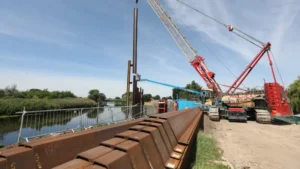
I have supplied sheet piles for river training projects across Southeast Asia and the Middle East. The riverbank project in Southeast Asia was a classic example—a guide wall that stabilized the river course and prevented erosion. Let me walk you through the design considerations for river training works.
What is the rule of thumb for sheet pile depth1?
The rule of thumb for sheet pile depth1 in river training works accounts for flow velocities2, scour potential3, and soil conditions.
For sheet piles in river training works, the rule of thumb for embedment depth (D) is 1.2 to 1.8 times the exposed height (H) for cantilever walls4. In river applications, the depth must also account for potential scour—the embedment should extend below the expected scour depth. For high-velocity rivers, embedment may need to be 2.0 times H or more.
[^1] rule of thumb diagram for river works](https://placehold.co/600x400 "Sheet Pile Depth Rule of Thumb")](https://cnsteelplant.com/wp-content/uploads/2026/03/Article-Application-River-Embankment-2.webp)
River-Specific Embedment Rules
Let me explain how river conditions affect the rule of thumb.
Base Rule for Cantilever Walls
For river training works, cantilever walls4 are most common:
- D = 1.2 to 1.8 H (higher than land-based walls)
- The higher range accounts for scour and dynamic water forces
Scour Factor
Scour is the erosion of riverbed around structures. Sheet piles must be embedded below the expected scour depth.
- Low velocity rivers ( 4 m/s): Add 3-5 m below scour depth
Flow Velocity Factor
| Flow Velocity | Additional Embedment |
|---|---|
| 4 m/s | +40-50% |
Example Calculation
Given:
- Exposed height (H) = 5 m
- Flow velocity = 3 m/s
- Scour depth = 2 m
Base D = 1.5 × H = 7.5 m
Velocity factor: +30% = 2.25 m
Scour allowance: 2 m below scour depth? Actually, piles must go below scour depth. If scour depth is 2 m, embedment below original bed must be at least 2 m deeper.
Final D = 7.5 + 2.25 + 2.0 = 11.75 m
My Experience
For the riverbank project, the river velocity was moderate (2.5 m/s), and scour depth was estimated at 1.5 m. We used D = 1.5 × H + 2 m = 7.2 m + 2 m = 9.2 m. The piles have stayed in place through several flood seasons.
What are the disadvantages of using sheet piles?
Sheet piles are excellent for river training, but they have limitations that engineers must consider.
The main disadvantages of sheet piles for river training works are corrosion in freshwater (though slow), potential for scour undermining the toe of the wall, difficulty driving through cobbles or rock, and the need for guide frames to maintain alignment in flowing water. In high-velocity rivers, the wall may need additional scour protection at the toe.
](https://cnsteelplant.com/wp-content/uploads/2026/03/Article-Application-River-Embankment-4.webp)
Addressing the Disadvantages
Let me discuss each disadvantage and how to mitigate it.
Corrosion1
In freshwater rivers, corrosion is slow (0.02-0.05 mm/year). For a 50-year design life:
- Add 1-2 mm corrosion allowance to wall thickness
- Use standard carbon steel (A328, S270GP) for freshwater
- For brackish or tidal rivers, use marine grade A690
Scour Undermining2
Scour can erode the soil at the toe of the wall, reducing embedment and causing failure.
- Design piles to extend below expected scour depth
- Install scour protection (riprap or concrete) at the toe
- Monitor scour after flood events
Driving Difficulties3
Rivers may have cobbles, boulders, or rock that make driving difficult.
- Conduct geotechnical investigation before design
- Pre-drill through hard layers
- Use impact hammers instead of vibratory
- Consider alternative pile types if rock is near surface
Alignment in Flowing Water4
Maintaining alignment in flowing water requires careful planning.
- Use guide frames mounted on barges or temporary piles
- Drive piles in calm water conditions if possible
- Use heavier piles that resist water forces during driving
Flow-Induced Vibration
In high-velocity rivers, sheet piles can vibrate.
- Design for dynamic loads
- Use stiffer sections (higher moment of inertia)
- Ensure proper embedment
Mitigation Summary
| Disadvantage | Mitigation |
|---|---|
| Corrosion1 | Corrosion1 allowance, marine grade steel |
| Scour | Embed below scour depth, scour protection |
| Hard driving | Pre-drilling, impact hammers |
| Alignment | Guide frames, calm water installation |
| Vibration | Stiffer sections, proper embedment |
My Experience
For the riverbank project, we addressed scour by driving piles 2 m below the estimated scour depth. We also placed riprap at the toe to prevent erosion. The piles have not moved despite several floods.
What is the difference between U type and Z type sheet piles1?
In river training works2, the choice between U type and Z type sheet piles1 depends on the wall alignment, height, and flow conditions.
U type sheet piles3 have interlocks at the neutral axis and are symmetric, making them ideal for curved river alignments and moderate heights. Z type sheet piles1 have interlocks at the outer flanges, giving them higher structural efficiency for taller walls. For most river training works2, U-type piles are preferred because they follow river curves easily and provide good water tightness4.
](https://cnsteelplant.com/wp-content/uploads/2026/03/Article-Application-River-Embankment-5.webp)
Comparison for River Training Applications
Let me explain which type works best for river conditions.
U Type Sheet Piles
- Profile: Symmetric, looks like a U
- Interlock: Larssen ball-and-socket at neutral axis
- Width: 400 mm or 600 mm
- Best for: Curved alignments, riverbanks, moderate heights (up to 8 m)
- Advantages: Easy installation, forgiving alignment, good water tightness4
- Common sections: U 400 x 125, U 400 x 170
Z Type Sheet Piles
- Profile: Asymmetric, looks like a Z
- Interlock: Ball-and-socket at outer flanges
- Width: 630-700 mm
- Best for: Straight alignments, tall walls (over 8 m)
- Advantages: Higher strength per kg, wider sections
- Common sections: AZ 18, AZ 26
River-Specific Considerations
| Factor | U Type | Z Type |
|---|---|---|
| Curved alignments | Excellent | Difficult |
| Water tightness | Good (Larssen interlock) | Good (ball-and-socket) |
| Installation in flowing water | Forgiving | Requires more care |
| Height capability | Up to 8 m | Over 8 m |
| Cost for moderate heights | Lower | Higher |
My Experience
For the riverbank project, the river had a curved alignment, so we chose U-type piles. The U 400 x 125 piles followed the curve easily and provided excellent water tightness4. For a straight river training wall over 8 m high, we would use Z-type piles.
What is the ASTM for sheet pile?
The ASTM standards for sheet piles define the material properties, chemical composition, and mechanical requirements.
The main ASTM standards for sheet piles are ASTM A3281 (carbon steel sheet piles), ASTM A572 Grade 50 (high-strength sheet piles), ASTM A6902 (marine grade sheet piles for brackish water), and ASTM A857 (cold-formed sheet piles). For freshwater river training works, ASTM A3281 is the standard choice.
](https://cnsteelplant.com/wp-content/uploads/2026/03/Article-Application-River-Embankment-3.webp)
ASTM Standards for River Training
Let me explain which ASTM standards apply to river training works.
ASTM A3281 – Carbon Steel Sheet Piles
This is the standard for standard carbon steel sheet piles.
- Yield strength: 240 MPa (35 ksi) minimum
- Tensile strength: 410 MPa (60 ksi) minimum
- Chemical composition: Standard carbon steel
- Best for: Freshwater rivers, moderate loads
- Cost: Lowest
ASTM A572 Grade 50 – High-Strength Low-Alloy
This standard covers higher strength steel.
- Yield strength: 345 MPa (50 ksi) minimum
- Tensile strength: 450 MPa (65 ksi) minimum
- Best for: Taller walls, higher loads
- Cost: Moderate
ASTM A6902 – Marine Grade Sheet Piles
This standard covers steel with improved corrosion resistance.
- Yield strength: 345 MPa (50 ksi) minimum
- Tensile strength: 485 MPa (70 ksi) minimum
- Contains copper, nickel, phosphorus
- Best for: Brackish or tidal rivers
- Cost: Higher
Selection Guide for River Training
| River Type | Recommended ASTM Standard |
|---|---|
| Freshwater, moderate loads | A328 |
| Freshwater, tall walls | A572 Grade 50 |
| Brackish water | A690 |
| Tidal river | A690 |
| Temporary works | A328 or A857 |
My Experience
For the riverbank project, the river was freshwater, so we used ASTM A3281 sheet piles. The standard carbon steel with a 2 mm corrosion allowance provided the required 50-year design life.
Conclusion
Sheet pile design for river training works requires careful consideration of scour, flow velocity, and alignment. U-type piles1 are preferred for curved river alignments. Embedment depth should account for scour potential. Use ASTM A3282 for freshwater and A690 for brackish water.
-
Explore this link to understand the advantages of U-type piles in curved river alignments and their role in effective river training. ↩ ↩ ↩ ↩ ↩ ↩ ↩ ↩ ↩ ↩ ↩ ↩ ↩ ↩
-
Learn about ASTM A328’s specifications and how it ensures durability in freshwater applications for sheet pile design. ↩ ↩ ↩ ↩ ↩ ↩ ↩
-
Explore the benefits of U type sheet piles for river training, including their adaptability to curved alignments and water tightness. ↩ ↩ ↩
-
Understand the water tightness capabilities of U and Z type sheet piles, crucial for effective riverbank protection. ↩ ↩ ↩ ↩ ↩ ↩