You have selected the pile profile. You have calculated the length. Now you are looking at the crane on site and wondering if it can handle the lift.
Steel sheet pile weight1 directly affects how many piles you can install per day, what equipment you need to rent, and how much the total project will cost. Heavier piles require bigger cranes, slow down driving rates, and increase transportation expenses.
](https://cnsteelplant.com/wp-content/uploads/2026/03/Article-Application-River-Embankment-1.webp)
I learned this lesson the hard way with a client in Saudi Arabia. He ordered heavy 600×210 piles without checking his crane capacity2. When the shipment arrived, his crane could not lift the piles off the truck. He had to rent a larger crane, which delayed the project by a week and cost him extra money. Let me walk you through how weight impacts every part of your project.
How many sheet piles can be installed in a day?
You are planning a schedule. You need to tell the client how long the job will take. The answer depends heavily on pile weight.
Installation rates vary from 4 meters per day to 60 meters per day, depending on pile weight, ground conditions, and equipment. For standard piles in good conditions, you can expect 20 to 25 piles per day, which equals about 8 to 10 linear meters of wall per rig.
](https://cnsteelplant.com/wp-content/uploads/2026/03/Article-Application-Subway-1.webp)
Breaking Down Installation Rates
Let me give you specific numbers based on real project data.
Standard Conditions
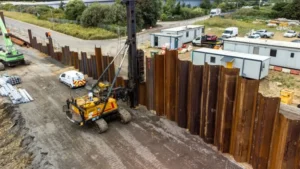
On reclamation projects with sand fill, using a crane and vibratory hammer1, crews can install 20 to 25 piles per day. Each pile is typically 6 meters long and 400 mm wide. This works out to 8 to 10 meters of completed wall length per day for each rig .
Difficult Conditions
When driving through existing ground or through a seawall, the rate drops significantly. You might only get 10 to 12 piles per day, which is 4 to 6 meters of wall per rig .
How Weight Changes the Numbers
Heavier piles are slower to install for several reasons:
- The crane swings slower with a heavier load
- The hammer needs more time to drive through each increment
- The crew gets tired faster handling heavy sections
- Alignment is more critical and takes more time
Depth Matters Too
For shallow walls2, specialized equipment like a Pilemaster can achieve 60 meters of wall per day . For deeper walls up to 35 meters, rates drop to 32 to 38 meters per day with vibratory or drop hammers .
Real Example from My Experience
For the riverbank project in Southeast Asia, we used 400×125 U piles weighing 60 kg/m. The contractor had good sandy conditions and a experienced crew. They averaged 22 piles per day, which kept them exactly on schedule. If they had used heavier 600×210 piles at 106 kg/m, their rate would have dropped to maybe 15 piles per day. That difference would have added weeks to the project.
How much does sheet piling weigh?
You are calculating shipping costs1 and crane requirements. You need the numbers.
Sheet piling typically weighs between 40 kg/m and 150 kg per meter for common profiles. For a standard 12-meter length2, a single pile can weigh anywhere from 480 kg to 1,800 kg. The weight per square meter3 of wall area ranges from 100 kg/m² to over 150 kg/m² .
](https://cnsteelplant.com/wp-content/uploads/2026/03/Article-images-6.webp)
Complete Weight Reference by Profile Type
Let me give you a comprehensive reference based on real products I have supplied.
U Type Pile Weights
| Profile (W x H) | Thickness (mm) | Weight per Meter (kg/m) | 12m Pile Weight (kg) | Wall Weight (kg/m²) |
|---|---|---|---|---|
| 400 x 100 | 10.5 | 48.0 | 576 | 120 |
| 400 x 125 | 13.0 | 60.0 | 720 | 150 |
| 400 x 170 | 15.5 | 76.1 | 913 | 190 |
| 600 x 130 | 10.3 | 61.8 | 742 | 103 |
| 600 x 180 | 13.4 | 81.6 | 979 | 136 |
| 600 x 210 | 18.0 | 106.2 | 1,274 | 177 |
Z Type Pile Weights
| Profile | Width x Height (mm) | Thickness (mm) | Weight per Meter (kg/m) | 12m Pile Weight (kg) |
|---|---|---|---|---|
| WRZ12-650 | 650 x 319 | 7 | 57.8 | 694 |
| WRZ16-635 | 635 x 379 | 7 | 61.5 | 738 |
| WRZ18-635 | 635 x 380 | 8 | 70.1 | 841 |
| WRZ30-635 | 635 x 420 | 12 | 113.3 | 1,360 |
| WRZ34-675 | 675 x 490 | 12 | 118.9 | 1,427 |
AZ Series Weights
For AZ piles4, the mass per square meter of wall is published directly. For example, the AZ13 pile has a mass of 107 kg per square meter of wall . This means if you have a 10-meter high wall, each linear meter of wall weighs 1,070 kg.
What This Means for Shipping
A standard 40-foot container can hold about 20 to 25 metric tons of steel. If your piles weigh 60 kg/m and are 12 meters long, each pile is 720 kg. You can fit about 30 piles in a container. If your piles weigh 106 kg/m, each is 1,272 kg, and you can only fit about 18 piles per container. Your shipping costs1 per pile go up significantly.
How much does steel sheet piling1 cost?
This is the question everyone asks. The answer depends on weight, material grade, and market conditions.
Steel sheet piling costs typically range from $30 to $70 per linear foot for material only . Installed costs, including labor and equipment, range from $600 to $1,800 per linear meter of wall, depending on depth and complexity .
](https://cnsteelplant.com/wp-content/uploads/2026/03/Article-Application-Port-3.webp)
Breaking Down the Cost Factors
Let me explain what drives the final price.
Material Costs
The steel itself is the biggest component. Global steel prices fluctuate based on iron ore costs, energy prices, and demand . In the Asia-Pacific market, import prices averaged $706 per ton in 2024, but with wide variations. Bangladesh paid the highest price at $1,014 per ton, while Hong Kong paid only $637 per ton .
For a 60 kg/m pile, material cost alone is:
- 60 kg/m × $0.70/kg = $42 per meter
- For a 12-meter pile: $504
For a 106 kg/m pile:
- 106 kg/m × $0.70/kg = $74.20 per meter
- For a 12-meter pile: $890
Installed Cost Ranges
Based on industry data, here are typical installed costs2 :
| Project Type | Cost per Linear Meter of Wall |
|---|---|
| Simple excavation, good ground | $600 – $900 |
| Complex urban site, moderate depth | $900 – $1,500 |
| Marine environment, deep water | $1,500 – $3,000+ |
How Weight Affects Installed Cost
Heavier piles cost more to install because:
- They require larger, more expensive cranes
- Installation is slower, increasing labor hours
- Driving is harder, which may require larger hammers
- Transportation costs are higher per meter of wall
The 10% Weight Saving Rule
By choosing efficient Z sections instead of U sections, you can save about 10% on steel weight for the same structural capacity . This directly reduces your material cost. Using higher grade steel (S430 instead of S270) can also reduce weight while maintaining strength .
New vs Used Piles
One advantage of steel is reusability. Used piles can cost significantly less than new ones . For temporary works, renting piles or buying used can cut material costs3 by 30% to 50%.
A Real Cost Example
For the riverbank project in Southeast Asia, the contractor used 400×125 U piles at 60 kg/m. The wall was 500 meters long and 15 meters high. Total steel weight was 450 metric tons. At a material price of $700 per ton, the steel cost $315,000. Installation added another $400,000. Total project cost was about $715,000.
If they had used a lighter but equally strong Z section at 50 kg/m, the steel weight would drop to 375 tons, saving $52,500 on material. That is real money.
How to calculate the weight of a pile?
You have a pile specification. You need to know the weight for your budget and logistics.
To calculate the weight of a pile, you multiply the cross-sectional area1 by the steel density (7,850 kg/m³)2 and then by the length. The cross-sectional area1 is available in manufacturer catalogs, typically given in square centimeters per meter or square meters of wall.
](https://cnsteelplant.com/wp-content/uploads/2026/03/product-image-59.webp)
Step-by-Step Calculation Methods
Let me show you several ways to get the numbers you need.
Method 1: Using Manufacturer Data (Easiest)
Most manufacturers provide weight per meter3 directly. For the AZ13 pile, the mass is 107 kg per square meter of wall . If your wall is 10 meters high, each linear meter of wall weighs 1,070 kg. If each pile is 670 mm wide, you need about 1.5 piles per meter of wall. Each pile weighs about 713 kg.
Method 2: Calculating from Cross-Sectional Area
If you have the cross-sectional area1 in cm² per pile:
Weight per meter (kg/m) = Area (cm²) × 0.785
Example: A pile with 140.6 cm² area:
140.6 × 0.785 = 110.4 kg/m
Method 3: Calculating Total Wall Weight
For a cofferdam project, you might need the weight per square foot of wall . Here is how:
- Calculate the perimeter of the wall
- Determine number of piles needed based on pile width
- Multiply by weight per pile
- Divide by total wall area
For a 60 ft × 100 ft cofferdam with 24 ft long piles weighing 40.5 lb/ft:
- Perimeter = 320 ft
- Pile width = 1.5 ft (18 inches)
- Piles needed = 320 ÷ 1.5 = 214 piles
- Total weight = 214 × (24 ft × 40.5 lb/ft) = 208,008 lb
- Wall area = 320 ft × 24 ft = 7,680 ft²
- Weight per ft² = 208,008 ÷ 7,680 = 27.1 lb/ft²
Method 4: Quick Estimate for Planning
For rough estimates, assume:
- Light sheet piling: 40-60 kg/m
- Medium sheet piling: 60-90 kg/m
- Heavy sheet piling: 90-150 kg/m
My Advice
Always get the manufacturer’s data sheet before ordering. The catalog numbers are based on actual measurements and are reliable. For the riverbank project, we used the published weights from the mill certificate. The shipment arrived exactly as calculated, and the contractor’s crane was perfectly sized.
Conclusion
Steel sheet pile weight1 drives every decision from crane selection to installation speed2 to total project cost. Calculate it carefully and choose efficient sections to save money.
-
Understanding the significance of steel sheet pile weight can help optimize project costs and efficiency. ↩ ↩ ↩ ↩ ↩ ↩ ↩ ↩ ↩
-
Exploring the impact of installation speed can lead to better planning and cost-saving strategies in construction. ↩ ↩ ↩ ↩ ↩ ↩
-
This formula is essential for budgeting and logistics in construction, ensuring accurate material estimates. ↩ ↩ ↩
-
AZ piles have specific weight metrics that are essential for construction and shipping logistics. ↩