You are working on a project in Europe, the Middle East, or Asia. The specification calls for sheet piles to EN 102481. You need to know what that means.
EN 102481 is the European standard for hot-rolled steel sheet piles2. It defines the dimensional tolerances, mechanical properties, and steel grades for U-shaped, Z-shaped, and straight web sheet piles. It is the most widely used standard for sheet piles outside North America.
](https://cnsteelplant.com/wp-content/uploads/2026/03/Article-Application-River-Embankment-5.webp)
I have supplied sheet piles to projects across Europe, the Middle East, and Southeast Asia. Almost all of them specified EN 102481. The riverbank project in Southeast Asia used piles to this standard. Let me explain what it covers and why it matters.
What is the difference between hot rolled and cold rolled sheet piles?
Before you understand EN 102481, you need to know that it covers hot rolled piles2. Cold formed piles have a different standard.
The main difference between hot rolled and cold rolled sheet piles is the manufacturing process. Hot rolled piles are shaped at high temperatures (about 1,200°C) in an integrated rolling mill. Cold formed piles are made by bending steel coils at room temperature. EN 102481 covers hot rolled piles2. Cold formed piles are covered by EN 10249.
](https://cnsteelplant.com/wp-content/uploads/2026/03/Article-Application-City-5.webp)
How the Processes Compare
Let me explain the two manufacturing methods.
Hot Rolled Sheet Piles (EN 102481)
Hot rolling starts with steel slabs heated to approximately 1,200°C. The hot steel passes through a series of rolling stands that gradually shape it into the final profile. The interlocks are formed during this same high-heat process.
The result is:
- Tight, precise interlocks with consistent geometry
- Standardized dimensions across all manufacturers
- Higher strength grades available (up to S430GP)
- Excellent water tightness3
- Proven performance over 100 years
Cold Formed Sheet Piles (EN 10249)
Cold forming starts with steel coils that have already been hot rolled. The coils are fed through rollers at room temperature that bend the steel into shape. The interlocks are formed by bending, not by rolling.
The result is:
- Looser interlocks that may need sealants
- Dimensions vary by manufacturer
- Limited to lower strength grades (typically S355)
- Lighter sections for temporary work
- More economical for some applications
Why EN 102481 Matters
EN 102481 is the standard for permanent, high-performance sheet piles. If your project requires:
- Water tightness
- Consistent properties
- High strength
- Long service life
Then EN 102481 hot rolled piles2 are the right choice.
My Experience
For the riverbank project, we used EN 102481 hot rolled U piles. The contractor needed water tightness3 for the river wall. Cold formed piles would have required sealants. The hot rolled piles2 worked perfectly.
What is a hot rolled steel sheet1?
A hot rolled steel sheet1 is a structural section formed by passing heated steel through rolling mills to create a specific profile with interlocks2.
A hot rolled steel sheet1 pile is a structural section manufactured by heating steel slabs to about 1,200°C and passing them through a series of rolling stands. The process creates the final profile with integral interlocks2 that allow adjacent piles to connect. The piles are produced to tight dimensional tolerances3 under EN 102484.
](https://cnsteelplant.com/wp-content/uploads/2026/03/Article-Application-City-2.webp)
The Hot Rolling Process
Let me explain how hot rolled sheet piles are made.
Step 1: Slab Heating
Steel slabs (or billets) are heated in a reheat furnace to approximately 1,200°C. The steel becomes plastic and ready for shaping.
Step 2: Roughing Rolling
The heated slab passes through roughing mills that reduce its thickness and begin to shape it. The steel is still thick at this stage.
Step 3: Finishing Rolling
The steel passes through a series of finishing stands that gradually form the final profile. Each stand shapes the steel a little more until it reaches the exact U, Z, or straight web shape.
Step 4: Interlock Formation
The interlocks2 are formed during the finishing rolling. They are integral to the profile, not added later. This creates a precise interlock that fits tightly with adjacent piles.
Step 5: Cooling and Straightening
The finished piles are cooled, straightened, and cut to length. They are then inspected for dimensional accuracy and surface quality.
Advantages of Hot Rolling
- Consistent dimensions: All piles from the same profile have identical interlocks2
- High strength: Can achieve grades up to S430GP (430 MPa yield)
- Good toughness: The hot rolling process refines the grain structure
- Proven interlocks2: Larssen and other designs have been used for decades
Types of Hot Rolled Profiles
EN 102484 covers:
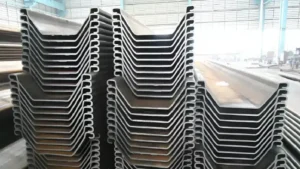
- U-shaped piles (symmetric, Larssen interlock)
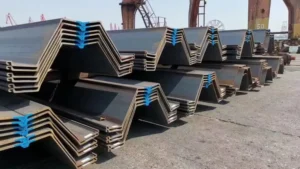
- Z-shaped piles (asymmetric, high efficiency)
- Straight web piles (for cellular cofferdams)
My Experience
I have visited rolling mills in Europe and Asia that produce EN 102484 piles. The precision is remarkable. Each pile is measured and inspected before leaving the mill. This quality control is why engineers trust hot rolled piles for permanent structures.
What is the difference between U type and Z type sheet piles1?
EN 102482 covers both U and Z profiles. The choice between them depends on your project.
U type sheet piles3 have interlocks at the neutral axis and are symmetric, making them easier to install and better for curved walls. Z type sheet piles1 have interlocks at the outer flanges, giving them higher structural efficiency per kilogram of steel. EN 102482 includes both types with standard dimensions and properties.
](https://cnsteelplant.com/wp-content/uploads/2026/03/Article-Application-City-6.webp)
Comparing U and Z in EN 102482
Let me explain the differences as they appear in the standard.
U Type Sheet Piles (EN 102482, Part 2)
U piles are designated by their dimensions. Common sections include:
- U 400 x 100: 400 mm wide, 100 mm high
- U 400 x 125: 400 mm wide, 125 mm high
- U 400 x 170: 400 mm wide, 170 mm high
- U 600 x 130: 600 mm wide, 130 mm high
- U 600 x 180: 600 mm wide, 180 mm high
- U 600 x 210: 600 mm wide, 210 mm high
The Larssen interlock4 is standard on U piles. This interlock is a ball-and-socket design that tightens under soil pressure, providing water tightness.
Z Type Sheet Piles (EN 102482, Part 2)
Z piles are designated by their section modulus or by their dimensions. Common sections include:
- Z 12: Section modulus about 1,200 cm³/m
- Z 18: Section modulus about 1,800 cm³/m
- Z 26: Section modulus about 2,600 cm³/m
- Z 38: Section modulus about 3,800 cm³/m
- Z 50: Section modulus about 5,000 cm³/m
Z piles have interlocks at the outer flanges. Modern Z piles often use the same Larssen interlock4 as U piles, but positioned differently.
Which to Choose?
| Application | Recommended Type |
|---|---|
| Curved walls | U type |
| Walls under 10 m | U type |
| Straight walls over 10 m | Z type |
| Deep water ports | Z type |
| Temporary works | U type (economical) |
| Permanent marine | Either with proper grade |
My Experience
For the riverbank project, we used U type. The wall was curved and moderate depth. For a deepwater port in the Middle East, we used Z type. Each was right for its project.
What grade steel is used for sheet piles?
EN 102481 specifies several steel grades for sheet piles. The grade determines the strength and, in some cases, the corrosion resistance.
EN 102481 specifies steel grades S270GP, S355GP2, and S430GP for hot rolled sheet piles. The number indicates the minimum yield strength in megapascals (MPa). S270GP has 270 MPa yield, S355GP2 has 355 MPa yield, and S430GP has 430 MPa yield. Higher grades allow thinner sections for the same load.
](https://cnsteelplant.com/wp-content/uploads/2026/03/Article-application-4.webp)
Understanding EN 102481 Steel Grades
Let me explain the grades and their applications.
S270GP
- Yield strength: 270 MPa minimum
- Tensile strength: 410-540 MPa
- Equivalent to ASTM A328
- Best for: General retaining, temporary works, freshwater applications
- Cost: Lowest
- Yield strength: 355 MPa minimum
- Tensile strength: 490-630 MPa
- Equivalent to ASTM A572 Grade 50
- Best for: Deep excavations, heavy loads, permanent walls
- Cost: Moderate
- Most common grade for permanent structures
S430GP
- Yield strength: 430 MPa minimum
- Tensile strength: 550-700 MPa
- No direct US equivalent (higher than A572 Grade 50)
- Best for: Very deep walls, heavy loads, weight-sensitive projects
- Cost: Higher
- Used where maximum strength is needed
Higher Strength Options
Some mills offer grades above S430GP, such as S460GP or S500GP. These are less common and may require special ordering.
Marine Grades
EN 102481 does not have a dedicated marine grade like ASTM A690. For marine applications3, S355GP2 with added alloying elements (copper, nickel) is often used. This is sometimes called "S355GP2 marine grade" or specified with additional corrosion requirements.
Grade Selection Guide
| Condition | Recommended Grade |
|---|---|
| Temporary wall, good soil | S270GP |
| Permanent wall, moderate loads | S355GP2 |
| Deep excavation, heavy loads | S430GP |
| Marine environment | S355GP2 with corrosion allowance |
| Very deep water, extreme loads | S430GP or higher |
My Experience
For the riverbank project, we used S270GP. The wall was in fresh water, the depth was moderate, and the loads were not extreme. The standard grade was sufficient and cost-effective. For the port project in the Middle East, we used S355GP2 with additional alloying for corrosion resistance.
Conclusion
EN 102481 is the European standard for hot rolled sheet piles2. It covers U and Z profiles in grades from S270GP to S430GP. Hot rolled piles offer consistent dimensions, tight interlocks, and proven performance for permanent structures.
-
Understanding EN 10248 is crucial for professionals in construction and engineering, as it ensures compliance and quality in using hot rolled sheet piles. ↩ ↩ ↩ ↩ ↩ ↩ ↩ ↩ ↩ ↩ ↩ ↩ ↩ ↩ ↩ ↩ ↩ ↩ ↩ ↩
-
Exploring the advantages of hot rolled sheet piles can enhance your knowledge of their applications and benefits in building durable structures. ↩ ↩ ↩ ↩ ↩ ↩ ↩ ↩ ↩ ↩ ↩ ↩ ↩ ↩ ↩ ↩ ↩ ↩ ↩ ↩ ↩ ↩ ↩ ↩
-
Discover the best steel grades for marine environments and how they differ from standard grades. ↩ ↩ ↩ ↩ ↩
-
Find out how the Larssen interlock works and why it’s crucial for the performance of U and Z type sheet piles. ↩ ↩ ↩ ↩ ↩