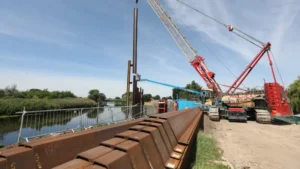
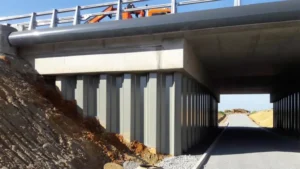
You are looking at an aging dam or an embankment that shows signs of seepage. The water is finding its way through the structure, and if left unchecked, failure could be catastrophic. You need a solution that stops the water and stabilizes the structure.
The best sheet pile types for dam and embankment stabilization are U-type sheet piles1 for cut-off walls and seepage control, and Z-type sheet piles2 for structural reinforcement of dam slopes. U-type piles with Larssen interlocks provide a watertight barrier that cuts off seepage through the dam core. They are driven vertically through the embankment to create a continuous cut-off wall.
](https://cnsteelplant.com/wp-content/uploads/2026/03/Article-Application-River-Embankment-5.webp)
I have worked on dam stabilization projects where seepage was threatening the structure. In one project, we installed U-type sheet piles1 through the embankment core to cut off the flow. The seepage stopped immediately. Let me walk you through the best sheet pile types for dam and embankment stabilization.
U type sheet pile dimensions1
U-type sheet piles are the standard choice for dam cut-off2f walls](https://mhfd.specialdistrict.org/files/332ffbafc/Cutoff-Walls-Sheet-Pile.pdf)[^3] and embankment stabilization3. Their dimensions determine the depth and strength of the cut-off.
U type sheet pile dimensions1 for dam stabilization include width (400 mm or 600 mm), height (100 mm to 210 mm), and thickness (8 mm to 18 mm). The most common sections for cut-off walls4 are U 400 x 125-13 (60 kg/m) and U 400 x 170-15.5 (76 kg/m). The section modulus ranges from 1,080 to 5,730 cm³/m.
](https://cnsteelplant.com/wp-content/uploads/2026/03/Article-Application-River-Embankment-4.webp)
Complete U Type Dimensions Table
Here are the dimensions for U-type sheet piles commonly used in dam and embankment stabilization3.
U 400 Series – Dimensions
| Section | Width (mm) | Height (mm) | Thickness (mm) | Weight (kg/m) | S (cm³/m) | Best Use |
|---|---|---|---|---|---|---|
| U 400 x 100 | 400 | 100 | 8.0 | 40.0 | 900 | Light cut-off, shallow depth |
| U 400 x 100 | 400 | 100 | 10.5 | 48.0 | 1,080 | Moderate cut-off |
| U 400 x 125 | 400 | 125 | 10.0 | 50.0 | 1,330 | Cut-off walls, up to 8 m |
| U 400 x 125 | 400 | 125 | 13.0 | 60.0 | 1,590 | Standard cut-off wall |
| U 400 x 125 | 400 | 125 | 15.0 | 68.0 | 1,800 | Deeper cut-off |
| U 400 x 170 | 400 | 170 | 11.0 | 55.0 | 1,790 | Embankment reinforcement |
| U 400 x 170 | 400 | 170 | 13.5 | 65.0 | 2,120 | Deep cut-off walls4 |
| U 400 x 170 | 400 | 170 | 15.5 | 76.1 | 2,470 | Standard dam cut-off2 |
| U 400 x 170 | 400 | 170 | 18.0 | 86.0 | 2,800 | Heavy cut-off, deep dams |
U 600 Series – Dimensions
| Section | Width (mm) | Height (mm) | Thickness (mm) | Weight (kg/m) | S (cm³/m) | Best Use |
|---|---|---|---|---|---|---|
| U 600 x 130 | 600 | 130 | 8.0 | 50.0 | 1,910 | Wide cut-off walls4 |
| U 600 x 130 | 600 | 130 | 10.3 | 61.8 | 2,350 | Moderate depth dams |
| U 600 x 180 | 600 | 180 | 10.0 | 65.0 | 3,040 | Large dams |
| U 600 x 180 | 600 | 180 | 12.0 | 75.0 | 3,510 | Deep cut-off |
| U 600 x 180 | 600 | 180 | 13.4 | 81.6 | 3,820 | Standard large dam cut-off2 |
| U 600 x 210 | 600 | 210 | 13.0 | 85.0 | 4,580 | Very deep cut-off |
| U 600 x 210 | 600 | 210 | 15.0 | 95.0 | 5,120 | Heavy dam reinforcement |
| U 600 x 210 | 600 | 210 | 18.0 | 106.2 | 5,730 | Major dam projects |
Selection for Dam Cut-Off Walls
| Dam Height | Recommended Section |
|---|---|
| Up to 8 m | U 400 x 125-13 |
| 8-12 m | U 400 x 170-15.5 |
| 12-16 m | U 600 x 180-13.4 |
| Over 16 m | U 600 x 210-18 or combination |
My Experience
For a dam stabilization project, we used U 400 x 170-15.5 piles for a cut-off wall through a 12 m high embankment. The piles were driven to 18 m depth, creating a continuous watertight barrier that stopped seepage through the dam core.
Sheet piling for sale
Sheet piling for dam stabilization1 projects is available through manufacturers, service centers, and specialized suppliers. Understanding the market helps you source the right piles.
Sheet piling for sale includes new hot-rolled sections2 from mills like ArcelorMittal, Nucor, and Chinese manufacturers, as well as used sheet piles4 from decommissioned projects. For dam stabilization, new piles are recommended to ensure consistent quality and water tightness. Prices range from $550 to $800 per ton depending on section and grade.
](https://cnsteelplant.com/wp-content/uploads/2026/03/Article-Application-River-Embankment-3.webp)
Sourcing Sheet Piles for Dam Projects
Let me explain the options for sourcing sheet piles.
New Sheet Piles
- Source: Direct from mills or through distributors
- Quality: Certified to ASTM or EN standards
- Sections: Full range of U-type and Z-type
- Lead time: 4-12 weeks depending on quantity
- Cost: $550-800 per ton
- Best for: Permanent dam structures
Used Sheet Piles
- Source: Used pile dealers, salvage from decommissioned projects
- Quality: Variable, may have corrosion or interlock damage
- Sections: Limited availability
- Lead time: Immediate to 4 weeks
- Cost: $300-500 per ton
- Best for: Temporary works or non-critical applications
Manufacturers
| Manufacturer | Location | Product Range |
|---|---|---|
| ArcelorMittal | Europe, global | PU, AZ series |
| Nucor Skyline | North America | PZC, PZ series |
| JFE Steel | Japan | U-type, Z-type |
| Chinese mills | China | EN and ASTM sections |
What to Look for in Sheet Piles for Dam Work
- Mill certificates showing chemical and mechanical properties
- Consistent interlock geometry for water tightness
- Straightness within tolerance (critical for deep driving)
- Corrosion protection if needed
My Experience
For dam stabilization projects, I always recommend new sheet piles from certified mills. The quality is consistent, the interlocks are tight, and the mill certificates3 provide traceability. Used piles can have interlock damage that compromises water tightness.
Shoring sheet pile
Shoring sheet piles are used to support excavations during dam construction and repair. They are temporary structures that allow work to proceed safely.
Shoring sheet piles are driven to create a temporary retaining wall around the work area. They allow dewatering and safe access for dam repairs. For dam stabilization, shoring may be needed to access the dam core for cut-off wall installation. U-type piles are commonly used for shoring because they are easy to install and extract.
](https://cnsteelplant.com/wp-content/uploads/2026/03/Article-Application-River-Embankment-1.webp)
Shoring Applications for Dam Work
Let me explain how shoring sheet piles1 are used in dam projects.
- Purpose: Create a dry work area for dam repairs
- Method: Sheet piles driven in a circle or rectangle, then dewatered
- Sections: U 400 x 125 or U 400 x 170
- Duration: Temporary, removed after work complete
Excavation Support
- Purpose: Support excavation for dam foundation repairs
- Method: Sheet piles driven around excavation, bracing installed
- Sections: U 400 x 125 for moderate depths
- Duration: Temporary or permanent
Slope Stabilization
- Purpose: Prevent slope movement during dam work
- Method: Sheet piles driven into unstable slope
- Sections: U 400 x 170 or U 600 x 180
- Duration: May be permanent
Shoring Design Considerations
| Factor | Consideration |
|---|---|
| Depth of excavation | Determines pile length and section |
| Soil conditions | Affects driving and embedment |
| Water table | Dewatering needed |
| Adjacent structures | Vibration and settlement control |
| Access | Equipment access to site |
My Experience
For a dam repair project, we used shoring sheet piles1 to create a cofferdam around the damaged spillway. The U 400 x 125 piles were driven in a circle, dewatered, and the repair work was completed in 3 weeks. The piles were then extracted and reused on another project.
Sheet piles retaining wall
Sheet pile retaining walls are used for permanent stabilization of dam abutments, embankment slopes, and spillway channels.
A sheet pile retaining wall1 for dam stabilization consists of interlocking sheet piles driven into the ground to hold back soil and water. The wall can be cantilever (for moderate heights) or anchored (for taller walls). U-type piles with Larssen interlocks are the standard for permanent retaining walls in dam applications.
[^1] at dam abutment](https://placehold.co/600x400 "Sheet Pile Retaining Wall")](https://cnsteelplant.com/wp-content/uploads/2026/03/Article-Application-River-Embankment-2.webp)
Retaining Wall Design for Dams
Let me explain the design considerations for dam retaining walls.
Cantilever Retaining Walls
- How it works: Wall embedded deep enough to resist rotation
- Height: Up to 6-8 m
- Sections: U 400 x 125, U 400 x 170
- Best for: Moderate dam abutments, embankment toes
Anchored Retaining Walls
- How it works: Tie rods or ground anchors provide support
- Height: 8-15 m
- Sections: U 600 x 180, U 600 x 210, or Z-type
- Best for: Tall dam abutments, steep slopes
Cut-Off Walls
- How it works: Sheet piles driven vertically through dam core
- Height: Through entire dam height
- Sections: U 400 x 125 to U 600 x 210
- Best for: Seepage control, dam rehabilitation
Design Example: Dam Abutment Retaining Wall
- Dam height: 10 m
- Abutment slope height: 8 m
- Soil: Clay, φ = 28°
- Required embedment: 7 m (anchored wall)
- Section: U 600 x 180-13.4 (S = 3,820 cm³/m)
- Anchors: Tie rods at 2 m and 5 m below top
My Experience
For a dam abutment stabilization project, we installed a sheet pile retaining wall1 using U 600 x 180 piles. The wall was 8 m high with two levels of anchors. It has held the abutment stable for over a decade.
Conclusion
U-type sheet piles1 are the best choice for dam and embankment stabilization2. Use U 400 x 125-13 for moderate depths and U 400 x 170-15.5 for deeper cut-off walls. For tall retaining walls, consider U 600 series or Z-type piles. Proper installation with guide frames is essential for water tightness.
-
Explore this link to understand the advantages and applications of U-type sheet piles in construction projects. ↩ ↩ ↩ ↩ ↩ ↩ ↩ ↩ ↩ ↩
-
This resource will provide insights into techniques and methods for effective dam and embankment stabilization. ↩ ↩ ↩ ↩ ↩ ↩ ↩
-
Find out why mill certificates are crucial for ensuring the quality and safety of construction materials. ↩ ↩ ↩
-
Discover the benefits and drawbacks of using used sheet piles for various construction needs. ↩ ↩ ↩ ↩