You are designing a deep excavation for a new building downtown. The wall needs to be 12 meters high. A cantilever wall would require an impractically deep embedment. You need anchors.
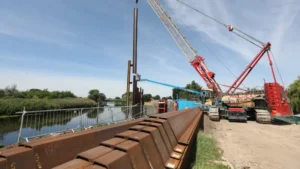
An anchored sheet pile wall1 uses tie rods or ground anchors2 to provide lateral support at one or more levels. The anchors reduce the required embedment depth, lower the bending moment in the piles, and allow much taller walls than cantilever designs.
[^1] with tie rods and anchor piles](https://placehold.co/600x400 "Anchored Sheet Pile Wall")](https://cnsteelplant.com/wp-content/uploads/2026/03/Article-Application-River-Embankment-1.webp)
I worked on a port project in the Middle East where the wall was 18 meters high with two levels of anchors. The analysis was complex—multiple soil layers, high water pressure, and heavy surcharge loads from container cranes. Let me walk you through how anchored wall analysis works.
What is the rule of thumb for sheet pile wall embedment?
Rules of thumb are useful starting points before detailed analysis. For anchored walls, the embedment is significantly less than for cantilever walls.
For anchored sheet pile walls1, the embedment depth2 is typically 0.5 to 0.8 times the exposed wall height. This is about half the embedment required for a cantilever wall of the same height. The exact depth depends on soil conditions3, anchor location, and surcharge loads4.
[^2] for anchored sheet pile wall](https://placehold.co/600x400 "Anchored Wall Embedment")](https://cnsteelplant.com/wp-content/uploads/2026/03/Article-Application-City-4.webp)
Understanding the Rule
Let me explain why anchored walls require less embedment.
The Mechanics
In a cantilever wall, the entire lateral resistance comes from the soil below the excavation. The wall must be embedded deeply enough to develop enough passive pressure to resist the active pressure from above.
In an anchored wall, the anchor provides a reaction at the top. This reaction changes the pressure distribution. The wall now behaves like a propped cantilever—supported at the top by the anchor and at the bottom by the soil. The embedment only needs to be deep enough to prevent rotation at the bottom (kick-out).
Typical Values
Based on many projects, here are typical embedment ratios:
| Wall Height | Cantilever D/H | Anchored D/H |
|---|---|---|
| 3 m | 1.0 – 1.2 | 0.4 – 0.6 |
| 6 m | 1.0 – 1.5 | 0.5 – 0.7 |
| 9 m | Not practical | 0.6 – 0.8 |
| 12 m | Not practical | 0.6 – 0.8 |
Factors That Change the Rule
The 0.5 to 0.8 range is a starting point. Actual embedment depends on:
- Soil strength: Weak soils need deeper embedment
- Anchor location: Lower anchors reduce required embedment
- Water table: Water reduces effective stress, increases required depth
- Surcharge loads: Heavy loads behind the wall require deeper embedment
- Multiple anchors: More anchors reduce required embedment
Limitations of Rules of Thumb
Rules of thumb are not substitutes for analysis. They are useful for:
- Preliminary estimates
- Checking computer results for reasonableness
- Rough cost estimates
Always perform a detailed analysis for final design.
My Experience
For the port project with an 18 m wall, the initial rule of thumb suggested 9 to 14 m embedment. After detailed analysis with multiple soil layers and water pressures, the actual embedment was 11 m—right in the middle of the range. The rule was a good starting point.
What is structural analysis of piles1?
Structural analysis of piles, for sheet pile walls, means determining the internal forces (bending moment, shear, deflection) and ensuring the pile section has adequate strength.
Structural analysis of sheet piles involves modeling the wall as a beam supported by soil springs or by discrete supports (anchors, bracing). The loads come from active earth pressure, water pressure, and surcharge loads. The analysis determines the bending moment diagram2, shear forces, and deflections.
](https://cnsteelplant.com/wp-content/uploads/2026/03/Article-application-4.webp)
Methods of Structural Analysis
Let me explain the different approaches engineers use.
Simplified Methods
For preliminary design, simplified limit equilibrium methods are used:
- Free earth support method: Assumes the wall is simply supported at the anchor and at the bottom
- Fixed earth support method: Assumes the bottom is fixed (stiff clay or rock)
These methods use classical earth pressure theory (Rankine, Coulomb) and solve for embedment depth, anchor force, and maximum moment using equilibrium equations.
Beam-on-Elastic-Foundation Methods3
More advanced methods model the soil as a series of springs (Winkler springs). The wall is a beam with spring supports representing the soil. This method accounts for:
- Soil-structure interaction
- Non-linear soil behavior
- Multiple soil layers
- Staged construction (excavation sequence)
Software like DeepEX, GeoStudio, and others use this approach.
Finite Element Analysis4
For complex projects, full finite element analysis models both the wall and the soil continuum. This captures:
- Complex soil behavior (plasticity, hardening)
- 3D effects
- Seismic loading
- Interaction with adjacent structures
This method is used for critical projects like nuclear facilities, major bridges, or very sensitive urban sites.
What the Analysis Produces
A complete structural analysis provides:
- Required embedment depth
- Anchor forces at each level
- Bending moment diagram
- Shear force diagram
- Deflection profile
- Required section modulus
My Experience
For the port project, we used a beam-on-elastic-foundation model. The soil was layered—soft clay over dense sand. The model captured the transition and gave us accurate bending moments. The selected Z piles had a section modulus 20% higher than the calculated maximum moment to provide safety.
What are the disadvantages of using sheet piles?
Sheet piles are versatile, but they have limitations. You need to know them before you specify anchored walls.
The main disadvantages of sheet piles are corrosion in aggressive environments, difficulty driving in hard soils or through obstructions, potential for interlock failure if not installed plumb, noise and vibration during installation, and the need for anchors or bracing for taller walls.
](https://cnsteelplant.com/wp-content/uploads/2026/03/Article-application-5.webp)
Addressing the Disadvantages in Anchored Walls
Let me discuss each disadvantage and how it applies to anchored walls.
Corrosion1
In marine or aggressive soil environments, sheet piles corrode. For permanent anchored walls:
- Use marine grade steel (ASTM A690) for 50% better corrosion resistance
- Add corrosion allowance (extra thickness)
- Use cathodic protection for long-life structures
- For tie rods, use coated or galvanized steel
Hard Driving
If the soil has boulders or dense layers, driving sheet piles may be difficult. Options:
- Pre-drill to clear obstructions
- Use impact hammers instead of vibratory
- Consider alternative wall types (secant piles, slurry walls)
Interlock Failure2
If piles are not driven plumb, the interlocks can separate (declutch). This is especially critical for anchored walls because the anchor forces increase the stress on the wall.
- Use templates and guide frames during installation
- Specify pile gates for alignment
- Use modern Z piles with ball-and-socket interlocks
Noise and Vibration3
Urban sites may restrict pile driving. For anchored walls:
- Use vibratory hammers (quieter than impact)
- Consider silent piling (press-in) methods
- Work within permitted hours
- Monitor noise and vibration levels
Space Requirements for Anchors
Anchors require space behind the wall. Tie rods need a clear zone to the anchor point. Ground anchors need drilling access. In tight urban sites:
- Use internal bracing instead of tiebacks
- Use shorter anchors with higher capacity
- Coordinate with adjacent property owners
Cost4
Anchored walls cost more than cantilever walls due to the anchors themselves and the installation. But for taller walls, anchored walls are more economical than cantilever walls because the embedment is much shallower.
My Experience
For the port project, we faced all these issues. We used A690 steel for corrosion, pre-drilled through a boulder layer, used guide frames for alignment, and installed tie rods that extended 25 m behind the wall. The wall has been in service for over a decade with no problems.
What is an anchored sheet pile1 driven to a shallow depth will have?
This question touches on a critical design concept. If an anchored wall is driven too shallow, it can fail by rotation at the bottom.
An anchored sheet pile1 driven to a shallow depth will have insufficient passive resistance2 to resist the active pressure below the anchor. The wall will rotate about the anchor point, pushing the bottom forward. This is called "kick-out" failure. The wall must be embedded deep enough to develop enough passive resistance2 to prevent this rotation.
[^3] of shallow embedded anchored wall](https://placehold.co/600x400 "Sheet Pile Kick-Out Failure")](https://cnsteelplant.com/wp-content/uploads/2026/03/Article-images-8.webp)
Understanding the Failure Mechanism
Let me explain why embedment depth4 is critical.
The Free Earth Support Method
In anchored wall analysis, the free earth support method assumes the wall rotates about the anchor point. The bottom of the wall is free to move. The embedment depth4 is sufficient when the passive resistance2 below the bottom equals the active pressure.
If the embedment is too shallow, the passive resistance2 is insufficient. The wall rotates outward at the bottom, and the soil in front of the wall fails. This is a progressive failure—as the wall rotates, the passive pressure decreases, making it worse.
Signs of Insufficient Embedment
In the field, insufficient embedment shows as:
- Excessive wall deflection at the bottom
- Heaving of soil in front of the wall
- Cracking of ground surface behind the wall
- Tie rod failures due to increased loads
How Engineers Prevent It
Proper analysis ensures adequate embedment:
- Calculate the required depth using limit equilibrium methods
- Apply factors of safety (typically 1.5 to 2.0 on passive resistance2)
- Consider worst-case water levels and surcharge loads
- Verify with beam-on-elastic-foundation analysis
Example
For a 10 m anchored wall with an anchor at 2 m below top, the analysis might show:
- Required embedment: 5 m
- If driven only 3 m, passive resistance2 is only 60% of what is needed
- The wall would rotate, causing ground movement and potential collapse
My Experience
I once visited a site where the contractor had driven anchored piles 2 m shallower than the design. The wall started rotating after excavation reached 6 m. We had to stop work and install additional anchors to stabilize the wall. The lesson: embedment depth4 is not a place to save money.
Conclusion
Anchored sheet pile walls1 allow taller excavations with shallower embedment than cantilever walls. Proper structural analysis2 determines anchor forces, bending moments, and embedment depth. Never shortcut the analysis—failure is expensive.
-
Explore this link to understand how anchored sheet pile walls can enhance excavation stability and reduce costs. ↩ ↩ ↩ ↩ ↩ ↩ ↩
-
Learn why thorough structural analysis is crucial for ensuring safety and preventing costly failures in construction. ↩ ↩ ↩ ↩ ↩ ↩ ↩ ↩ ↩ ↩ ↩
-
Learn about kick-out failure to grasp its implications in wall design and how to prevent it. ↩ ↩ ↩
-
Discover the significance of embedment depth in ensuring structural stability and safety. ↩ ↩ ↩ ↩ ↩ ↩