How Do You Compare Steel Sheet Pile Weight per Meter Across Different Profiles?
Two offers quote the same tonnage. One wall holds; the other bends past its limit. The gap hides in weight per metre and what it actually buys you.
Steel sheet pile weight per meter is the mass of steel in each metre of wall, quoted as kg per pile or as kg/m² of wall. Convert every offer to the same unit first, then compare it with section modulus, because weight tells you cost while modulus tells you capacity.
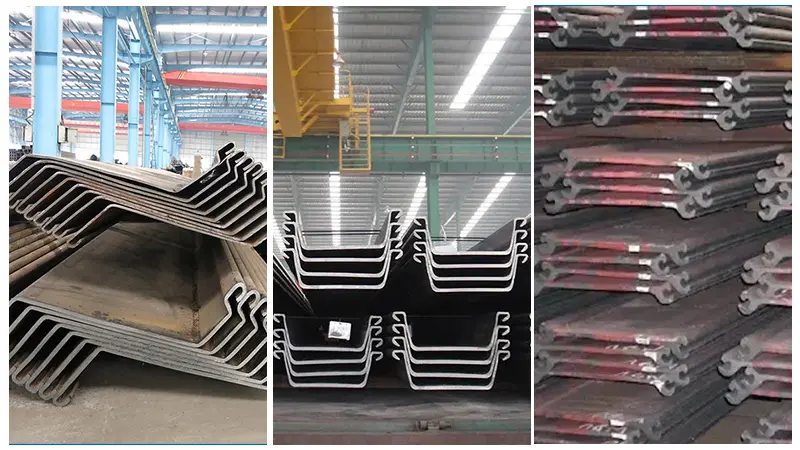
I run export sales for a sheet pile factory in Liaocheng, Shandong, and I quote walls for ports, riverbanks, and deep basements on four continents. Every week a buyer sends me two quotations and asks why one is cheaper per tonne. My answer is almost always the same: tonnage is not the number to lead with. This article walks through how I compare weight per metre across U-type, Z-type, and straight web steel sheet pile profiles, and the mistakes I watch buyers make before they sign.
Why Is Weight per Meter the First Number to Check in Any Offer?
Tonnage looks like a price question. It is really a coverage question.
Weight per meter tells you how much steel lands in each metre of finished wall. Convert every offer to kg/m² of wall before you compare anything, because a heavier single pile can still make a lighter wall.
Per Pile, Per Pair, or Per Square Metre of Wall?
Catalogs quote weight three ways, and none of them is wrong on its own. Kilograms per pile describes one driven unit, over its whole length. Kilograms per metre of wall describes the steel in a one-metre strip of finished wall, per metre of height. Kilograms per square metre of wall is the same figure written as a surface density. That last one is my favourite, because it makes any two profiles comparable at a glance, whatever their widths.
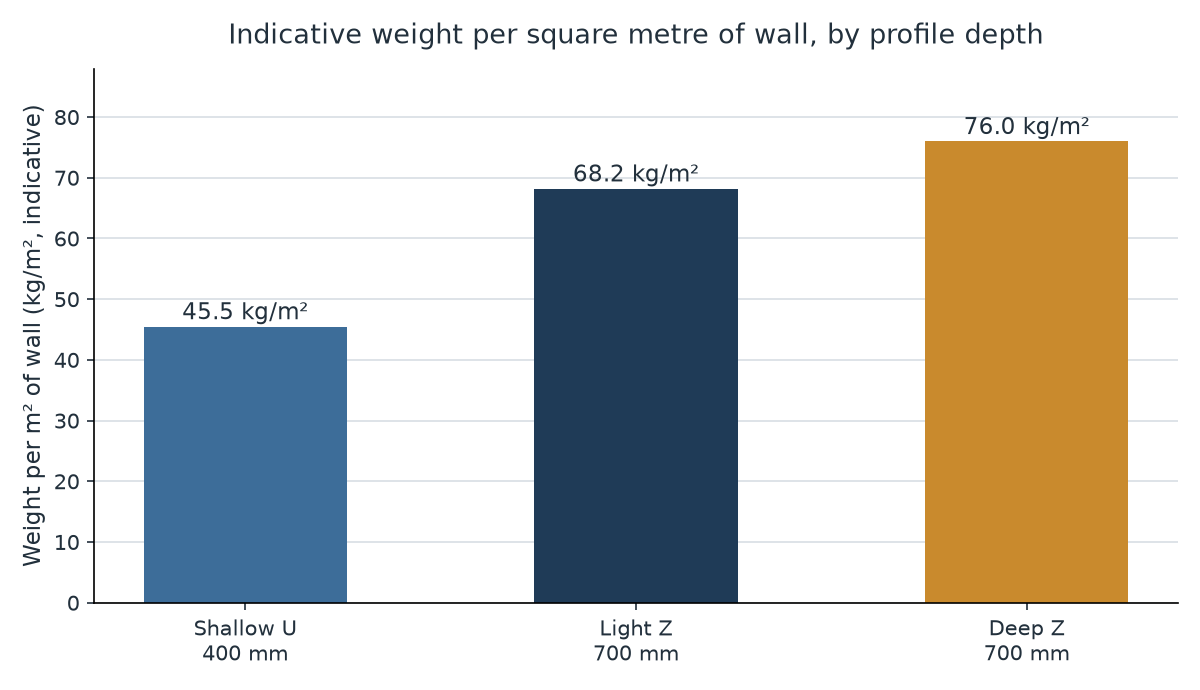
The conversion is simple once you know the pile width. Take the weight per pile, divide it by the pile width in metres, and you get the weight per metre of wall. A 400 mm U pile that weighs about 18.2 kg per pile metre works out to roughly 45.5 kg/m² of wall. A 700 mm Z pile at 47.7 kg per pile metre lands near 68.2 kg/m² of wall. The pile weighs 2.6 times as much, yet the wall it builds weighs only 50 percent more, because each pile covers far more width. That single calculation kills more bad comparisons than anything else I know.
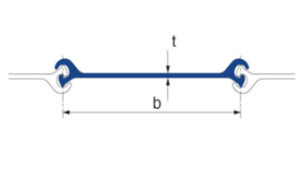
Then there is the pair trap. U sections are normally supplied and driven in pairs, locked back to back. Some catalogs quote the width of one pile, others quote the width of the pair, and the two conventions differ by exactly a factor of two. I always ask suppliers to state the unit width next to the weight, and I write it the same way in my own offers. The unit weight wording varies by region too, so never assume a number is per square metre until you have checked its width convention.
| Quoting unit | What it actually means | Example figure | Conversion trap |
|---|---|---|---|
| kg per pile | Mass of one driven pile, per metre of length | U 400 mm pile: about 18.2 kg/m | Meaningless alone; the width decides coverage |
| kg per metre of wall | Mass of steel in one metre of wall, per metre of height | Same pile: about 45.5 kg/m² | Pairs double the width, not the wall weight |
| kg per m² of wall | Same value expressed as surface density | Z 700 mm pile: about 68.2 kg/m² | The fairest unit for comparing offers |
| lb per ft per pile | US convention, one pile | About 12.2 lb/ft | Convert before comparing with metric offers |
When every offer sits in the same unit, the price conversation becomes honest. When it does not, one bidder usually wins on paper and loses on the wall.
How Do U-Type and Z-Type Profiles Differ in Weight per Meter?
Two families, same steel grade, very different results from the same kilograms.
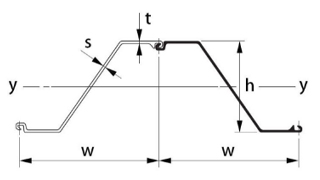
Z-type sections normally deliver more section modulus per kilogram than shallow U-type sections, because their deeper webs put steel further from the neutral axis. Straight web piles use weight for tension and cells, not for bending.
Where Does the Efficiency Gap Come From?
Bending capacity comes from geometry, not just mass. Section modulus equals the moment of inertia divided by the distance to the extreme fibre, so steel placed far from the neutral axis works harder. A deep Z section spreads its web across the full wall depth, and that is why our flange width and web depth guide reads the way it does. The same idea sits behind the section modulus entry every engineer studies before a wall design, and our buyer-side walkthrough of what section modulus really tells you pairs well with this page.
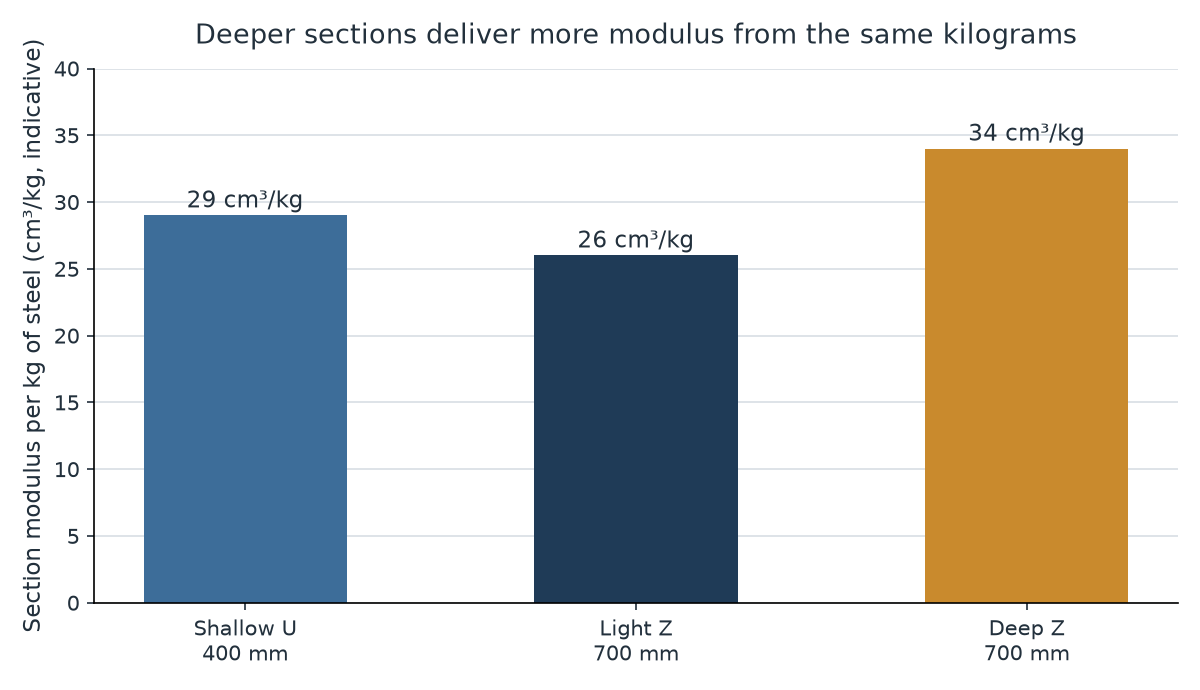
Indicative catalog figures make the point. A shallow 400 mm U section gives roughly 1,300 cm³ of modulus per metre of wall at 45.5 kg/m², which is about 29 cm³ per kilogram. A light 700 mm Z section gives about 1,800 cm³ at 68.2 kg/m², close to 26. A deeper Z pushes past 2,600 cm³ at 76 kg/m², roughly 34 cm³ per kilogram. The deeper profile wins on efficiency even though it weighs more per square metre, and that is exactly why deep excavations specify Z families more often than not.
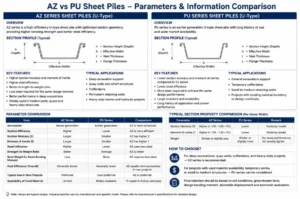
U sections still earn their place. They drive well in pairs, they suit shallow walls, and when a design applies the correct interlock reduction they remain honest structures. Our U-type versus Z-type comparison covers that in detail. What I refuse to accept is comparing a U and a Z on weight alone. The kilograms do not bend the wall; the modulus does. My rule is simple: convert weight to kg/m² of wall, convert modulus to cm³ per metre of wall, then look at the ratio between them. That ratio, more than the tonnage line on a quotation, tells you which profile deserves your money. If you are still choosing a family, start with our profile selection guide.
| Profile family | Indicative weight (kg/m² of wall) | Indicative modulus per kg (cm³/kg) | Best use |
|---|---|---|---|
| Shallow U, 400 mm | about 45 | about 29 | Shallow riverbank and utility walls |
| Light Z, 700 mm | about 68 | about 26 | Medium retaining walls, balanced cost |
| Deep Z, 700 mm | about 76 | about 34 | Deep excavation, high moment demand |
| Straight web | about 120 or more | not for bending | Cellular walls, cofferdams in water |
Figures above are indicative catalog ballpark values. Always confirm against the mill data sheet for the exact section and rolling mill.
How Does Weight per Meter Drive Your Freight and Landed Cost?
The heaviest line in your budget often sits on a ship, not in the steel.
Freight cost follows total tonnes, while wall cost follows tonnes per square metre of wall. A lighter profile packs more metres into each container, but it may need extra walers or anchors, so always price the whole wall, not the shipment.
What Does One Container Actually Hold?
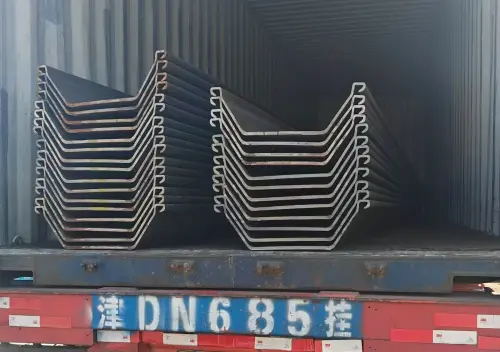
A standard container carries roughly 26 tonnes of payload, and every one of our export offers is priced around that limit. If a profile weighs 45.5 kg/m² of wall, one container holds about 570 square metres of wall face. The Z section at 68.2 kg/m² holds about 380. The deep section at 76 kg/m² holds about 340. Same container, same ocean freight per box, three very different freight costs per metre of finished wall. Buyers in Iraq and Jordan ask me for this calculation on almost every order, because freight to the Gulf can add 10 to 15 percent to landed cost.
For very large orders we quote break-bulk vessels instead, and there the maths shifts: the ocean cost tracks total tonnes more closely, so the lighter wall wins on freight again, just through a different door. Handling matters too. A lighter pile means lighter bundles, smaller cranes, and faster driving. On one Southeast Asia riverbank protection project, the contractor chose a mid-weight hot-rolled steel sheet pile U section over a heavier Z offer. The wall was shallow, the piles were driven quickly with vibratory equipment, and the freight saving on the extra containers paid for the site camp.
But freight is only half of the landed story. A lighter profile that forces an extra row of walers, more anchoring, or slower installation can erase every dollar it saved on the ship. I have quoted walls where the cheapest tonnage ended up the most expensive metre of wall after the engineer added bracing. Our quotation comparison guide explains how we break those numbers out, and our packaging and transportation note shows how bundles are loaded and secured.
| Freight factor | Driven by weight per meter? | Effect on landed cost | What to check |
|---|---|---|---|
| Container count | Yes, directly | More tonnes, more boxes | Payload limit, about 26 t |
| Ocean freight per m² of wall | Yes | Heavier wall, pricier freight | Convert to kg/m² first |
| Crane and handling cost | Yes | Lighter bundles, faster lifts | Bundle weight in the loading plan |
| Extra bracing or anchors | Indirectly | Lighter S can add steelwork | Wall design summary, not tonnage |
| Port handling at destination | Yes | Heavier units need bigger gear | Discharge limits at the destination port |
How Should You Build a Weight per Meter Comparison Table for Your Project?
A comparison you can defend in a meeting needs seven columns, not two.
Build one table with profile family, unit width, weight per pile, weight per m² of wall, section modulus per metre of wall, steel grade, and price per m² of wall. Fill it from mill data sheets, then verify the delivered steel.
The Seven Columns I Never Skip
The first column is the profile family and the exact section name, because two catalogs can use the same number for different sections. The second is the unit width, stated as per pile or per pair, which unlocks every other conversion. The third and fourth carry the weight per pile and the weight per m² of wall, calculated rather than copied, so the arithmetic is visible to everyone. The fifth column holds section modulus per metre of wall, both gross and net of corrosion allowance if the wall is permanent. The sixth is the steel grade, because a grade change moves allowable stress while the weight stays identical. The seventh is price, and I always ask for it per square metre of wall alongside the price per tonne.
Tolerance deserves its own line. Standards allow small thickness deviations, and a web rolled half a millimetre under nominal loses a few percent of its modulus, which matters when the design margin is tight. Our thickness guide for heavy-duty retaining explains how much margin to keep, and the dimensions and modulus guide puts the conversions in one table. When goods arrive, we support SGS inspection and check thickness against the mill certificate before anything is driven, and the full procurement walkthrough for buying from China covers every step from RFQ to jobsite.
| Column | Source | Why it matters |
|---|---|---|
| Section name and family | Mill data sheet | Same number, different sections |
| Unit width (pile or pair) | Supplier confirmation | Prevents factor-of-two errors |
| Weight per pile | Catalog, then verified | Basis for every conversion |
| Weight per m² of wall | Calculated | The fair comparison unit |
| Modulus per metre of wall | Catalog, gross and net | Capacity, not cost |
| Steel grade | Mill certificate | Moves allowable stress |
| Price per m² of wall | Quotation | Reveals the real winner |
A buyer who sends this table to two suppliers gets two answers that finally mean the same thing.
My Take: The Number Everyone Quotes and Almost Nobody Converts
After years of shipping sheet piles from Liaocheng to the Gulf, Australia, and West Africa, my honest view is that weight per meter is the most quoted and least converted figure in our trade. Buyers compare kilograms because kilograms look objective. But kilograms hide width conventions, pair traps, and the difference between a pile and a wall. I have watched tenders won on a lighter tonnage, only to see the engineer add a row of walers that cost more than the steel saving. I have also watched a client pay more per tonne for a deeper Z section and delete an entire bracing level, because the modulus per kilogram told him a different story. So when a buyer asks which profile is cheapest, I answer with a question of my own: cheapest per tonne, or cheapest per square metre of wall that actually holds the soil? The second question is the one that keeps projects out of trouble, and weight per meter, properly converted, is how you answer it.
Conclusion
Convert weight to kg/m² of wall, pair it with section modulus, and verify the delivered steel. Then compare price per square metre of wall, never per tonne.
Tags: steel sheet pile weight per meter, steel sheet pile profiles, sheet pile wall design, steel sheet pile procurement, sheet pile freight cost