How Should Steel Sheet Piles Be Packaged, Loaded, and Transported Overseas?
Every week, I see project cargo managers ask the same question: how do steel sheet piles arrive at a Middle Eastern port without dents, bent interlocks, or missing pieces? Poor packaging and careless loading can turn a profitable shipment into a claim nightmare. The good news is that most of this damage is preventable.
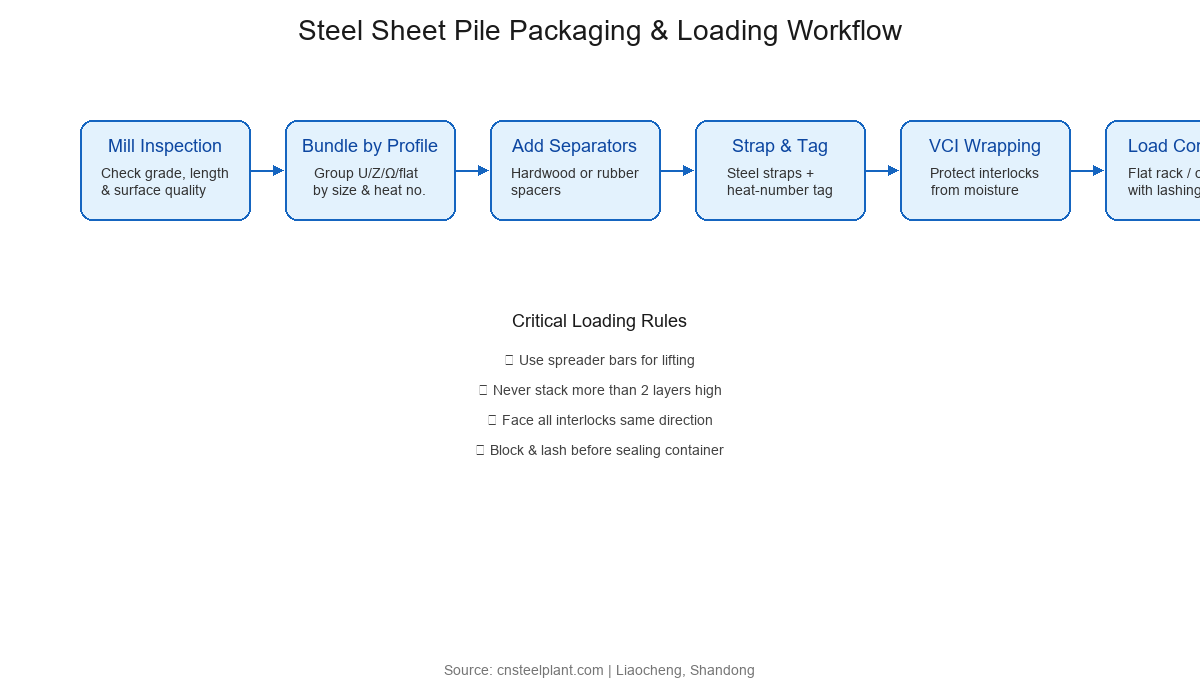
Steel sheet piles should be bundled by profile and length, lifted with spreader bars or padded slings, secured with steel straps and wooden separators, and loaded in flat racks or open-top containers so interlocks never bear direct weight.
At our plant in Liaocheng, Shandong, we have shipped U-type, Z-type, Omega-type, and flat steel sheet piles to Iraq, Iran, Jordan, the UAE, Saudi Arabia, Bahrain, Kuwait, Pakistan, Australia, Africa, North America, and South America. Over the years, we have learned that packaging is not a cosmetic step. It is part of the engineering chain. When a contractor in Karachi or a steel distributor in Perth opens a container, they expect every interlock to be ready for driving. That only happens if the loading team understands how sheet piles behave during sea transit.
Why Does Proper Packaging Matter for Steel Sheet Piles?
Damaged interlocks are the fastest way to lose money on a sheet pile project. A single bent clutch can jam an entire wall during installation. Contractors then face downtime, extra cutting, or rejected panels. The pain is real, and the cost is high.
Proper packaging protects the interlock edges, keeps bundles stable, and lets the buyer count and inspect the cargo quickly at destination.
The Real Risks We See in Transit
I have seen four problems show up again and again:
-
Interlock deformation. When bundles are lifted from one corner or stacked without separators, the clutch profiles get crushed. A deformed interlock will not slide into the next panel. On site, that means burning, grinding, or worse, replacing the panel.
-
Surface damage from strap pressure. Plain steel straps cut into the surface if they are pulled too tight or placed over unsupported spans. We use strap protectors and keep straps away from interlock lips.
-
Bundle shifting in the container. A 25-tonne bundle that moves even 10 centimeters during a voyage can punch through container walls or damage neighboring cargo. Blocking and lashing are not optional.
-
Mixed lengths and profiles. If the yard does not label each bundle clearly, the receiver spends hours sorting panels at the port. Time at port costs money.
To keep these risks low, we bundle piles by identical profile, steel grade, and length. Each bundle gets a metal tag with heat number, quantity, length, and profile type. This simple step saves our clients hours during customs inspection and site offloading.
| Packaging Element | What We Do | Why It Matters |
|---|---|---|
| Bundle composition | Same profile, grade, length | Prevents mixed unloading and simplifies tally |
| Separators | Hardwood or rubber spacers | Stops interlock crushing and surface rubbing |
| Lifting points | Marked and balanced | Avoids bending from single-point lifts |
| Strapping | Steel straps with protectors | Holds bundles tight without cutting into steel |
| Metal tags | Heat number, length, profile | Speeds up inspection and inventory matching |
The way we package also depends on the final destination. For example, shipments to Australian ports often face strict biosecurity rules. Wooden separators must be heat-treated and stamped. For Middle Eastern ports, dust and salt exposure during trans-shipment are bigger concerns, so we add extra edge protection. Our steel sheet pile export solutions already include these regional details in the planning stage.
What Is the Best Way to Lift and Load Steel Sheet Piles?
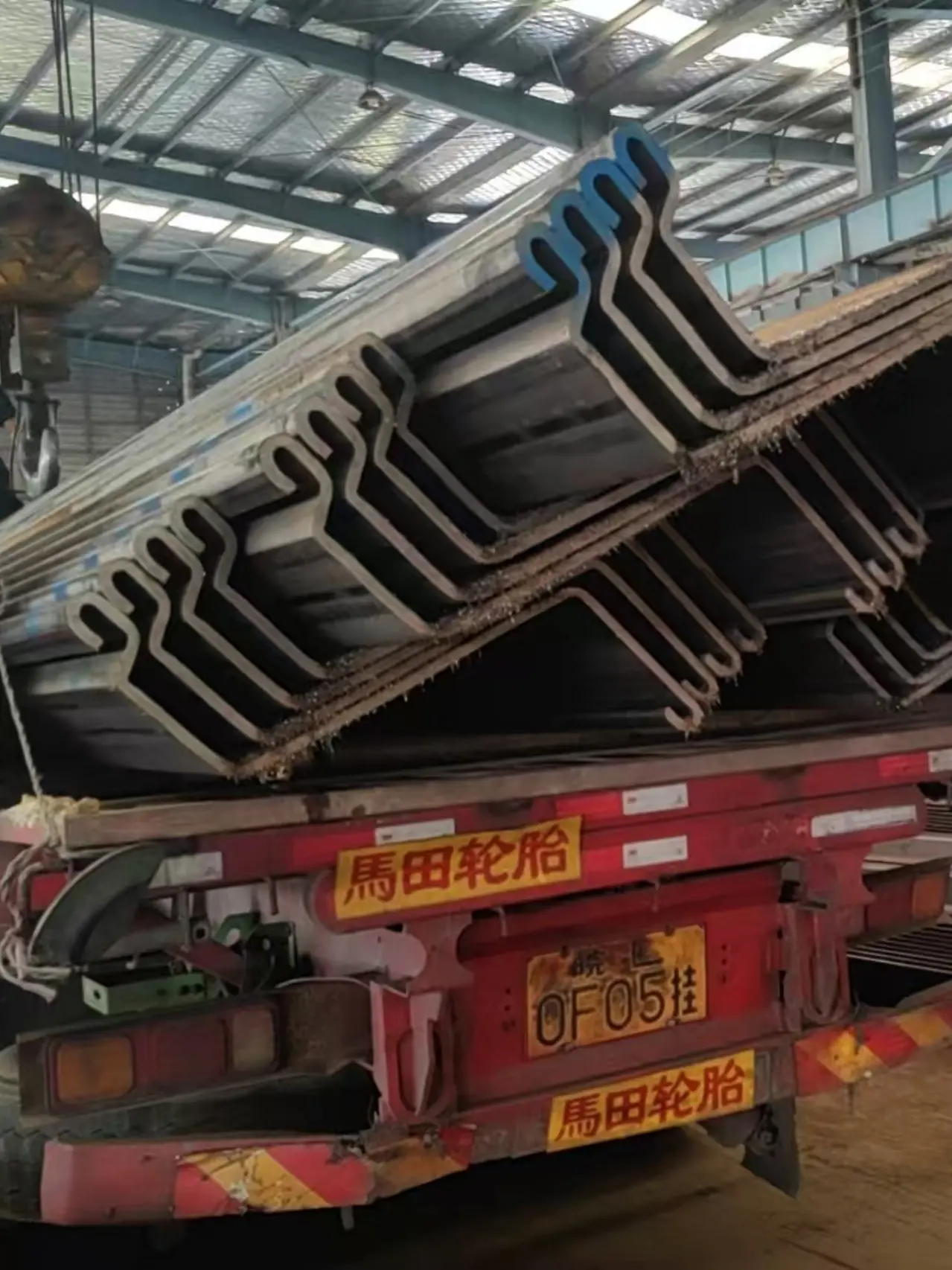
Loading looks simple until you try to move a 15-meter panel without bending it. Steel sheet piles are long, slender, and top-heavy. A crane hook in the wrong place creates a permanent bow. We never lift a bundle from the middle unless the entire bundle is supported by a spreader frame.
Use spreader bars or multiple padded slings, lift parallel to the ground, and place bundles only on level ground or container floors.
Equipment Choices on Our Yard
We keep three loading setups ready depending on the bundle size:
- Overhead gantry crane with spreader bar for standard 12-meter bundles. The spreader bar keeps the slings vertical, so the bundle stays straight.
- Mobile crawler crane with C-hook for short panels under 8 meters. The C-hook grips the web without touching the interlocks.
- Forklift with long padded forks only for small accessory bundles like corner sections or waling beams. We do not forklift full-size sheet piles.
Before any lift, the operator checks the bundle weight tag. A typical bundle of U-type sheet piles, 12 meters long, can weigh 4 to 7 tonnes. Z-type bundles are often heavier because the piles are wider and thicker. Knowing the exact weight prevents overloading the crane or the container floor.
Container Loading Patterns
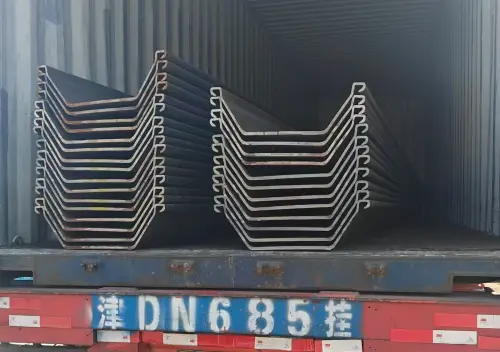
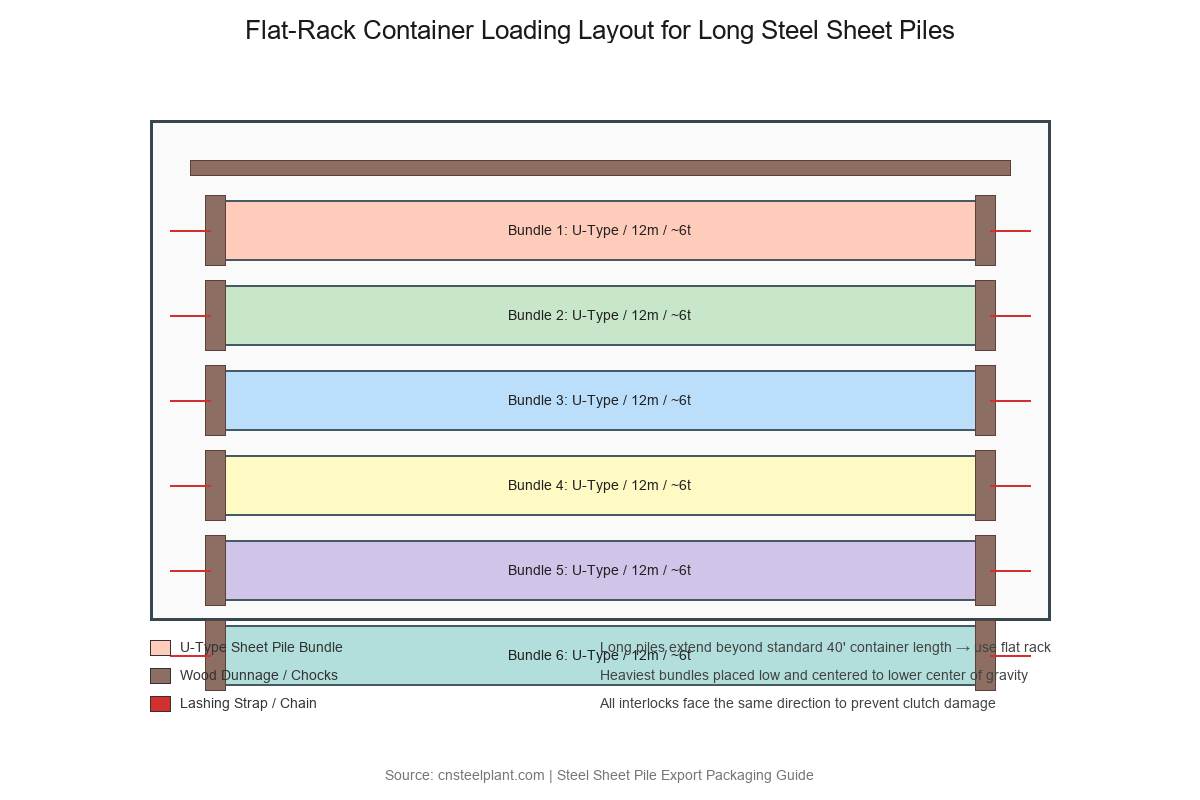
Most of our export shipments use 40-foot flat racks or open-top containers. Standard dry containers are rarely suitable because the door width limits panel length and bundle width. Here is how we plan the stowage:
- Lay dunnage on the floor first. Hardwood beams run across the container width. They keep bundles clear of any floor moisture and create forklift pocket access.
- Place the heaviest bundles low and centered. This lowers the center of gravity and reduces dynamic loads during vessel rolling.
- Stack lighter bundles on top, never more than two high. More than two layers creates excessive point loads on the lower interlocks.
- Face all interlocks the same direction. This stops clutch tips from grinding against each other.
- Block every bundle with timber chocks and lash with chains or polyester webbing. The lashing angle should be roughly 45 to 60 degrees for best restraint.
When a buyer orders mixed lengths, we load the longest panels first and place shorter bundles on top or in gaps. This minimizes wasted cubic capacity and keeps the load stable. Our packaging, loading, and transportation of steel sheet piles process is built around these rules.
How Do You Prevent Corrosion and Moisture Damage During Sea Transit?
Salt air and condensation are the enemies of bare steel on a long voyage. Even though sheet piles are designed for marine environments, arriving with heavy rust makes a bad first impression and can delay handover.
We apply a thin mill protective oil, seal bundle ends, use moisture-absorbent bags inside wrappings, and avoid loading wet bundles.
Our Anti-Corrosion Steps
Most of our sheet piles leave the mill with a light protective oil film. We do not remove it before shipment. In fact, we sometimes re-oil the interlock edges if the storage period before loading is long. The steps are:
- Inspect each bundle for pooled water. Wet bundles go back to the drying area.
- Wrap the bundle ends with VCI film. Volatile corrosion inhibitor film releases a protective vapor inside the wrapping. This is standard for shipments to humid destinations like Southeast Asia or West Africa.
- Place silica gel or desiccant bags between bundles. One or two kilograms per container is usually enough for a 40-foot box.
- Seal ventilation partially. We want some airflow to stop condensation pockets, but not so much that salty spray enters freely.
For permanent marine structures, we often recommend corrosion resistance solutions for steel sheet piles. These go beyond shipping protection and include coating systems, cathodic protection, and steel grade upgrades.
What Documentation Travels With the Shipment?
Cargo without papers is cargo stuck at customs. Every export shipment from our plant carries a complete document set. We double-check it before the truck leaves the gate.
The standard document set includes a commercial invoice, packing list, bill of lading, mill test certificates, and certificates of origin or SGS inspection when required.
| Document | Purpose | Common Destination Requirement |
|---|---|---|
| Commercial invoice | Customs valuation | All destinations |
| Packing list | Cargo tally and identification | All destinations |
| Bill of lading | Ownership and shipping contract | All destinations |
| Mill test certificate | Material grade and mechanical proof | Middle East, Australia, Africa |
| Certificate of origin | Preferential tariff or import license | Many African and Middle Eastern countries |
| SGS inspection report | Third-party quality confirmation | Often requested for government projects |
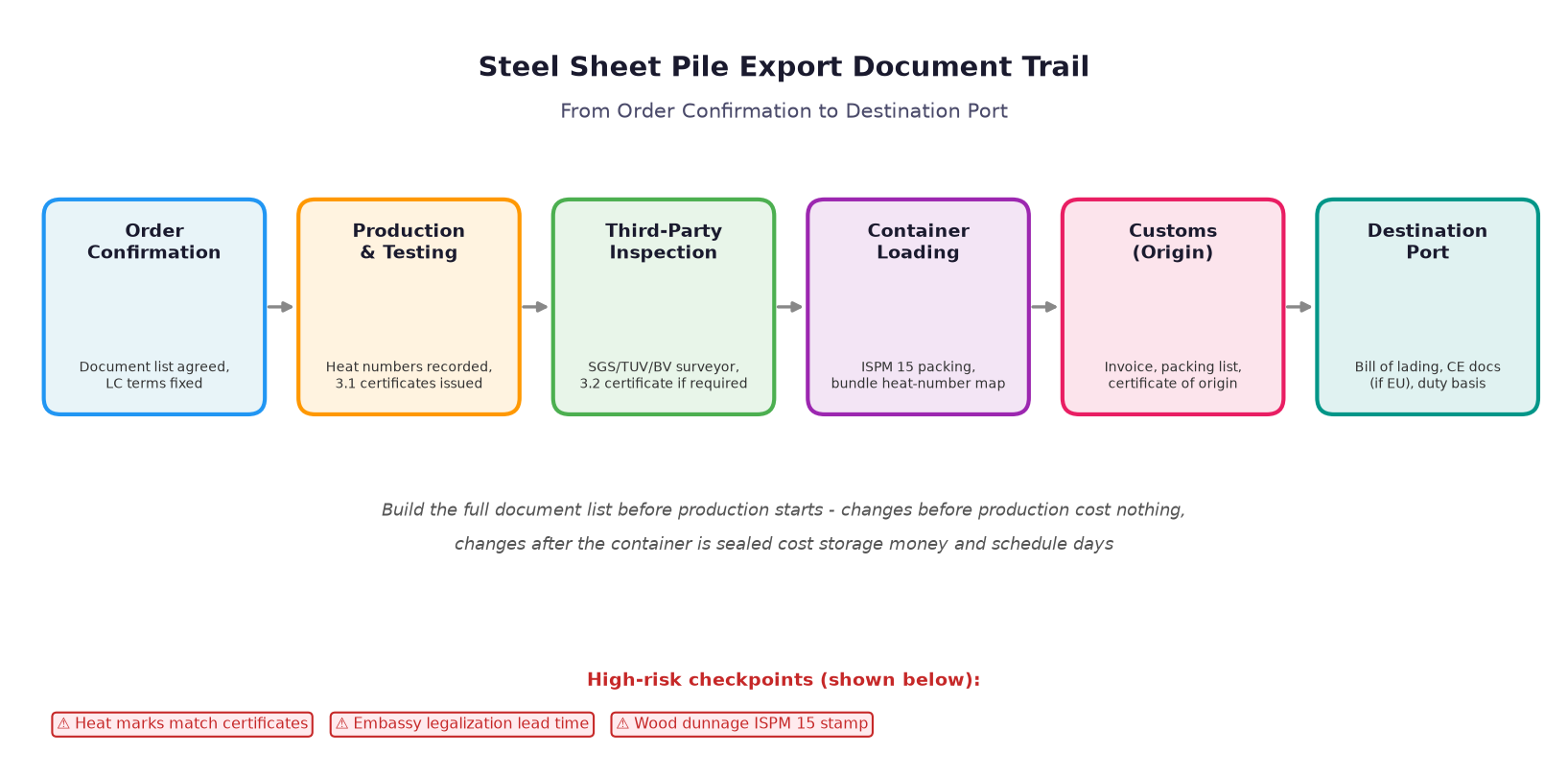
We also keep digital copies in case original documents are delayed. For buyers who want deeper background, our article on common certifications for steel sheet pile export projects explains ISO, EN, ASTM, and mill test certificates in detail. The ASTM A690 standard, which covers corrosion-resistant H-piles and sheet piles, can be checked at ASTM A690 standards.
How Do You Choose the Right Shipping Container for Steel Sheet Piles?
The wrong box costs more than the right box. A standard 40-foot high-cube container can carry about 26 to 28 tonnes of payload, but its internal width is only about 2.35 meters. That is fine for short panels but impossible for long ones.
Use flat racks for long piles, open-top containers for medium lengths, and standard containers only for cut pieces or accessories under 12 meters.
Container Type Decision Table
| Container Type | Best For | Max Length | Notes |
|---|---|---|---|
| 40-foot flat rack | Long sheet piles up to 22 meters | About 22 meters | Requires top and side lashing |
| 40-foot open-top | Medium piles 12 to 14 meters | About 14 meters | Crane loading from top |
| 40-foot high-cube | Short piles, cut sections, fittings | Under 12 meters | Most economical per tonne |
| Bulk vessel hold | Very large project orders | No fixed limit | Charter or break-bulk schedule |
When a single order exceeds 500 tonnes, we often look at break-bulk or bulk vessel options. This avoids the per-container lifting and lashing cost and lets us ship directly to project ports. The trade-off is longer scheduling lead time. For most contractor orders between 50 and 300 tonnes, flat racks in sets of three or four work best.
Our logistics team coordinates with freight forwarders who know steel cargo. We send them the bundle list, weights, dimensions, and lifting drawings two weeks before the intended loading date. That buffer lets them book the right equipment and avoid demurrage at the port. If you are new to importing, our guide on how to buy steel sheet piles from China walks through the full purchase-to-delivery chain.
What Should Buyers Inspect When the Cargo Arrives?
Receiving inspection is where many claims start. Buyers should not simply sign the delivery note and send the truck away. A careful check at the port gate can save a lot of argument later.
Check bundle count, tag details, visible dents, interlock condition, and corrosion signs before the carrier leaves the terminal.
Our Recommended Arrival Checklist
- Count bundles against the packing list. Do not rely on the bill of lading piece count alone.
- Photograph each bundle from both ends and the side. Timestamped photos are strong evidence if a claim is needed.
- Inspect interlock lips for bending or crushing. Use a straight edge or sample panel to test fit.
- Look for rust that exceeds normal mill surface oxidation. Light surface rust is acceptable; deep pitting is not.
- Check strap integrity. Broken straps may mean the bundle shifted.
- Verify certificate numbers match the tags. Each tag heat number should appear on the mill test certificate.
If the buyer finds damage, they should note it on the delivery receipt immediately and notify the shipping agent. We then coordinate with the insurer or carrier. Our goal is to resolve the issue before the first panel is driven.
For contractors who want to understand how sheet piles are installed after they arrive, our post on steel sheet pile installation methods covers vibratory and impact driving. The two methods have very different handling needs before the rig starts work.
How Do We Customize Packaging for Specific Project Needs?
Not every buyer wants the same bundle size. A civil engineering company in Saudi Arabia may ask for 25-tonne bundles to match its large crawler crane. A distributor in Pakistan may prefer 5-tonne bundles because its yard forklifts are smaller. We can adjust.
Bundle size, strapping pattern, tagging language, and document set can all be tailored to the buyer’s unloading equipment and customs requirements.
Typical Customizations
- Bundle weight: From 3 tonnes up to about 30 tonnes, depending on lifting capacity at destination.
- Tag language: English, Arabic, Spanish, or Russian labels on request.
- Paint markings: Project name, color-coded profile bands, or buyer logo stenciling.
- Additional wrapping: Full VCI wrap for long storage, or open wrap for immediate installation.
- Document format: Embassy legalization, chamber of commerce stamps, or notarized copies.
Because we work as a wholesale B2B exporter, we do not sell single piles to retail buyers. Our minimum order quantity and lead time depend on the profile, grade, and current production schedule. OEM customization is available for profile dimensions, steel grade, and length. SGS or other third-party inspection can be arranged before shipment.
My View: Packaging Is Part of the Product
In my opinion, the packaging and transport phase is where a supplier proves they understand steel sheet piles. Anyone can cut a price. But only a supplier who protects the interlocks, loads the container correctly, and prepares clean documents delivers real value. At our Liaocheng plant, we treat every bundle as if it were going onto our own project site. That is why we spend time on strap spacing, separator thickness, and lashing angles. It is not bureaucracy. It is how we make sure a contractor in Basra or a distributor in Brisbane gets steel that is ready to work.
If you are planning a shipment and want to confirm bundle weights, container choices, or inspection timing, contact us through cnsteelplant.com. We can review your lifting equipment, port access, and project schedule to recommend the safest, most cost-effective packaging and transport plan.
Conclusion
Smart packaging, careful loading, and the right shipping container protect steel sheet pile interlocks, reduce claims, and keep project schedules on track. Plan the bundle, secure the load, and inspect at arrival.
Tags: steel sheet pile packaging, sheet pile transportation, container loading steel piles, steel sheet pile export, B2B steel supplier