Which Certifications Do Steel Sheet Pile Export Projects Actually Require?
One missing certificate can strand a container at customs for weeks. I have watched buyers lose project schedules over paperwork, not steel. Here is what you actually need.
Steel sheet pile export projects typically require four certificate groups: mill quality certifications such as ISO 9001 and EN 10204 test certificates, product standard compliance for ASTM or EN 10248 dimensions and grades, trade documents including the certificate of origin and CE marking, and third-party inspection reports from agencies like SGS.
The paperwork side of the steel trade is not glamorous, but it decides whether your project starts on time. I run an export business from Liaocheng, Shandong, and I ship U-type, Z-type, and custom-profile sheet piles to contractors in Iraq, Saudi Arabia, the UAE, Australia, and beyond. Every one of those shipments carries a different mix of certificates, depending on the destination port, the project specs, and the client’s own quality requirements. In this guide, I will walk you through the four certificate groups that matter most, in the order I check them myself.
What Quality Certifications Should You Check Before Signing a Steel Sheet Pile Contract?
Most disputes I see start before the first pile is rolled. The buyer trusted a supplier’s word instead of their paperwork. Quality certifications are your first line of defense.
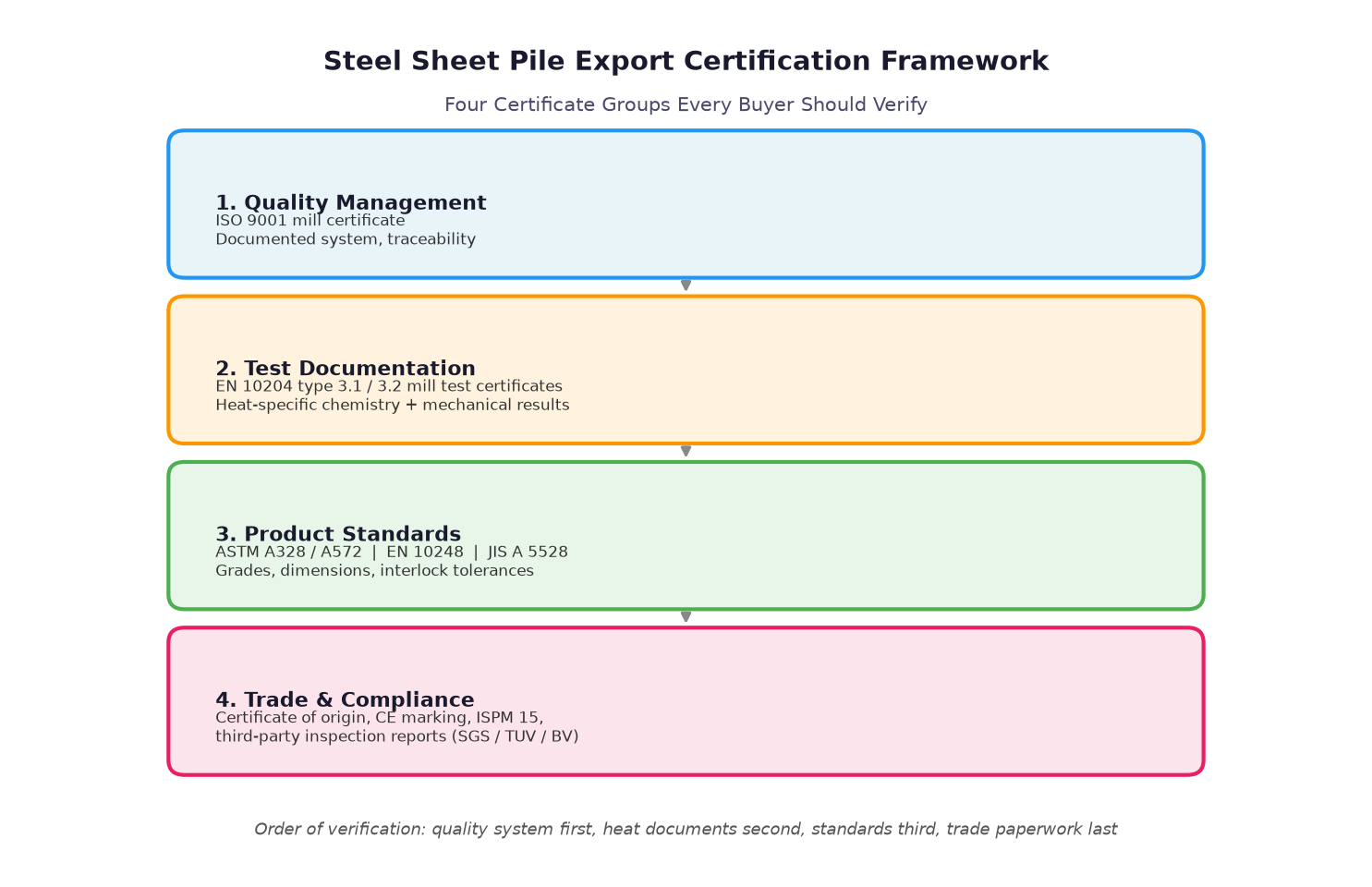
Quality certifications for steel sheet piles start with a valid ISO 9001 certificate from the mill, followed by EN 10204 type 3.1 mill test certificates for each heat number, and type 3.2 certificates when a third-party inspector witnesses the tests.
Understanding the Certificate Hierarchy
When a new contractor contacts our factory, the first document I send is not a price list. It is our ISO 9001 certificate and a sample mill test certificate. I do this because quality documentation follows a hierarchy, and each level answers a different question about the steel you are buying.
ISO 9001: The System Behind the Steel
An ISO 9001 certificate tells you that the mill runs a documented quality management system. It does not tell you that a specific pile is defect-free. What it does tell you is that the mill records its heat numbers, tracks its chemical analysis, calibrates its instruments, and can trace any problem back to its source. I have visited mills without ISO 9001 certification, and the difference is visible within an hour. Records are incomplete, operators guess at process parameters, and nobody can produce a traceability report on demand. For steel sheet pile export projects, I treat ISO 9001 as the entry ticket. Without it, everything else becomes a claim instead of a system.
EN 10204 Type 3.1: The Heat-Specific Evidence
The mill test certificate is where quality becomes specific to your order. A type 3.1 certificate under EN 10204 is issued by the manufacturer’s own inspection department, independent of the production team. It lists the heat number, chemical composition, yield strength, tensile strength, and elongation for the exact heat your piles came from. This is the document that connects the steel in your container to a laboratory result. On projects where the wall carries heavy loads, such as deep excavation support or marine structures, I always recommend clients ask for 3.1 certificates matched to their actual shipment, not a sample from the product family.
EN 10204 Type 3.2: When a Third Party Witnesses the Tests
Type 3.2 certificates go one step further. An authorized inspector from outside the mill, such as an SGS or TUV surveyor, witnesses the mechanical tests and co-signs the certificate. This costs extra and adds a few days to production, but for government projects in the Middle East, it is often mandatory. I have supplied bridge foundation projects where the client’s consultant insisted on 3.2 certificates for every heat. The extra cost was small compared to the risk of a rejected shipment.
| Certificate | Issued By | What It Proves | Typical Use |
|---|---|---|---|
| ISO 9001 | Accredited certification body | Mill has a documented quality management system | Pre-qualification of any supplier |
| EN 10204 3.1 | Mill’s independent inspection dept | Chemical and mechanical results for your specific heat | Standard requirement for most export orders |
| EN 10204 3.2 | Mill + third-party inspector | Same results, witnessed and co-signed | Government projects, high-spec infrastructure |
| Material datasheet | Sales or production dept | General product claims | Marketing reference only, not evidence |
The last row in that table matters more than people expect. A material datasheet is not a certificate. I have seen buyers accept a polished PDF datasheet as proof of grade, then discover at their port that the steel tested below spec. Always match certificates to heat numbers, and always match heat numbers to the piles loaded in your container.
Which Product Standards Govern Steel Sheet Pile Dimensions and Grades?
Quality systems tell you the mill is organized. Product standards tell you the pile in front of you meets the geometry and strength your engineer designed.
The main product standards for steel sheet pile exports are ASTM A328 and A572 for the American market, EN 10248 for European projects, and JIS for Japanese specifications, each defining chemical limits, mechanical properties, and dimensional tolerances.
Matching Standards to Your Destination Market
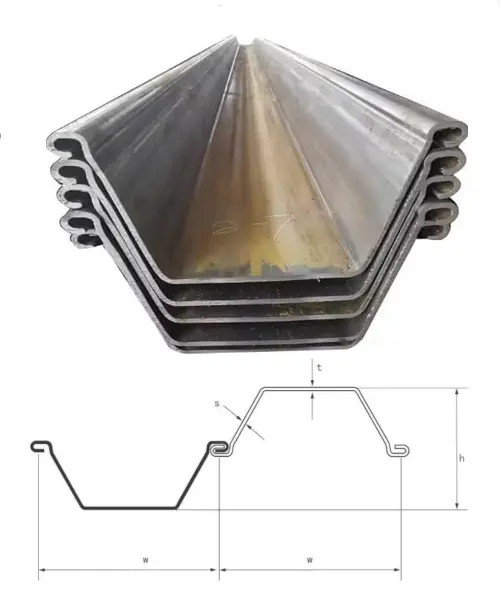
The standard your piles must follow is usually written into the project specification, and it often depends on who designed the wall. American consultancies dominate infrastructure design in parts of the Middle East, so those projects demand ASTM. European contractors bring EN 10248 with them. I keep tooling ready for both because our export markets flip between the two systems project by project.
ASTM Standards for American-Specification Projects
ASTM A328/A328M is the classic specification for steel sheet piles, covering minimum yield strength of 385 MPa for the standard grade. Many projects upgrade to ASTM A572 Grade 50 or higher for heavier walls. When a client specifies ASTM, I confirm the chemical limits, the yield and tensile requirements, and the dimensional tolerances on interlock and camber. The ASTM International standards also define how tests are sampled, which affects how the mill prepares certificates. On a recent project in Saudi Arabia, the design called for ASTM A572 Gr50, and we ran production heats specifically to meet the tighter manganese and carbon equivalents the grade demands.
EN 10248 for European Specifications
EN 10248 covers hot-rolled sheet piles in grades from S240GP up to S430GP. The standard defines the permitted deviation on section depth, flange width, thickness, and interlock alignment, and these tolerances are tighter than many buyers expect. Interlock tolerance is where dimensional problems show up first. If the lock does not accept the mating pile smoothly during trial assembly, the whole driving sequence slows down, and water tightness suffers in ways I describe in more detail when discussing interlock sealing performance. I always advise clients to review our steel grade options from Q235 to S355GP against the EN grade table before finalizing their design, because a mismatch between the specified grade and the mill’s grade system creates certificate confusion at customs.
JIS and Other National Standards
Japanese-standard projects appear occasionally in Southeast Asia and Africa. JIS A 5528 and A 5541 define Japanese sheet pile grades and dimensions. The geometry tables differ from both ASTM and EN, so the pile cross-sections themselves are different products. I tell buyers to lock the standard early, because switching standards mid-order means new rolls, new tooling, and a new set of certificates.
| Standard | Region of Use | Key Grades | What the Standard Defines |
|---|---|---|---|
| ASTM A328/A572 | Americas, Middle East US-spec projects | A328 (385 MPa), A572 Gr50 | Chemical limits, mechanical properties, tolerances |
| EN 10248 | Europe, Africa, Australia | S240GP to S430GP | Grades, dimensions, interlock and straightness tolerances |
| JIS A 5528 | Southeast Asia, Japan-linked projects | SY295, SY390 | Japanese grade system and cross-section geometry |
| GB/T 20933 | China domestic and compatible projects | Q235, Q355, Q390 | Chinese grade system and dimensional tolerances |
One more point on grades. The grade named in the contract must appear on the mill test certificate exactly. If your specification says S355GP and the certificate lists Q355B, customs officers and project consultants can read that as non-compliance, even when the chemistry is equivalent. I fix this at the order stage, not the shipping stage.
What Trade Documents and Compliance Certificates Keep Your Shipment Moving?
Once the steel is right, the paperwork must be too. Trade documents do not talk about steel quality at all. They talk about origin, value, and compliance, and customs officers read them before your engineer ever sees the piles.
Core trade documents for steel sheet pile exports include the commercial invoice, packing list, bill of lading, certificate of origin, CE marking documentation for EU-bound goods, and ISPM 15 fumigation certificates for wooden packing materials.
The Document Trail From Factory to Port
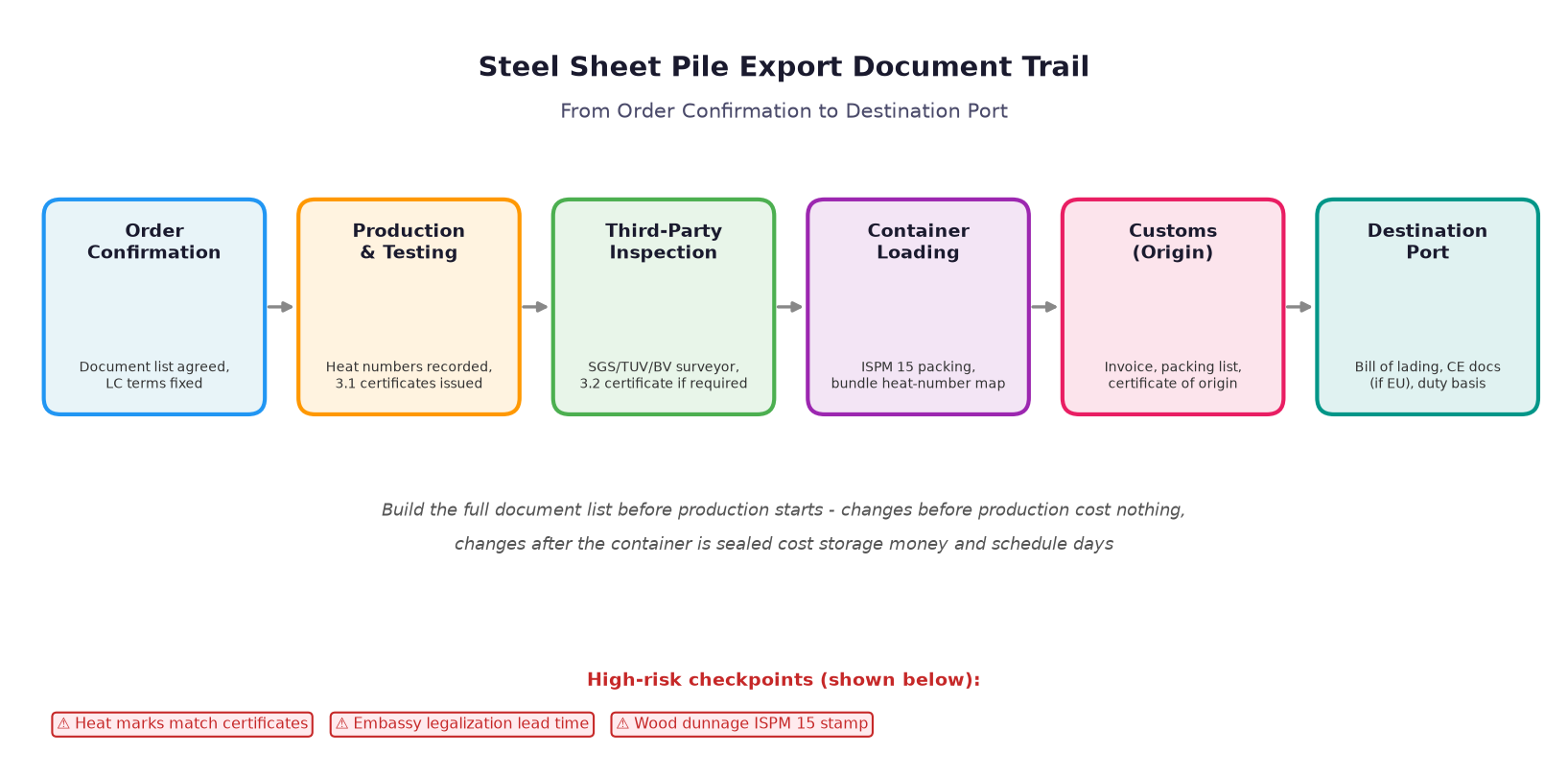
I prepare the same core set of documents for nearly every shipment, but small details change per destination, and those details are where delays hide.
Certificate of Origin and Its Local Variants
The certificate of origin states where the goods were produced, and it can cut import duty significantly when issued under a preferential trade agreement. For shipments to the Gulf, some clients ask for certificates legalized by the destination embassy. Legalization adds a week, so I flag it during order confirmation, not at loading. A shipment to Iraq last year needed embassy-legalized documents, and because we planned for it, the container cleared Basra without a single day of storage charges.
CE Marking and EU-Bound Shipments
For piles entering the European Union, CE marking under the construction products regulation demonstrates conformity with the relevant harmonized standard. The CE marking process requires a declaration of performance backed by factory production control and testing. I handle CE documentation for our European distributor clients, and the key point is that CE is a process, not a sticker. The declaration, the test basis, and the factory control records must line up.
Packing Compliance and ISPM 15
Wooden dunnage, pallets, and bracing inside the container must comply with ISPM 15 fumigation and marking requirements. This sounds trivial, but non-compliant wood is one of the most common reasons agricultural inspection holds a container at destination. Our packing uses ISPM 15-stamped timber, and we photograph the bracing before closing the container so the client has evidence if inspection asks.
Third-Party Inspection Reports
Agencies like SGS, TUV, and Bureau Veritas perform pre-shipment inspection on request. The surveyor visits the factory, checks dimensions against the approved drawings, witnesses tensile tests, and inspects loading. The resulting report becomes a condition of payment under many letters of credit. For our port construction clients, third-party loading inspection is standard practice because container or vessel loading damage is invisible until the wall is being driven.
| Document | Issued By | Purpose | Common Delay Cause |
|---|---|---|---|
| Commercial invoice + packing list | Exporter | Declares value, quantity, and package count | Value mismatch with LC terms |
| Bill of lading | Shipping line | Title document for the cargo | Wrong consignee or notify party |
| Certificate of origin | Chamber of commerce / CCPIT | Proves production origin for customs and duty | Missing embassy legalization |
| CE declaration of performance | Manufacturer | EU conformity for construction products | Missing test basis records |
| ISPM 15 mark | Certified treatment facility | Wood packing compliance | Unstamped dunnage found at inspection |
| Inspection report | SGS / TUV / BV | Third-party verification of goods and loading | Surveyor scheduling conflicts |
My rule for trade documents is simple. Build the document list at order confirmation, before production starts. Changing documents after the container is sealed costs storage money and schedule days. Changing them before production costs nothing.
How Do You Verify Supplier Certificates Before Money Changes Hands?
Certificates are easy to fake and hard to verify from the other side of the world. A structured verification routine protects your project budget better than any warranty clause.
Verifying supplier certificates involves checking certificate numbers against issuing-body databases, matching heat numbers on documents to actual piles, requesting sample mill certificates before ordering, and running a pre-shipment inspection for high-value orders.

A Practical Verification Workflow
I teach this workflow to buyers who are new to importing from China, and it has saved several of them from painful lessons.
Verify the Issuer Before the Document
Every credible certificate carries a number and an issuing body. ISO 9001 certificates can be checked against the certification body’s public register. Accreditation bodies publish lists of legitimate certifiers. When I evaluate a competitor’s documents as part of market research, I start there. A certificate whose issuing body cannot be found online, or whose accreditation logo belongs to a different certificate number, ends the conversation. I also check the certificate’s scope. A mill that is ISO 9001 certified for furniture parts should not be selling you structural steel.
Match Heat Numbers Physically
The heat number stamped on the pile or painted on its surface must match the heat number on the mill test certificate. When we ship, we stencil heat numbers on every bundle and photograph the mapping between bundles and certificates. Buyers receiving long-service infrastructure piles should treat this mapping as the anchor of their quality file, because every future audit will trace back through it. On one project in Jordan, the client’s consultant cross-checked twenty bundles at random against the 3.1 certificates, and every number matched. That thirty-minute check built more trust than any sales conversation.
Ask for Sample Certificates at RFQ Stage
Before you commit, ask the supplier for a redacted sample mill test certificate from a recent shipment. The format, the level of detail, and the issuing department tell you a lot about how the mill operates. Combine this with a review of the supplier’s product range and cost structure, because a price far below market usually signals corner-cutting somewhere, and documentation is often the first corner cut.
Use Pre-Shipment Inspection for Large Orders
For orders above a certain value, a third-party pre-shipment inspection is cheap insurance. The inspector verifies quantity, dimensions, coating, marking, and certificates against your purchase order, then witnesses loading. I welcome these inspections at our factory. A supplier who resists third-party inspection is telling you something, and you should listen before the money moves, not after.
| Verification Step | When | What You Check | Red Flag |
|---|---|---|---|
| Issuer database check | Pre-order | Certificate number and accreditation | Untraceable issuing body |
| Sample certificate review | RFQ stage | Format, detail level, traceability | Datasheets offered instead of certificates |
| Heat number matching | Receiving | Physical marks vs certificate heat numbers | Missing or repainted heat marks |
| Third-party inspection | Pre-shipment | Dimensions, quantity, documents, loading | Supplier resists inspection |
| Trial assembly check | Receiving | Interlock fit between mating piles | Locks do not accept mating sections |
That last row catches problems that no certificate can. Interlock fit is physical. If piles do not assemble smoothly on the ground, they will not drive smoothly either, and driving trouble is the root of most of the site problems I see contractors face. I tell clients to trial-assemble a few pairs on arrival, especially on orders that will feed into demanding retaining wall designs where driving sequence and wall alignment matter.
My Take
After years of shipping sheet piles to five continents, here is my honest view. Certificates are not bureaucracy. They are compressed trust. A mill test certificate is a promise from a laboratory, an ISO 9001 certificate is a promise from a system, and a third-party inspection report is a promise from a stranger with no stake in the sale. The buyers who treat documentation as a serious deliverable, equal in importance to the steel itself, are the ones who never call me in a crisis. The buyers who chase the lowest price and ignore paperwork eventually meet a customs officer or a consultant who asks the question the file cannot answer. My advice is blunt. Build the certificate list into your purchase order, verify before you pay, and work with suppliers who volunteer documents instead of hiding behind them. In this trade, the mills with nothing to hide are the easiest ones to work with, and their paperwork shows it long before their steel arrives.
Conclusion
Verify four certificate groups: mill quality systems, heat-specific test certificates, product standard compliance, and trade documents. Match numbers physically, inspect before payment, and your steel will clear customs as smoothly as it leaves the mill.