How Long Do Steel Sheet Piling Systems Actually Last?
A sheet pile wall that fails early never warns you. Corrosion eats the splash zone quietly, and the repair bill arrives years later.
A well designed steel sheet piling system lasts 25 to 50 years in permanent marine service, and even longer in mild soil or fresh water, provided the wall carries the right corrosion allowance, protective coating, and inspection plan for its exposure zones.
I have supplied sheet piles for long enough to see the difference between walls that are still straight after twenty years and walls that had to be replaced in eight. The difference is almost never the steel itself. It is the decisions made before driving: the section depth, the corrosion allowance, the coating, and the honesty of the exposure assessment. In this article I will walk you through what actually controls the service life of a steel sheet piling system, zone by zone, and how I advise my customers to buy durability instead of hoping for it.
What Determines the Service Life of a Steel Sheet Pile Wall?
Most buyers ask me for a price per ton. Very few ask how long the wall will last, and that is the more expensive question to get wrong.
Service life is decided by four things working together: the steel grade and section thickness, the corrosion environment around the wall, the protection system applied, and the quality of installation. Change any one of them and the life of the same wall can swing by decades.
Steel grade and thickness set the baseline
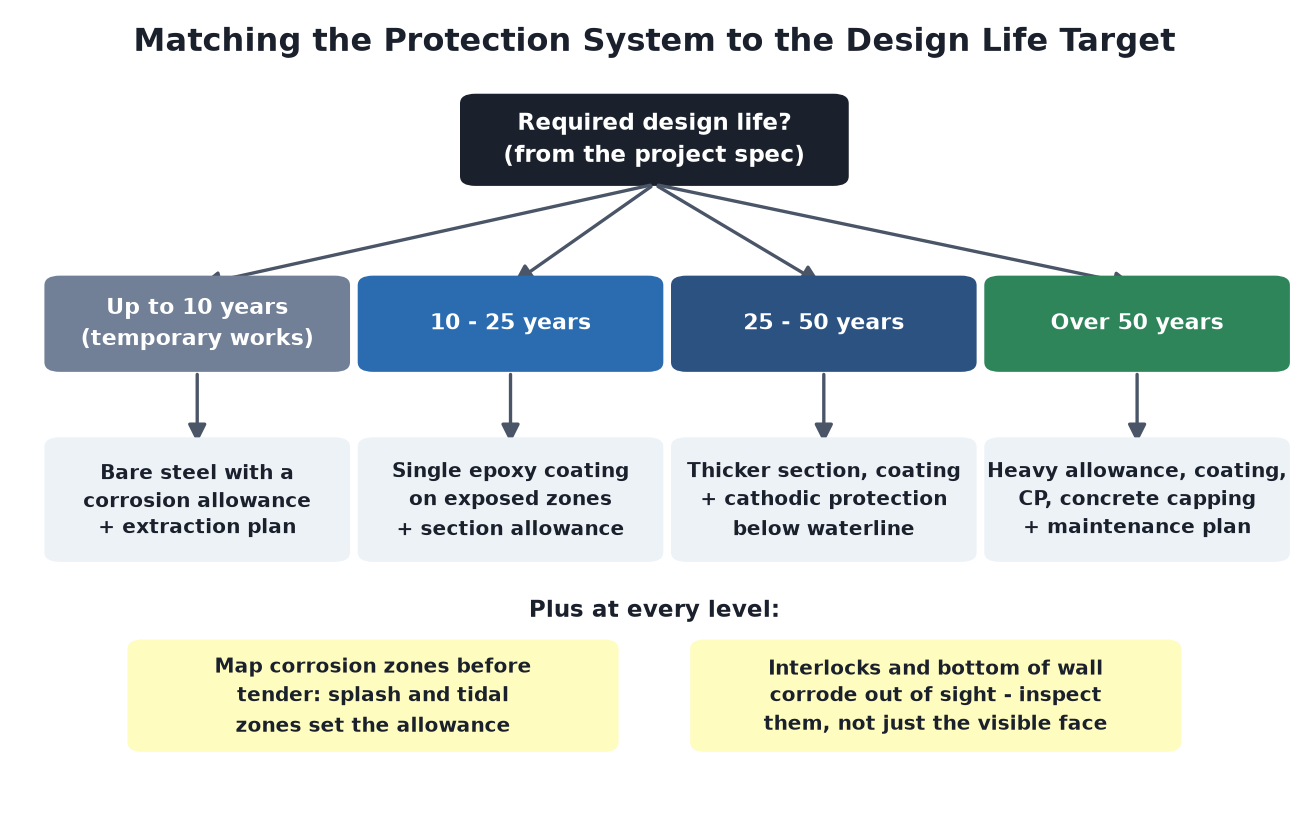
Durability starts with metal you can afford to lose. A corrosion allowance is simply extra thickness added to the design section so that rust can consume it without touching the structural core. If the design needs 10 mm and the environment will eat 3 mm per side over the design life, a 12 or 14 mm flange keeps the structure safe long after the surface has weathered. This is why I always ask about design life before quoting. European design practice treats this explicitly: Eurocode 3 Part 5 requires durability to be addressed through allowance, coating, or corrosion resistant steel at the design stage. A wall meant to stand for five years behind a temporary excavation and a quay wall meant to serve for fifty should not be quoted from the same catalogue line.
Grade matters too, but less than people think. Higher yield grades such as S355 let you use a thinner, lighter section, which is great for cost and driving speed. The catch is that a thinner flange has less metal to sacrifice. When a customer chooses a high grade thin section for a marine wall, I remind them to add back an allowance or a coating, otherwise the strength advantage disappears as the surface rusts. You can read more about the trade-offs in our guide to common steel grades for sheet piles.
Environment does most of the damage
The same pile driven in two places can age completely differently. In dry inland soil with good drainage, uncoated steel can hold its strength for most of a century. In a harbor with warm seawater, ship traffic, and salt spray, the splash zone can lose measurable thickness every year. The wall does not know its catalogue rating. It only knows where it stands. That is why the exposure assessment, not the brochure, decides the real service life of steel sheet piling in any given project.
| Factor | How it acts on the wall | What I control as a supplier |
|---|---|---|
| Section thickness | Thicker flanges give more sacrificial metal to corrosion | Offer heavier sections with proper allowance |
| Steel grade | Higher grade allows thinner sections but less reserve metal | Advise on grade vs allowance balance |
| Exposure environment | Salt, moisture, and temperature set corrosion speed | Ask for site data before quoting |
| Protection system | Coatings and cathodic protection slow metal loss dramatically | Supply coated piles and advise systems |
| Installation quality | Damaged coatings and over-driven piles create early failure points | Guide handling and driving practice |
How Does Corrosion Attack Different Zones of the Wall?
One wall, one piece of steel, and yet several different climates act on it at the same time. That is the part most spec sheets hide.
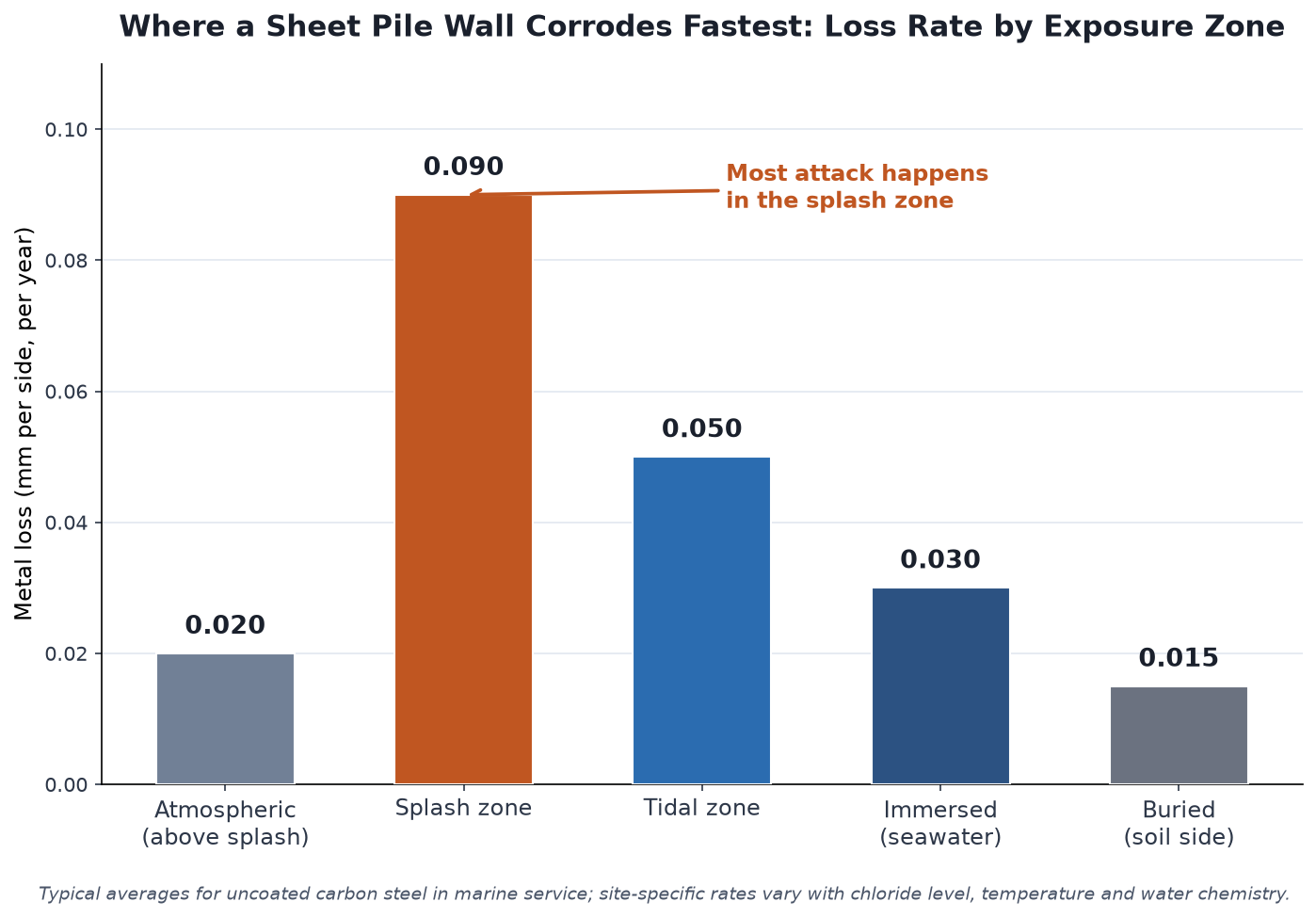
Corrosion is not uniform on a sheet pile wall. The splash zone above water corrodes fastest because it stays wet with oxygen rich salt water, while the buried toe can lose less than a tenth of that. Design the allowance zone by zone, not as one average number.
The splash zone is the battlefield
The splash zone sits between high and low water, where waves keep the steel wet but air keeps it full of oxygen. That combination is exactly what rust needs. On uncoated carbon steel in seawater, the splash band can lose around 0.08 to 0.10 mm per side per year, several times the rate below the seabed. I have inspected quay walls where the steel was still bright under the waterline while the splash band had thinned visibly and flaked. This is also why special marine grades exist: ASTM A690 steel was developed specifically to resist splash zone attack better than ordinary carbon steel.
The tidal zone behaves a bit better because it is wet almost constantly with less oxygen. The immersed zone slower still, because seawater holds less oxygen than air. And the buried zone, below the seabed or behind the wall, is usually the gentlest environment on the wall, especially in clay soils with limited oxygen movement.
Do not ignore the side you cannot see
Here is the detail that surprises people: the soil side of the wall is not always harmless. Clean sands and clays are mild, but fill material with cinders, industrial waste, or aggressive leachate can corrode almost as fast as seawater. On one redevelopment project, the land side of an old wall showed worse loss than the harbor side, purely because the fill behind it was decades of uncontrolled rubble. When I review a site, I ask what is in the ground, not just what is in the water. Our article on corrosion resistance solutions covers this assessment in more depth.
| Zone | Typical loss (mm per side, per year) | Design response |
|---|---|---|
| Atmospheric (above splash) | 0.01 – 0.03 | Coating for appearance and long term margin |
| Splash zone | 0.07 – 0.10 | Heaviest allowance, durable coating, consider A690 type steel |
| Tidal zone | 0.03 – 0.06 | Allowance plus coating, inspect from a boat or ladder |
| Immersed (seawater) | 0.02 – 0.04 | Allowance, cathodic protection works well here |
| Buried (soil side) | 0.01 – 0.02 (higher in aggressive fill) | Check fill chemistry, keep minimum allowance |
How Do You Extend Service Life Beyond the Bare Steel Baseline?
Bare steel is the cheapest option on day one and often the most expensive one over fifty years. The good news is that you can buy extra decades quite precisely.
Coatings, cathodic protection, and corrosion allowances each add decades of life. A coated wall with cathodic protection below water can realistically reach 50 years or more in seawater, at a fraction of the cost of replacing the wall early.
Coatings buy the first decades
A good epoxy or polyurethane coating slows oxygen and water at the steel surface. On projects I supply into the Middle East, a two coat epoxy system over blast cleaned steel is the standard request for permanent marine walls. The coating does not need to cover the buried toe, which saves money, but it must cover the splash and tidal bands generously. Application quality matters as much as the paint itself: a coating applied over mill scale or moisture fails early, no matter what the data sheet promises. For milder atmospheric exposure or buried service, some buyers instead consider hot-dip galvanizing on lighter structures, though it is less common on heavy marine piling.
Cathodic protection guards the underwater zones
Below the waterline, cathodic protection is beautifully simple. Sacrificial anodes or an impressed current make the whole steel surface the cathode of a controlled electrochemical cell, so the steel stops giving up its own ions. It protects immersed and buried zones very well, but it cannot do much in the splash zone, where the electrical contact with the water is intermittent. That is why the two systems are partners, not alternatives: the coating carries the splash band, the cathodic protection carries the rest. For a deeper dive into combining methods, see our article on marine engineering applications of sheet piling, and our comparison of hot rolled vs cold formed sheet piles, since interlock quality also affects long term watertightness.
Allowance and capping close the gap
The cheapest protection is simply more steel. Adding 2 or 3 mm to the flange often costs less than a premium coating system and never wears off, chips, or needs maintenance. Our dimensions and thickness guide shows how allowance changes the effective section modulus over time. Many permanent marine walls combine a modest allowance with a coating, so the coating buys the early decades and the allowance absorbs the later ones. Concrete capping beams also help more than they look: they seal the top of the wall, move the atmospheric exposure away from the interlocks, and give the wall a tidy finished edge.
| Protection method | What it adds | Best suited for |
|---|---|---|
| Corrosion allowance (extra steel) | Decades, permanently, zero maintenance | Every permanent wall, any environment |
| Epoxy coating system | 15 – 25+ years on treated zones | Splash and tidal bands of marine walls |
| Cathodic protection | Effectively stops loss below waterline | Immersed and buried zones in seawater |
| Concrete capping | Seals the wall head, cuts atmospheric attack | Permanent quay walls and flood walls |
What Does Real Project Experience Tell Us About Durability?
Numbers on a chart are useful, but walls in the ground are the honest exam. Here is what I keep seeing on real projects.
Real walls confirm the theory: buried and freshwater walls age slowly, splash zones age fast, and maintenance, not the steel grade, decides whether a wall reaches its full design life.
A riverbank wall that aged gracefully
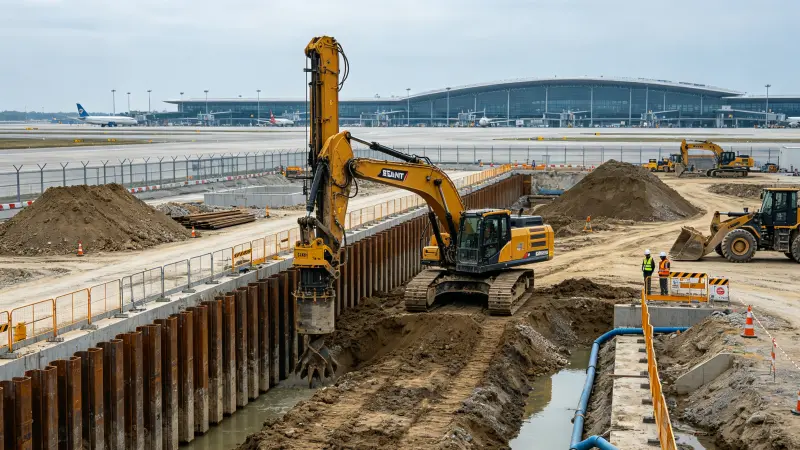
One of our repeat customers built a riverbank protection wall in Southeast Asia using hot rolled U type sheet piles, driven with vibratory equipment along a flooding river reach. The design intent was simple: stop erosion, hold the bank, survive annual flood cycles. After several flood seasons the wall has done exactly that, and the parts that matter are the ones nobody photographs. The interlocks stayed tight, so fine soil did not wash out behind the wall. The toe stayed buried in clay, where corrosion is slow, so the structural section barely changed. You can read the full story in our riverbank and flood control case study.
The lesson I take from that project is that matching the product to the environment quietly adds years. Hot rolled sections with fuller interlock types in a moderate freshwater-soil environment need far less help than a seawater wall. The customer spent money where the risk was, and nowhere else.
The walls that disappoint are usually neglected, not underdesigned
When I see a sheet pile wall in poor condition, the cause is usually visible at the wall head: no capping, damaged coating left unrepaired, debris piled against the atmospheric zone holding moisture and salt. Drifting debris and vessel impact also nick coatings, and every nick becomes a small corrosion cell. This is why I tell every permanent-wall customer to budget a small annual inspection, especially for port and harbor structures, where salt and traffic never stop. A coat of touch-up paint every few years protects the whole investment.
| Environment | What aging looks like | What it takes to reach design life |
|---|---|---|
| Freshwater riverbank | Slow, even weathering, tight interlocks preserved | Correct section, modest allowance, flood debris checks |
| Seawater harbor | Fast splash zone loss, coating wear, marine growth below | Coating, cathodic protection, scheduled inspection |
| Urban redevelopment fill | Aggressive land side loss if fill is contaminated | Test the fill, allow for it, seal the wall head |
What Is My Honest Take After Years of Supplying Sheet Piles?
My honest take is this: durability is decided at the drawing stage, not at the delivery stage. When a customer sends me a soil report, a water chemistry note, and a design life target, I can almost guarantee the wall will still be standing when its design life ends. When a customer just asks for the cheapest section that passes the structural check, I know we will have an uncomfortable conversation in fifteen years. Corrosion maps, a few millimeters of allowance, and a sensible coating cost very little compared with the wall itself. Buy them early, because buying them late is called rebuilding.
It also pays to remember that a sheet pile wall is one of the few geotechnical assets that can outlive its first project entirely. Piles extracted from a temporary works job and re-driven start their life cycle again, which is something concrete simply cannot offer. If your project is temporary, design for extraction as deliberately as you design for driving, and the same wall may serve two or three projects over the decades. Our comparison of temporary vs permanent sheet pile structures explains how the reuse cycles work, and our article on reusable steel sheet piles shows what that means in real cost and carbon terms.
Conclusion
A steel sheet piling system lasts as long as its design allows. Match allowance, coating, and protection to each exposure zone, and your wall will outlive its paperwork.
Tags: steel sheet pile service life, sheet pile durability, sheet pile corrosion zones, steel sheet pile coating, sheet pile corrosion allowance