I have seen sheet pile walls fail because the engineer did not understand the soil. It is a costly mistake. The soil pushes against the wall, and that push is called earth pressure.
Earth pressure is the horizontal force that soil exerts on a retaining structure like a sheet pile wall. This force depends on how the wall moves. The pressure can be active, passive, or at-rest.
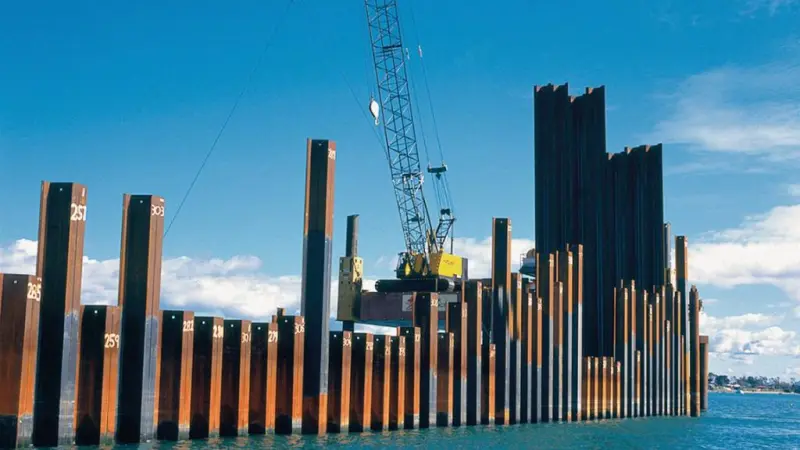
You might think the pressure is a constant number. But I have learned that it changes with the wall’s movement. Understanding this is the first step to a safe and cost-effective design. I will explain these states and show you how to calculate them.
What is meant by earth pressure?
I often hear this question from new contractors. They see soil as just dirt. But in engineering, soil is a powerful force. It pushes against any structure that holds it back.
Earth pressure is the lateral pressure that soil exerts on a retaining structure. This pressure is caused by the soil’s weight and the loads on the surface. The pressure is not a fixed value. It depends on how the structure moves.
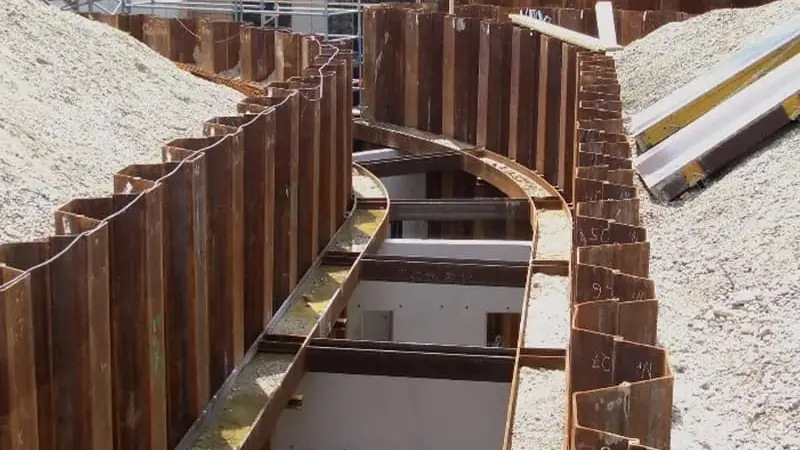
The Three States of Earth Pressure
I think of earth pressure as having three main states. Each state matches a different movement of the wall. I use these states to decide how to design the wall.
- Active Pressure: This happens when the wall moves away from the soil. The soil stretches and pushes less hard. The pressure is at its lowest point. This is the state I use to design the wall’s strength, as it is the force the wall must resist to prevent failure.
- Passive Pressure: This happens when the wall moves into the soil. The soil compresses and pushes back hard. The pressure is at its highest point. This is the state that provides the resistance to hold the wall in place.
- At-Rest Pressure: This happens when the wall does not move at all. The soil is in a neutral state. The pressure is between the active and passive values.
A study on sheet pile walls for a high-speed railway used finite element analysis to study these pressures. The researchers found that the traditional triangular pressure diagrams are not always correct. They proposed a new, simplified straight-line form that considers the effect of the sheet.
Why Movement Matters
The key to understanding earth pressure is movement. The wall must move a little to reach the active state. This movement is called the "active wall movement." For a cantilever wall, this movement is about 0.1% to 0.4% of the wall height. For a propped wall, it is about 0.1% to 0.2%.
I have seen designers ignore this. They assume the wall is rigid and does not move. This leads to an overestimation of the pressure. It makes the design more expensive than it needs to be. On the other hand, if you assume too much movement, you might underestimate the pressure and create an unsafe design. It is a balance that I always consider carefully.
When to use earth pressure at rest?
This is a question that comes up when a wall is very stiff. It is a condition where you cannot rely on movement to reduce the pressure.
Use the at-rest pressure when the wall is rigid and does not move. This is common for massive concrete walls, basement walls connected to stiff floors, and for calculating settlement.
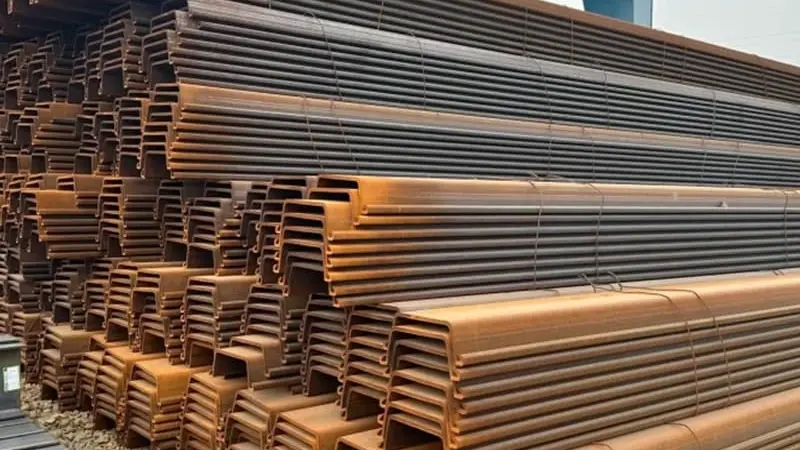
Understanding the At-Rest State
The at-rest state is the baseline. It is the pressure that exists in the ground before any construction. It is also the pressure on a wall that does not yield. The at-rest pressure is often higher than the active pressure. This means it is a more conservative design assumption.
Jaky’s formula is the most common way to estimate the at-rest coefficient (K0). For normally consolidated soils, the formula is:
K0 = 1 – sin(φ)
where φ is the soil’s friction angle.
However, I have to be careful with this formula. It works well for loose sand. But for dense, compacted sand, it can underestimate the pressure. I learned this when I saw a compacted fill push a rigid wall more than expected. The compaction process locked in higher horizontal stresses.
Research on this topic confirms this issue. Studies have shown that Jaky’s formula may not apply to all soils, especially those that are heavily compacted. In these cases, a more detailed analysis is necessary.
Practical Applications
I see two main cases where I use at-rest pressure.
- Rigid Structures: These are structures that cannot move. Examples include massive gravity walls and basement walls that are tied into a floor slab at the top and bottom. The wall’s stiffness prevents the movement needed to reach the active state.
- Initial Stress State: This is used for predicting settlements or ground movements before any excavation starts. The soil is in its natural state, and it has not been disturbed. This is the starting point for any numerical analysis, such as finite element modeling.
I also keep in mind that for sheet pile walls, the at-rest state is usually only valid in the upper part of the wall. The part below the excavation is in the passive state. The part behind the wall is in the active state. This zone of influence is the foundation of my design.
How to calculate earth pressure?
I often use a step-by-step method to calculate earth pressure. It is not just about picking a formula. It is about understanding the soil and the wall’s behavior.
The calculation starts by determining the vertical stress at a given depth. Then, you multiply that stress by the appropriate earth pressure coefficient. The coefficient you choose depends on the wall movement and the soil type.
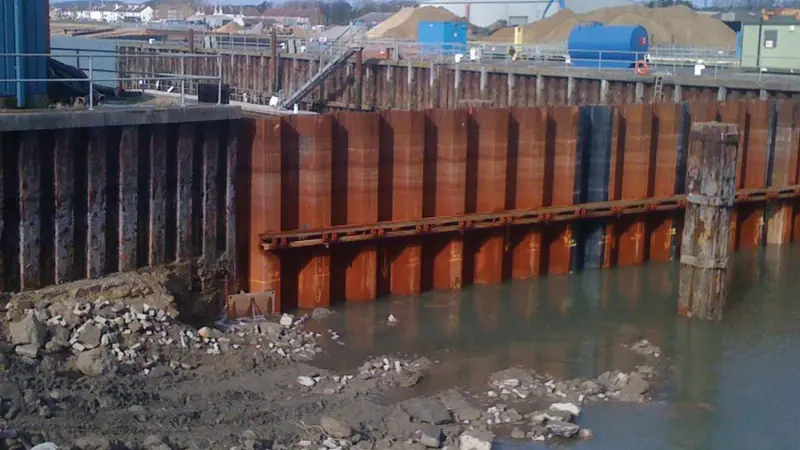
The Basic Formula
The fundamental equation I use is simple:
σh = K * σv
Where σh is the horizontal earth pressure, σv is the vertical effective stress, and K is the earth pressure coefficient. The vertical stress is just the weight of the soil above that point. This formula is the core of all my calculations.
The challenge is picking the right "K". For active pressure, I use Ka. For passive, I use Kp. For at-rest, I use K0.
Choosing the Right Theory
I have two main theories to pick from.
- Rankine’s Theory: This is the simpler one. It assumes the wall is frictionless. The formulas are:
- Ka = (1 – sin φ) / (1 + sin φ)
- Kp = (1 + sin φ) / (1 – sin φ)
- Coulomb’s Theory: This is more advanced. It accounts for wall friction. The formulas are more complex. I use this when I need a more accurate result.
I generally start with Rankine for a quick estimate. Then I might check it against Coulomb, especially if the wall has significant friction. I also consider the soil type. The Japanese standard, for example, has separate formulas for sandy and cohesive soils. This is a good practice that I follow.
A More Realistic Approach
The traditional methods assume a triangular pressure distribution. But I have found that this is not always accurate. A study on sheet pile walls showed that the sheet’s location and the pile stiffness affect the pressure distribution.
The study proposed a simplified straight-line form for the earth pressure diagram. This was based on a 3D finite element model. It considered the "sheet effect," which is the interaction between the soil and the wall.
This is a more realistic approach. It accounts for things like soil arching. Arching happens when the soil transfers load around a stiff element. It can reduce the pressure on the wall. Ignoring arching can lead to an over-designed and expensive wall.
A Practical Example
I will use a simple example to show the process.
| Depth (m) | Soil Type | Unit Weight (kN/m³) | σv (kPa) | Ka | σh (kPa) |
|---|---|---|---|---|---|
| 0.0 | Sand | 18 | 0 | 0.33 | 0 |
| 2.0 | Sand | 18 | 36 | 0.33 | 11.9 |
| 4.0 | Sand | 18 | 72 | 0.33 | 23.8 |
| 6.0 | Clay | 20 | 120 | 0.5 | 60.0 |
This table shows how the pressure increases with depth. I can use this data to find the total force on the wall. Then I can design the sheet pile to resist that force.
What is the rule of thumb for sheet pile embedment depth?
I still use rules of thumb. They are good for quick estimates. But I always warn my clients that these are not final answers. They are just a starting point.
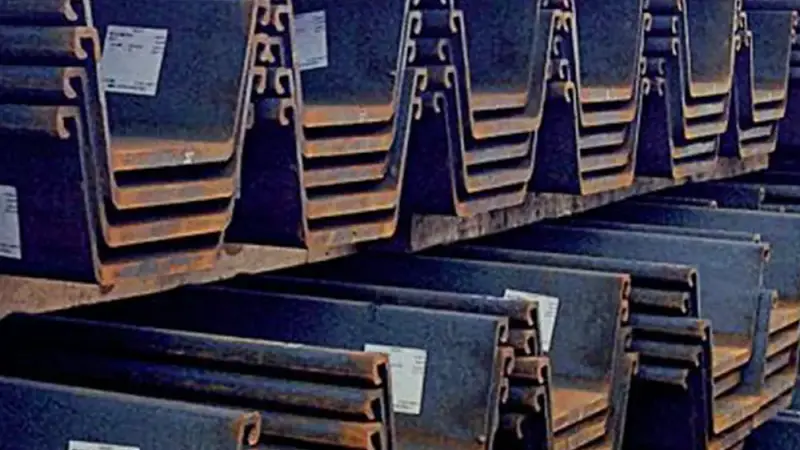
A common rule of thumb is that the embedment depth for a cantilevered wall is about two-thirds of the total pile length. For an anchored wall, the embedment depth is often between 20% and 75% of the distance from the tie rod to the bottom.
Historical and Practical Rules
I often hear the "1/3 above, 2/3 below" rule for cantilevered walls. This means that one-third of the pile is above the excavation, and two-thirds is embedded. This is a very old rule. It comes from a time when detailed calculations were not common.
For anchored walls, the rule is more varied. It depends on the soil and the project. The embedment depth is often between 20% and 75% of the distance from the tie rod to the bottom. The exact number depends on the soil conditions.
I also look at other guidelines. The EAU 1996 recommendations state that the embedment depth for intermediate piles in good bearing soil should be at least 2.5 meters. This is a minimum value that ensures the pile has enough lateral support.
Using Rules in Practice
I use these rules as a sanity check. If my detailed calculation gives a depth that is wildly different from the rule, I know I need to re-examine my assumptions. For instance, if I calculate a depth that is only 10% of the pile length, I would be suspicious.
I also adjust the rule for specific conditions. For waterfront structures in hurricane zones, the embedment is often increased. A recent article suggested that in soft mud, the embedment should be at least 1.5 times the combined surge and wave height. This shows that the environment plays a huge role.
I also use normalized relationships for a more accurate estimate. These are non-dimensional charts that I can use to find the required depth quickly. They are based on the soil properties and the wall height. They save me from doing a full trial-and-error calculation for a simple estimate.
Conclusion
Earth pressure is the key to sheet pile design. You must understand the active, passive, and at-rest states. And remember, rules of thumb are just a starting point.