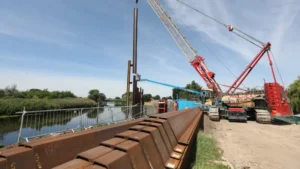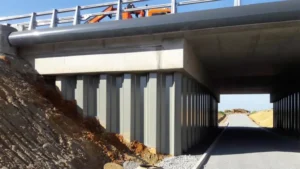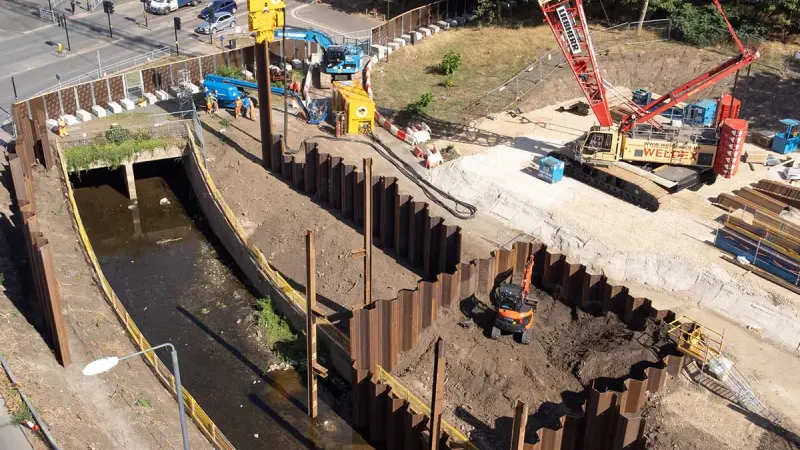
You are standing in a dense city center. On one side is a 100-year-old building with cracks in its walls. On the other side is a hospital with sensitive equipment. You need to drive sheet piles for a new basement. The vibration from pile driving could damage both structures.
Vibration control during sheet pile driving in urban areas is achieved through method selection, monitoring, and mitigation measures. Press-in (silent piling) methods produce almost no vibration. Vibratory hammers produce low vibration. Impact hammers produce the highest vibration and are often restricted in urban areas. Pre-drilling and jetting can also reduce vibration.
](https://cnsteelplant.com/wp-content/uploads/2026/03/Article-Application-City-4.webp)
I have worked on urban projects where vibration control was critical. A metro project in Singapore used press-in piling1 next to a historic mosque. A high-rise foundation in London used vibratory hammers with strict monitoring. Let me walk you through how to control vibration during sheet pile driving in urban areas.
What is vibration monitoring1 in construction?
Vibration monitoring in construction is the measurement and recording of ground vibrations caused by construction activities2 like pile driving, blasting, or demolition.
Vibration monitoring uses sensors (geophones3 or accelerometers) placed on the ground or on adjacent structures to measure particle velocity, acceleration, and frequency. The measurements are compared to established limits (typically 5-25 mm/s peak particle velocity4 for buildings). Monitoring provides real-time data to ensure construction activities2 do not exceed safe limits.
[^1] equipment on construction site](https://placehold.co/600x400 "Vibration Monitoring")](https://cnsteelplant.com/wp-content/uploads/2026/03/Article-Application-City-3.webp)
How Vibration Monitoring Works
Let me explain the components and process of vibration monitoring1.
Monitoring Equipment
| Equipment | Function | Typical Placement |
|---|---|---|
| Geophone | Measures particle velocity | Ground surface |
| Accelerometer | Measures acceleration | Building foundation |
| Data logger | Records measurements | On-site or remote |
| Software | Analyzes data | Office computer |
Key Parameters Measured
| Parameter | Unit | Description |
|---|---|---|
| Peak particle velocity (PPV) | mm/s or in/s | Maximum velocity of ground movement |
| Frequency | Hz | Number of cycles per second |
| Acceleration | g or m/s² | Rate of change of velocity |
| Displacement | mm | Distance of movement |
Monitoring Process
- Install sensors at critical locations
- Establish baseline measurements before construction
- Monitor continuously during pile driving
- Compare measurements to allowable limits
- Alert if limits are exceeded
- Adjust construction methods if needed
Typical Vibration Limits
| Structure Type | PPV Limit (mm/s) |
|---|---|
| Historic buildings | 2-5 |
| Residential buildings | 5-10 |
| Commercial buildings | 10-15 |
| Industrial buildings | 15-25 |
| Underground utilities | 25-50 |
My Experience
For a project adjacent to a historic building, we installed geophones3 on the building foundation and at several points on the ground. We set a limit of 5 mm/s PPV. When the vibratory hammer exceeded this at one location, we switched to press-in piling for that section.
What are the damage effects of pile driving vibrations1?
Pile driving vibrations can damage adjacent structures if the vibration levels exceed the structure’s capacity to absorb energy.
The damage effects of pile driving vibrations1 include cracking of plaster and masonry, settlement of foundations, damage to underground utilities, and disturbance of sensitive equipment. The severity depends on vibration amplitude2, frequency, soil conditions, and building condition. Older buildings are more vulnerable than modern structures.
](https://cnsteelplant.com/wp-content/uploads/2026/03/Article-Application-City-2.webp)
Types of Damage and Thresholds
Let me explain the types of damage and the vibration levels that cause them.
Types of Damage
| Damage Type | Description | Typical PPV Threshold |
|---|---|---|
| Cosmetic cracks | Fine cracks in plaster, paint | 2-5 mm/s |
| Minor structural | Cracks in masonry, mortar joints | 5-10 mm/s |
| Major structural | Cracks through bricks, concrete spalling | 10-25 mm/s |
| Utility damage | Broken pipes, cable damage | 25-50 mm/s |
| Settlement | Foundation movement | Depends on soil |
Factors Affecting Damage
| Factor | Effect |
|---|---|
| Building age | Older buildings have weaker mortar |
| Building condition | Preexisting cracks are more vulnerable |
| Soil type | Sandy soils transmit vibration more than clay |
| Distance | Vibration decreases with distance |
| Frequency | Low frequency (under 10 Hz) causes more damage |
Distance and Vibration Attenuation
- Vibration amplitude decreases with distance
- At 5 m: 100% of source amplitude
- At 10 m: 50% of source amplitude
- At 20 m: 25% of source amplitude
- At 50 m: 10% of source amplitude
Comparison of Pile Driving Methods
| Method | Typical PPV at 10 m (mm/s) | Damage Risk |
|---|---|---|
| Impact hammer | 10-50 | High |
| Vibratory hammer | 2-10 | Moderate |
| Press-in (silent) | <1 | Low |
My Experience
On a project with a nearby historic building, impact hammer driving3 produced 15 mm/s PPV at 15 m distance. We switched to a vibratory hammer, which reduced PPV to 5 mm/s. For the closest piles (5 m from the building), we used press-in piling with PPV under 1 mm/s.
How to control vibration on construction sites?
Vibration on construction sites is controlled through method selection, mitigation measures, monitoring, and planning.
Vibration control methods include choosing low-vibration equipment1 (press-in, vibratory), pre-drilling to reduce driving resistance, using wave barriers2 (trenches or sheet piles) to block vibration transmission, and adjusting driving sequences to avoid cumulative effects. Real-time monitoring allows immediate adjustments if vibration limits are exceeded.
](https://cnsteelplant.com/wp-content/uploads/2026/03/Article-Application-City-1.webp)
Vibration Control Techniques
Let me explain the most effective vibration control techniques.
Method Selection
| Method | Vibration Level | Best For |
|---|---|---|
| Press-in (silent) | Very low | Sensitive structures, historic buildings |
| Vibratory hammer | Low | Most urban sites |
| Impact hammer | High | Rural sites, hard soils |
| Jetting | Low to moderate | Sandy soils, reducing driving resistance |
Mitigation Measures
| Measure | How It Works | Effectiveness |
|---|---|---|
| Pre-drilling | Removes soil, reduces driving resistance | High |
| Wave barriers | Trenches or sheet piles block vibration | Moderate |
| Cushioning material | Rubber pad between hammer and pile | Low to moderate |
| Sequential driving | Allows soil to stabilize between blows | Moderate |
Planning Measures
- Conduct pre-construction building surveys
- Establish vibration limits before work begins
- Plan driving sequence to keep distance from sensitive structures
- Schedule high-vibration work for times when structures are unoccupied
Wave Barriers
- Open trench: 0.5-1.0 m wide, depth to bedrock or 2-3 m
- Filled trench: Sand or gravel fill
- Sheet pile barrier: Driven sheet piles between source and structure
My Experience
For a project adjacent to a hospital, we used multiple control measures:
- Press-in piling for the first 10 m from the hospital
- Vibratory hammer beyond 10 m
- Pre-drilling through a gravel layer to reduce resistance
- Continuous monitoring with alerts at 3 mm/s PPV
- Wave barrier trench between the site and hospital
How noisy is pile driving?
Pile driving noise levels vary significantly by method. Impact hammer1s are the loudest, while press-in methods are almost silent.
Pile driving noise levels: impact hammer 90-120 dB at 10 m (loud as a rock concert), vibratory hammer 80-100 dB at 10 m (loud as heavy traffic), press-in piling 60-70 dB at 10 m (normal conversation). Urban noise ordinances often restrict pile driving to daytime hours and may prohibit impact hammers entirely.
](https://cnsteelplant.com/wp-content/uploads/2026/03/Article-Application-City-6.webp)
Noise Levels by Method
Let me provide detailed noise level data for different pile driving methods.
Typical Noise Levels
| Method | Noise at 10 m (dB) | Noise at 30 m (dB) | Comparable Sound |
|---|---|---|---|
| Impact hammer1 | 90-120 | 80-100 | Rock concert, chainsaw |
| Vibratory hammer2 | 80-100 | 70-85 | Heavy traffic, vacuum cleaner |
| Press-in (silent) | 60-70 | 50-60 | Normal conversation, office |
| Jetting | 70-85 | 60-75 | Busy street |
Noise Ordinances3 (Typical)
| Time | Allowable Noise (dB) | Typical Restrictions |
|---|---|---|
| Daytime (7 am – 7 pm) | 75-85 | Vibratory hammer2s allowed |
| Evening (7 pm – 10 pm) | 65-75 | Restricted, may need permit |
| Night (10 pm – 7 am) | 55-65 | Impact hammer1s prohibited |
| Weekend | 65-75 | Reduced hours |
| Measure | Noise Reduction | Notes |
|---|---|---|
| Sound blankets | 5-10 dB | Wrap around hammer |
| Enclosures | 10-20 dB | Full enclosure of hammer |
| Bubble curtains | 10-15 dB | For underwater driving |
| Distance | 6 dB per doubling | Move equipment away |
My Experience
For a residential area project, we were limited to 75 dB at the property line. Impact hammer1s exceeded this (95 dB), so they were prohibited. Vibratory hammer2s were allowed during daytime hours (85 dB). For early morning work, we used press-in piling (65 dB), which complied with the 70 dB limit.
Conclusion
Vibration control1 during sheet pile driving in urban areas requires careful method selection, monitoring, and mitigation. Press-in piling produces the lowest vibration and noise. Vibratory hammers are acceptable for most urban sites. Impact hammers are often restricted. Use real-time monitoring2 to ensure compliance with limits and protect adjacent structures.
-
Understanding vibration control techniques is crucial for minimizing impact on nearby structures and ensuring compliance with regulations. ↩ ↩ ↩ ↩ ↩ ↩ ↩ ↩ ↩ ↩ ↩
-
Exploring real-time monitoring can enhance safety measures and compliance, making it essential for effective construction management. ↩ ↩ ↩ ↩ ↩ ↩ ↩ ↩
-
Understanding noise ordinances is vital for construction projects to ensure compliance and minimize community disruption. ↩ ↩ ↩ ↩
-
Discover various noise control measures that can help mitigate the impact of pile driving on surrounding areas. ↩ ↩