You have just finished the geotechnical analysis for a retaining wall. The maximum bending moment is on your screen. Now you need to pick a sheet pile section that can handle that moment without bending too much or failing.
The section modulus1 (S) is the most important number in sheet pile selection2. It tells you how much bending moment a wall can resist per meter of length. You calculate the required section modulus1 by dividing the maximum bending moment by the allowable stress in the steel.
[^1] chart with cross section diagrams](https://placehold.co/600x400 "Steel Sheet Pile Section Modulus Chart")](https://cnsteelplant.com/wp-content/uploads/2026/03/Article-Application-Port-2.webp)
I have used section modulus1 charts on countless projects. The riverbank project in Southeast Asia required S = 1,450 cm³/m, so we chose U 400 x 125 with S = 1,590 cm³/m. A port project in the Middle East needed S = 2,600 cm³/m, so we selected AZ 26. Let me walk you through the complete section modulus1 charts for both U and Z type sheet piles.
Sheet pile weight per meter
The weight per meter of a sheet pile is directly tied to its section modulus1, but the relationship is different for U and Z profiles.
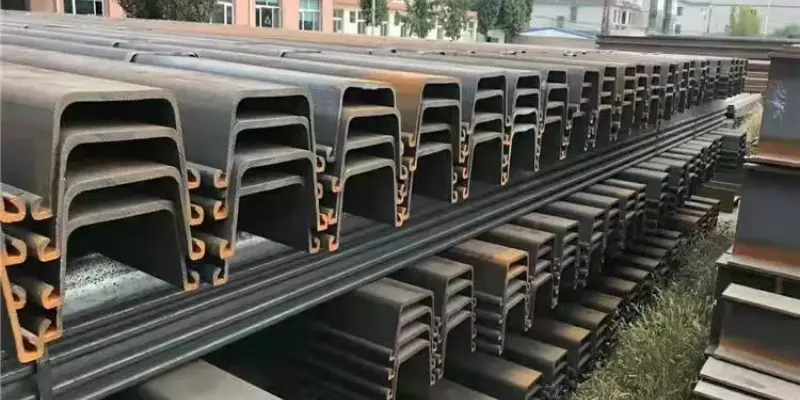
Sheet pile weight per meter ranges from about 40 kg/m for light sections to over 200 kg/m for heavy sections. For U type piles, weight ranges from 48 kg/m (U 400 x 100) to 106 kg/m (U 600 x 210). For Z type piles, weight ranges from 58 kg/m (AZ 12) to 211 kg/m (AZ 50). Z piles generally achieve higher section modulus1 per kilogram of steel, which means you get more strength for the same weight.
[^2] comparison chart](https://placehold.co/600x400 "Sheet Pile Weight per Meter")](https://cnsteelplant.com/wp-content/uploads/2026/03/Article-images-4.webp)
Weight vs Section Modulus Comparison
Let me show you how weight and section modulus1 relate for different pile types.
U Type Sheet Piles3 – Weight and Section Modulus
| Section | Width (mm) | Height (mm) | Weight (kg/m) | S (cm³/m) | Efficiency (S per kg) |
|---|---|---|---|---|---|
| U 400 x 100-10.5 | 400 | 100 | 48.0 | 1,080 | 22.5 |
| U 400 x 125-13 | 400 | 125 | 60.0 | 1,590 | 26.5 |
| U 400 x 170-15.5 | 400 | 170 | 76.1 | 2,470 | 32.5 |
| U 600 x 130-10.3 | 600 | 130 | 61.8 | 2,350 | 38.0 |
| U 600 x 180-13.4 | 600 | 180 | 81.6 | 3,820 | 46.8 |
| U 600 x 210-18 | 600 | 210 | 106.2 | 5,730 | 54.0 |
Notice how the efficiency (section modulus1 per kg) increases with section height. The U 600 x 210 achieves 54 cm³/m per kg, which is very efficient.
Z Type Sheet Piles4 – Weight and Section Modulus (AZ Series)
| Section | Width (mm) | Height (mm) | Weight (kg/m) | S (cm³/m) | Efficiency (S per kg) |
|---|---|---|---|---|---|
| AZ 12 | 630 | 260 | 57.8 | 1,200 | 20.8 |
| AZ 18 | 670 | 345 | 75.0 | 1,800 | 24.0 |
| AZ 26 | 670 | 396 | 109.0 | 2,600 | 23.9 |
| AZ 34 | 670 | 444 | 143.0 | 3,400 | 23.8 |
| AZ 42 | 670 | 487 | 177.0 | 4,200 | 23.7 |
| AZ 50 | 670 | 529 | 211.0 | 5,000 | 23.7 |
Z piles maintain a consistent efficiency of about 24 cm³/m per kg across all sections. For very high section moduli (over 4,000), U piles become more efficient. For medium range (1,500-3,000), Z piles are often more efficient.
What This Means for Your Design
- For S 4,000 cm³/m: U piles (600 series) are more efficient
My Experience
When we needed S = 5,000 cm³/m for a deep wall, we compared U 600 x 210 (106 kg/m) with AZ 50 (211 kg/m). The U pile was much lighter. But for S = 2,600 cm³/m, AZ 26 (109 kg/m) and U 400 x 170-15.5 (76 kg/m) were both options. The U pile was lighter but had a narrower width (400 vs 670 mm). We chose the Z pile because it meant fewer piles to drive.
Steel Sheet pile specifications
Steel sheet pile specifications tell you exactly what you need to order. The section modulus1 is usually the key number.
Steel sheet pile specifications include the required section modulus1, the pile type (U or Z), dimensions, steel grade2, and interlock type3. A well-written specification ensures that the supplied piles meet the structural requirements of the design without wasting steel.
[^1]](https://placehold.co/600x400 "Steel Sheet Pile Specifications")](https://cnsteelplant.com/wp-content/uploads/2026/03/Article-Application-City-6.webp)
How to Write a Section Modulus Specification
Here is a sample specification that focuses on the structural requirements.
1. Structural Requirements
The sheet pile wall shall be designed for the maximum bending moment determined from the geotechnical analysis. The required section modulus1 is calculated as:
Srequired = Mmax / σallowable
Where:
- Mmax = maximum bending moment (kN-m/m)
- σallowable = allowable stress in steel (MPa)
For ASTM A328 steel (240 MPa yield) with a safety factor of 1.5:
σallowable = 240 / 1.5 = 160 MPa = 160,000 kN/m²
2. Section Selection
Provide sheet piles with section modulus1 S ≥ Srequired. Acceptable sections include those listed in the manufacturer’s data sheets with certified section moduli.
3. Steel Grade
- ASTM A328 for standard applications
- ASTM A572 Grade 50 for higher strength
- ASTM A690 for marine environments
- EN 10248 S355GP for European projects
4. Interlock
- U type: Larssen ball-and-socket
- Z type: Ball-and-socket (PZC, AZ) or hook-and-grip (PZ)
5. Tolerances
The section modulus1 shall be based on nominal dimensions. Actual section modulus1 shall not be less than 95% of the nominal value.
Sample Specification for a Project
My Experience
When I receive a specification that says "S ≥ 2,500 cm³/m," I know exactly which sections to quote. I can provide U 400 x 170-15.5 (S = 2,470) or U 600 x 180-12 (S = 3,510) or AZ 26 (S = 2,600). The engineer then chooses based on width, weight, and availability.
Sheet pile type 4 specification
Type 41 is a historical designation for U-type sheet piles that is still used in many specifications, particularly in Asia and the Middle East.
Sheet pile type 4 has a section modulus of approximately 2,470 cm³/m, weight of 76.1 kg/m, width of 400 mm, and height of 170 mm. It is equivalent to U 400 x 170-15.52 in modern designation. Type 41 is commonly used for retaining walls, port structures, and permanent marine walls.
](https://cnsteelplant.com/wp-content/uploads/2026/03/Comparison-Table-of-Article-Information-1.webp)
Complete Type Specifications
Here are the common Type designations with their properties.
| Type | Width (mm) | Height (mm) | Thickness (mm) | Weight (kg/m) | S (cm³/m) | I (cm⁴/m) |
|---|---|---|---|---|---|---|
| Type 2 | 400 | 100 | 10.5 | 48.0 | 1,080 | 5,400 |
| Type 3 | 400 | 125 | 13.0 | 60.0 | 1,590 | 9,900 |
| Type 41 | 400 | 170 | 15.5 | 76.1 | 2,470 | 21,000 |
| Type 5 | 400 | 170 | 18.0 | 86.0 | 2,800 | 23,800 |
| Type 6 | 600 | 180 | 13.4 | 81.6 | 3,820 | 34,400 |
| Type 7 | 600 | 210 | 18.0 | 106.2 | 5,730 | 60,200 |
How to Read Type Specifications
- Type number increases with strength
- Type 2 is light, Type 7 is heavy
- The properties are standardized across Japanese and Asian mills
- Type 41 is one of the most common for permanent walls
Modern Equivalents
If a specification calls for Type 41, you can supply:
- U 400 x 170-15.52 (EN 10248)
- U 400 x 170 (ASTM A328)
- Any equivalent section with S ≥ 2,470 cm³/m and 400 mm width
My Experience
I still see Type 41 specifications on projects in Southeast Asia and the Middle East. The riverbank project used Type 3 (U 400 x 125). For a larger project, Type 41 would be the next step up. Knowing the Type system helps me match historical specifications to modern products.
Sheet pile size chart
A sheet pile size chart1 puts all the key properties in one place: dimensions, weight, section modulus2, and moment of inertia3.
A sheet pile size chart1 lists each section with its width, height, thickness, weight per meter, section modulus2 (S), and moment of inertia3 (I). It allows engineers and contractors to quickly compare sections and select the appropriate pile for their project.
[^1] with all dimensions and properties table](https://placehold.co/600x400 "Sheet Pile Size Chart")](https://cnsteelplant.com/wp-content/uploads/2026/03/Article-Application-River-Embankment-3.webp)
Complete Size Chart – U Type4
| Section | Width (mm) | Height (mm) | Thick (mm) | Weight (kg/m) | S (cm³/m) | I (cm⁴/m) |
|---|---|---|---|---|---|---|
| U 400 x 100 | 400 | 100 | 8.0 | 40.0 | 900 | 4,500 |
| U 400 x 100 | 400 | 100 | 10.5 | 48.0 | 1,080 | 5,400 |
| U 400 x 100 | 400 | 100 | 12.0 | 54.0 | 1,220 | 6,100 |
| U 400 x 125 | 400 | 125 | 10.0 | 50.0 | 1,330 | 8,300 |
| U 400 x 125 | 400 | 125 | 13.0 | 60.0 | 1,590 | 9,900 |
| U 400 x 125 | 400 | 125 | 15.0 | 68.0 | 1,800 | 11,300 |
| U 400 x 170 | 400 | 170 | 11.0 | 55.0 | 1,790 | 15,200 |
| U 400 x 170 | 400 | 170 | 13.5 | 65.0 | 2,120 | 18,000 |
| U 400 x 170 | 400 | 170 | 15.5 | 76.1 | 2,470 | 21,000 |
| U 400 x 170 | 400 | 170 | 18.0 | 86.0 | 2,800 | 23,800 |
| U 600 x 130 | 600 | 130 | 8.0 | 50.0 | 1,910 | 12,400 |
| U 600 x 130 | 600 | 130 | 10.3 | 61.8 | 2,350 | 15,300 |
| U 600 x 130 | 600 | 130 | 12.0 | 70.0 | 2,680 | 17,400 |
| U 600 x 180 | 600 | 180 | 10.0 | 65.0 | 3,040 | 27,400 |
| U 600 x 180 | 600 | 180 | 12.0 | 75.0 | 3,510 | 31,600 |
| U 600 x 180 | 600 | 180 | 13.4 | 81.6 | 3,820 | 34,400 |
| U 600 x 180 | 600 | 180 | 15.0 | 90.0 | 4,210 | 37,900 |
| U 600 x 210 | 600 | 210 | 13.0 | 85.0 | 4,580 | 48,100 |
| U 600 x 210 | 600 | 210 | 15.0 | 95.0 | 5,120 | 53,800 |
| U 600 x 210 | 600 | 210 | 18.0 | 106.2 | 5,730 | 60,200 |
Complete Size Chart – Z Type5 (AZ Series)
| Section | Width (mm) | Height (mm) | Thick (mm) | Weight (kg/m) | S (cm³/m) | I (cm⁴/m) |
|---|---|---|---|---|---|---|
| AZ 12 | 630 | 260 | 7.0 | 57.8 | 1,200 | 15,600 |
| AZ 13 | 670 | 305 | 7.0 | 57.8 | 1,300 | 19,800 |
| AZ 14 | 670 | 308 | 7.5 | 62.0 | 1,400 | 21,500 |
| AZ 16 | 670 | 322 | 8.0 | 66.5 | 1,600 | 25,800 |
| AZ 18 | 670 | 345 | 9.0 | 75.0 | 1,800 | 31,000 |
| AZ 20 | 670 | 358 | 10.0 | 83.5 | 2,000 | 35,800 |
| AZ 22 | 670 | 367 | 11.0 | 92.0 | 2,200 | 40,400 |
| AZ 24 | 670 | 378 | 12.0 | 100.5 | 2,400 | 45,400 |
| AZ 26 | 670 | 396 | 13.0 | 109.0 | 2,600 | 51,500 |
| AZ 28 | 670 | 408 | 14.0 | 117.5 | 2,800 | 57,200 |
| AZ 30 | 670 | 422 | 15.0 | 126.0 | 3,000 | 63,300 |
| AZ 34 | 670 | 444 | 17.0 | 143.0 | 3,400 | 75,500 |
| AZ 38 | 670 | 465 | 19.0 | 160.0 | 3,800 | 88,400 |
| AZ 42 | 670 | 487 | 21.0 | 177.0 | 4,200 | 102,300 |
| AZ 46 | 670 | 508 | 23.0 | 194.0 | 4,600 | 116,800 |
| AZ 50 | 670 | 529 | 25.0 | 211.0 | 5,000 | 132,300 |
Complete Size Chart – Z Type5 (PZC Series6)
| Section | Width (in) | Width (mm) | Height (in) | Weight (lb/ft) | Weight (kg/m) | S (in³/ft) | S (cm³/m) |
|---|---|---|---|---|---|---|---|
| PZC 12 | 27.88 | 708 | 12.52 | 46.4 | 69.1 | 12.8 | 2,210 |
| PZC 13 | 27.88 | 708 | 12.56 | 50.4 | 75.0 | 14.5 | 2,500 |
| PZC 14 | 27.88 | 708 | 12.60 | 55.0 | 81.9 | 16.3 | 2,810 |
| PZC 17 | 25.00 | 635 | 15.21 | 46.4 | 69.1 | 17.4 | 3,000 |
| PZC 18 | 25.00 | 635 | 15.25 | 50.4 | 75.0 | 19.5 | 3,360 |
| PZC 19 | 25.00 | 635 | 15.30 | 55.0 | 81.9 | 21.7 | 3,740 |
| PZC 26 | 27.88 | 708 | 17.70 | 73.9 | 110.0 | 28.8 | 4,960 |
| PZC 28 | 27.88 | 708 | 18.00 | 80.4 | 119.7 | 33.4 | 5,750 |
| PZC 29 | 27.88 | 708 | 18.20 | 84.0 | 125.0 | 36.5 | 6,290 |
How to Use the Size Chart
- Calculate required section modulus2: S = Mmax / σallowable
- Find a section with S ≥ required value
- Check weight for handling and shipping
- Verify width for wall length calculation (Number of piles = wall length ÷ width)
Sheet pile weight calculator
A sheet pile weight calculator1 helps you quickly determine the total weight2 for ordering, shipping, and handling.
To calculate sheet pile weight, multiply the weight per meter3 by the length of each pile, then multiply by the number of piles. For a wall, total piles = wall length ÷ pile width. The total weight2 determines shipping cost4 and crane requirements.
[^1] formula and example diagram](https://placehold.co/600x400 "Sheet Pile Weight Calculator")](https://cnsteelplant.com/wp-content/uploads/2026/03/Article-Application-City-2.webp)
Weight Calculation Formulas
Here are the formulas you need for accurate calculations.
Single Pile Weight
Example:
720 kg × 250 piles = 180,000 kg = 180 metric tons
Quick Reference Table – Single Pile Weights
| Pile Section | Weight (kg/m) | 10m Pile (kg) | 12m Pile (kg) | 15m Pile (kg) | 18m Pile (kg) |
|---|---|---|---|---|---|
| U 400 x 100-10.5 | 48.0 | 480 | 576 | 720 | 864 |
| U 400 x 125-13 | 60.0 | 600 | 720 | 900 | 1,080 |
| U 400 x 170-15.5 | 76.1 | 761 | 913 | 1,142 | 1,370 |
| U 600 x 130-10.3 | 61.8 | 618 | 742 | 927 | 1,112 |
| U 600 x 180-13.4 | 81.6 | 816 | 979 | 1,224 | 1,469 |
| U 600 x 210-18 | 106.2 | 1,062 | 1,274 | 1,593 | 1,912 |
| AZ 18 | 75.0 | 750 | 900 | 1,125 | 1,350 |
| AZ 26 | 109.0 | 1,090 | 1,308 | 1,635 | 1,962 |
| PZC 13 | 75.0 | 750 | 900 | 1,125 | 1,350 |
| PZC 26 | 110.0 | 1,100 | 1,320 | 1,650 | 1,980 |
Quick Reference Table – Wall Weights (per 100 m of wall)
| Pile Section | Width (m) | Piles per 100m | Weight (kg/m) | 12m Length Total (tons) | 15m Length Total (tons) |
|---|---|---|---|---|---|
| U 400 x 125-13 | 0.40 | 250 | 60.0 | 180 | 225 |
| U 400 x 170-15.5 | 0.40 | 250 | 76.1 | 228 | 285 |
| U 600 x 180-13.4 | 0.60 | 167 | 81.6 | 163 | 204 |
| U 600 x 210-18 | 0.60 | 167 | 106.2 | 212 | 265 |
| AZ 18 | 0.67 | 149 | 75.0 | 134 | 168 |
| AZ 26 | 0.67 | 149 | 109.0 | 195 | 244 |
| PZC 13 | 0.71 | 141 | 75.0 | 127 | 159 |
| PZC 26 | 0.71 | 141 | 110.0 | 186 | 233 |
My Experience
When a client asks for a quote, I use these calculations to determine total weight2. Shipping cost is based on weight, so accurate calculation is essential. For the riverbank project, we calculated 450 tons of steel and arranged shipping accordingly.
Conclusion
Section modulus is the key property for sheet pile selection. Use the size charts to find the right section for your required bending moment1. Calculate total weight using weight per meter times length times number of piles.
-
Exploring bending moments will enhance your knowledge of structural integrity and design principles, vital for any engineering professional. ↩ ↩ ↩ ↩ ↩ ↩ ↩ ↩ ↩ ↩ ↩ ↩ ↩ ↩ ↩ ↩ ↩ ↩ ↩ ↩ ↩ ↩ ↩ ↩ ↩
-
Discover the factors influencing total weight to optimize your material orders and logistics. ↩ ↩ ↩ ↩ ↩ ↩ ↩ ↩ ↩ ↩
-
Learn about calculating weight per meter to ensure accurate shipping and handling costs for your construction projects. ↩ ↩ ↩ ↩ ↩
-
Understanding how shipping costs are calculated can help you budget more effectively for your construction projects. ↩ ↩ ↩
-
Understanding the differences can help you choose the right type for your project needs. ↩ ↩
-
Get detailed insights into PZC Series sheet piles for informed decision-making in your projects. ↩