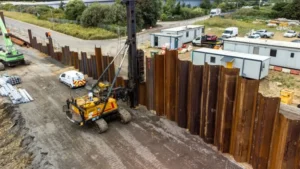
You are sitting in your office with a set of structural drawings. The engineer has specified sheet piles, but you need to order them by weight, not by piece count. The clock is ticking.
The sheet pile weight calculation formula is: Weight = Cross-sectional Area × Density of Steel × Length1. For steel, the density is 7,850 kilograms per cubic meter2. You find the cross-sectional area in the manufacturer’s technical catalog, usually given in square centimeters.
](https://cnsteelplant.com/wp-content/uploads/2026/03/Article-Application-Port-2.webp)
I remember my first big project in the UAE. The client sent me a list of pile types and asked for total tonnage. I thought it would be simple. Then I realized every profile has a different area, and the math had to be exact. One mistake and the whole shipment would be wrong. Let me walk you through the formulas I use every day.
What is the formula for sheet weight calculation?
This is the foundation of everything we do in procurement. If you get this wrong, nothing else matters.
The formula for sheet pile weight per meter is: Weight (kg/m) = Cross-sectional Area1 (m²) × 7,850 kg/m³. The cross-sectional area comes from the manufacturer’s technical data sheet. You multiply this by the total length to get the weight for each pile, then by the quantity to get the total order weight.
](https://cnsteelplant.com/wp-content/uploads/2026/03/应用-10.webp)
Breaking Down the Calculation Step by Step
Let me explain this in a way you can use immediately.
The Core Principle
Steel has a fixed density. It is always 7,850 kilograms per cubic meter. This number comes from the physical properties of carbon steel. It does not change based on the manufacturer or the profile shape. If you know the volume of steel in one meter of pile, you multiply it by this density and you get the weight.
Finding the Cross-Sectional Area
Every rolled steel section has a cross-sectional area. For sheet piles, manufacturers list this in their catalogs. For example, ArcelorMittal’s AU 25 section2 has a cross-sectional area of 140.6 square centimeters for a single pile. This number is calculated by the mill using precise measurements of the profile.
You take that number and convert it to square meters by dividing by 10,000. There are 10,000 square centimeters in one square meter.
The Math in Action
Let me show you with real numbers from a project:
- Area from catalog: 140.6 cm²
- Convert to m²: 140.6 ÷ 10,000 = 0.01406 m²
- Multiply by density: 0.01406 × 7,850 = 110.4 kg/m
This matches exactly the weight per meter listed in the ArcelorMittal data sheet for that profile. The formula works every time.
Why Engineers Need This
When you design a retaining wall, you need to know the total load on the foundation. The weight of the piles themselves is part of that calculation. Also, you need to specify crane capacity for installation. A 12-meter pile at 110 kg/m weighs 1,320 kg. Your crane needs to handle that.
I had an engineer in Australia call me once. He was designing a wall and needed to know the exact weight for his structural analysis. He did not trust the catalog numbers. We walked through the formula together, using the area from the mill certificate. He confirmed the catalog was correct, and his design moved forward.
How to calculate the weight of a pile1?
Maybe you do not have a catalog. Maybe you have a sample pile on site, or you only have the basic dimensions. Can you still figure out the weight?
To calculate the weight of a pile1 without catalog data, you need to break the profile into simple geometric shapes, calculate the area of each part, sum them to get the total cross-sectional area, then multiply by steel density and length.
](https://cnsteelplant.com/wp-content/uploads/2026/03/Article-Application-City-2.webp)
Practical Calculation Methods for Engineers
Let me walk you through several methods, from simple to complex.
Method 1: Using Published Data (Easiest)
The best method is to use published data2 from reputable manufacturers. For example, a Z type pile measuring 400 x 185 x 8 mm has a published weight of 44.965 kg per meter. This comes from actual measurements and calculations by the manufacturer. You can trust this number.
Method 2: Approximating from Dimensions
If you do not have published data2, you can approximate. For a U pile, imagine it as a center web and two flanges. The web height is the section height minus the flange thicknesses. The flange width is the section width divided in half.
For a 400×125 U pile with 13 mm thickness:
- Web height = 125 mm – 13 mm – 13 mm = 99 mm
- Web area = 99 mm × 13 mm = 1,287 mm²
- Each flange area = (400 mm ÷ 2) × 13 mm = 2,600 mm²
- Total for two flanges = 5,200 mm²
- Total area = 5,200 + 1,287 = 6,487 mm²
- Convert to m²: 6,487 ÷ 1,000,000 = 0.006487 m²
- This is for half the profile? Wait, this is getting messy.
This approximation method is risky. The curved sections and interlocks add area that is hard to calculate manually. That is why engineers use catalog data.
Method 3: The Accurate Engineering Method3
The proper way is to use computer modeling or manufacturer data. Mills use precise measurements of the profile’s perimeter and thickness. The area is calculated as the perimeter length times the average thickness, adjusted for corners and curves.
Method 4: Weight Calculation for Multiple Piles
Once you have the weight per meter, the rest is simple:
Weight per pile = Weight per meter × Length
Total weight = Weight per pile × Number of piles
A Real Example
For the riverbank project in Southeast Asia, we supplied 400×125 U type piles weighing 60 kg/m. The client needed 500 pieces, each 15 meters long.
- 60 kg/m × 15 m = 900 kg per pile
- 900 kg × 500 piles = 450,000 kg = 450 metric tons
This number told them exactly how much shipping space to book and how much crane capacity to bring.
How much does a 4×8 sheet of 3/16 steel1 weigh?
This question comes up often when engineers are designing guide frames, templates, or temporary works for pile installation.
A 4×8 sheet of 3/16 inch steel weighs approximately 245 pounds (about 111 kilograms). This is based on the standard weight of steel plate2, which is 40.8 pounds per square foot per inch of thickness.
](https://cnsteelplant.com/wp-content/uploads/2026/03/product-image-50.webp)
Understanding Plate Weight Calculations
Let me show you exactly how this number is derived.
The Standard Formula for Steel Plate
In imperial units, the weight of steel plate2 is calculated as:
Weight (lbs) = Thickness (inches) × 40.8 lbs/ft²/inch × Area (ft²)
The number 40.8 comes from the density of steel3. One cubic foot of steel weighs 490 pounds. When you spread that over 12 inches of thickness, each inch weighs 40.8 pounds per square foot.
Step-by-Step Calculation for 3/16 Inch Plate
- Convert thickness to decimal inches: 3/16 = 0.1875 inches
- Calculate weight per square foot: 0.1875 × 40.8 = 7.65 lbs/ft²
- Calculate area of a 4×8 sheet: 4 ft × 8 ft = 32 ft²
- Total weight: 32 ft² × 7.65 lbs/ft² = 244.8 pounds
Different sources show slight variations. Russel Metals lists 3/16 inch plate at 7.66 lbs/ft². Using that number:
32 × 7.66 = 245.12 pounds
Metric Calculation
For engineers working in metric:
- Thickness: 3/16 inch = 4.76 mm
- Steel density: 7,850 kg/m³
- Weight per square meter: 7,850 × 0.00476 = 37.4 kg/m²
- Area: 4 ft = 1.219 m, 8 ft = 2.438 m, total area = 2.97 m²
- Total weight: 2.97 × 37.4 = 111 kg
Why This Matters for Piling Projects
You might need this calculation when building:
- Guide frames to keep piles aligned during driving
- Template plates for cutting pile ends
- Temporary platforms for installation equipment
- Test weights for crane calibration
I had a client in Jordan who was building a guide frame for a deep excavation. He needed to order steel plate for the base. We calculated the total weight so he could specify the crane needed to lift the assembled frame. Getting it right saved him from renting a crane that was too small.
How much do sheet piles weigh?
This is the question I answer most often. New buyers want a simple number, but the reality is that sheet pile weights1 vary widely.
Sheet piles typically weigh between 40 kg/m and 150 kg per meter for common profiles. For a standard 12-meter length, a single pile can weigh anywhere from 480 kg to 1,800 kg. The weight depends on the profile type, dimensions, and thickness.
](https://cnsteelplant.com/wp-content/uploads/2026/03/product-image-33.webp)
Complete Weight Reference Guide
Let me give you a comprehensive reference based on real products I have supplied.
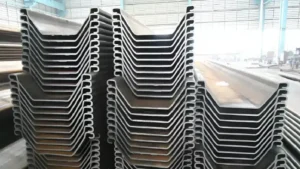
U Type Pile Weights2
Here are common U type sections and their weights:
| Profile (W x H) | Thickness (mm) | Weight per Meter (kg/m) | 12m Pile Weight (kg) |
|---|---|---|---|
| 400 x 100 | 10.5 | 48.0 | 576 |
| 400 x 125 | 13.0 | 60.0 | 720 |
| 400 x 170 | 15.5 | 76.1 | 913 |
| 600 x 130 | 10.3 | 61.8 | 742 |
| 600 x 180 | 13.4 | 81.6 | 979 |
| 600 x 210 | 18.0 | 106.2 | 1,274 |
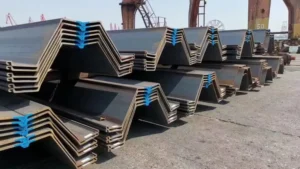
Z Type Pile Weights3
Z piles often achieve higher strength with efficient designs:
| Profile | Width x Height (mm) | Thickness (mm) | Weight per Meter (kg/m) | 12m Pile Weight (kg) |
|---|---|---|---|---|
| WRZ12-650 | 650 x 319 | 7 | 57.8 | 694 |
| WRZ16-635 | 635 x 379 | 7 | 61.5 | 738 |
| WRZ18-635 | 635 x 380 | 8 | 70.1 | 841 |
| WRZ30-635 | 635 x 420 | 12 | 113.3 | 1,360 |
| WRZ34-675 | 675 x 490 | 12 | 118.9 | 1,427 |
PZC Series Weights4 (US Standards)
For projects using American standard piles:
| Section | Width (in) | Height (in) | Weight per Foot (lbs/ft) | 40ft Pile Weight (lbs) |
|---|---|---|---|---|
| PZC 13 | 27.88 | 12.56 | 50.4 | 2,016 |
| PZC 18 | 25.00 | 15.25 | 50.4 | 2,016 |
| PZC 26 | 27.88 | 17.70 | 73.9 | 2,956 |
What These Numbers Mean for Your Project
A 12-meter pile at 60 kg/m gives you 720 kg. You can handle this with a small crane. A 15-meter pile at 118 kg/m gives you 1,770 kg. This requires heavier equipment.
I had a client in Saudi Arabia who ordered 600×210 piles at 106.2 kg/m. He planned 18-meter lengths. Each pile weighed 1,912 kg. His site crane was rated for 2,000 kg, so he was right at the limit. We had to coordinate lifting carefully to stay safe. Knowing the exact weight prevented an accident.
Conclusion
Sheet pile weight calculation is simple when you use the formula of area times density times length. Always verify with manufacturer data1 before ordering.
-
Verifying with manufacturer data ensures you receive the correct specifications and quality for your project needs. ↩ ↩ ↩ ↩ ↩ ↩ ↩
-
Explore U Type Pile Weights to find detailed specifications that can help in your project planning. ↩ ↩ ↩ ↩ ↩ ↩ ↩
-
Learn about Z Type Pile Weights to understand their strength and efficiency in construction. ↩ ↩ ↩
-
Discover PZC Series Weights to ensure compliance with US standards in your construction projects. ↩