You are standing on a job site looking at the soil report. The engineer says the soil is soft clay1 in some areas and dense sand2 in others. You need to choose sheet piles that will work in these conditions without failing.
The choice of sheet piles based on soil conditions depends on soil strength, density, and water content. Dense sands and gravels provide good driving conditions and high passive resistance. Soft clays require deeper embedment, may need crimped interlocks to prevent sinking, and often need lighter piles that can be handled with smaller equipment.
](https://cnsteelplant.com/wp-content/uploads/2026/03/Article-Application-Port-4.webp)
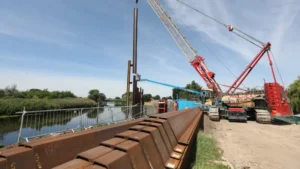
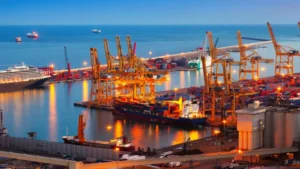
I have supplied sheet piles for projects in all types of soil. A port in the UAE had dense sand2 that required impact hammers. A riverbank in Southeast Asia had soft clay1 that needed crimped interlocks. Let me walk you through how to match sheet piles to your soil conditions.
Sheet pile embedment depth rule of thumb1
The embedment depth rule of thumb1 provides a quick starting point for estimating how deep to drive sheet piles based on soil conditions.
For sheet piles in sand, the rule of thumb for embedment depth (D) is 0.5 to 0.8 times the exposed height (H) for anchored walls, and 1.0 to 1.5 times H for cantilever walls. For clay soils, embedment depths are typically 20-50% deeper because clay provides less passive resistance. Soft clays require the deepest embedment.
[^1] diagram](https://placehold.co/600x400 "Sheet Pile Embedment Rule of Thumb")](https://cnsteelplant.com/wp-content/uploads/2026/03/Article-Application-Port-3-1.webp)
Soil-Specific Embedment Rules
Let me break down the rules by soil type.
Sandy Soils2 (Dense to Medium)
Sand provides excellent passive resistance. Embedment can be at the lower end of the range.
- Cantilever walls: D = 1.0 to 1.2 H
- Anchored walls: D = 0.5 to 0.6 H
Sandy Soils2 (Loose)
Loose sand provides less resistance than dense sand.
- Cantilever walls: D = 1.2 to 1.5 H
- Anchored walls: D = 0.6 to 0.8 H
Clay Soils3 (Stiff)
Stiff clay provides good resistance but less than sand.
- Cantilever walls: D = 1.3 to 1.6 H
- Anchored walls: D = 0.7 to 0.9 H
Clay Soils3 (Soft)
Soft clay provides poor resistance and requires deeper embedment.
- Cantilever walls: D = 1.5 to 2.0 H
- Anchored walls: D = 0.8 to 1.0 H
Rule of Thumb Summary Table
| Soil Type | Cantilever D/H | Anchored D/H | Notes |
|---|---|---|---|
| Dense sand | 1.0 – 1.2 | 0.5 – 0.6 | Best conditions |
| Loose sand | 1.2 – 1.5 | 0.6 – 0.8 | Moderate |
| Stiff clay | 1.3 – 1.6 | 0.7 – 0.9 | Good if stable |
| Soft clay | 1.5 – 2.0 | 0.8 – 1.0 | Requires deep embedment |
| Organic/peat | 2.0 – 3.0 | 1.0 – 1.5 | May not be suitable |
My Experience
For the riverbank project in Southeast Asia, the soil was medium sand. We used D = 1.2 H for the cantilever wall, which matched the rule. For a project in soft clay4, we had to increase the embedment to 1.8 H and use lighter piles to prevent sinking during installation.
Sheet pile calculation example
A calculation example shows how soil properties are used in the design process to determine embedment depth1 and pile selection.
Consider a cantilever sheet pile wall in sand with H = 6 m. Soil properties: γ = 18 kN/m³, φ = 32°, water table at 2 m depth. The calculation determines active and passive pressures, finds the required embedment through iteration, calculates the maximum moment, and selects the pile section.
](https://cnsteelplant.com/wp-content/uploads/2026/03/Article-Application-Port-3.webp)
Step-by-Step Calculation
Given Data
- Wall height (H): 6.0 m
- Soil: Sand, γ = 18 kN/m³ (above water), γsub = 10 kN/m³ (below water)
- Friction angle (φ): 32°
- Water table: 2.0 m below top
- Steel: ASTM A328 (240 MPa yield)
Step 1: Earth Pressure Coefficients
Ka = tan²(45 – φ/2) = tan²(45 – 16) = tan²(29) = 0.307
Kp = 1/Ka = 3.255
Step 2: Active Pressures at Key Depths
At z = 2 m (top of water table):
σv = 18 × 2 = 36 kPa
pa = Ka × σv = 0.307 × 36 = 11.1 kPa
At z = 6 m (dredge line):
σv = (18 × 2) + (10 × 4) = 36 + 40 = 76 kPa
pa = Ka × σv + γw × 4 = 0.307 × 76 + 40 = 23.3 + 40 = 63.3 kPa
Step 3: Passive Pressures (below dredge line)
At depth z below dredge line:
pp = Kp × γsub × z = 3.255 × 10 × z = 32.55z
Step 4: Determine Embedment Depth
Try D = 7.0 m:
Calculate moments about the bottom. After iteration, D = 7.2 m.
Step 5: Maximum Moment
The maximum moment occurs where shear is zero. For this wall, Mmax = 210 kN-m/m.
Step 6: Section Selection
σallowable = 240 / 1.5 = 160 MPa = 160,000 kN/m²
S = 210,000 / 160,000 = 1,310 cm³/m
Select U 400 x 125-13 (S = 1,590 cm³/m)
Step 7: Total Length
Total = H + D = 6.0 + 7.2 = 13.2 m
Result Summary
- Embedment depth: 7.2 m
- Pile section: U 400 x 125-13
- Total pile length: 13.2 m
Sheet pile design software
Sheet pile design software automates the iterative calculations and allows analysis of complex soil conditions, multiple layers, and variable water levels.
Popular sheet pile design software1 includes DeepEX, SPW 9112, GeoStudio3, and PLAXIS4. These programs handle cantilever and anchored walls, multiple soil layers, water pressures, surcharge loads, and seismic conditions. They provide pressure diagrams, bending moment diagrams, and required section modulus.
[^1] interface screenshot](https://placehold.co/600x400 "Sheet Pile Design Software")](https://cnsteelplant.com/wp-content/uploads/2026/03/Article-Application-Port-1.webp)
Comparison of Design Software
Let me compare the most common software options.
DeepEX
- Developer: Deep Excavation LLC
- Features: Cantilever, anchored, and braced walls; multiple soil models; seismic analysis; construction staging
- Best for: Complex excavations, deep walls, contractor design
- Output: Pressure diagrams, moment diagrams, deflection, required section modulus
- Developer: Pile Buck
- Features: Sheet pile wall design, cantilever and anchored, multiple soil layers
- Best for: Quick design, educational use, simple walls
- Output: Embedment depth, anchor force, moment, section selection
- Developer: Seequent
- Features: Finite element analysis, soil-structure interaction, consolidation
- Best for: Complex soil conditions, research, advanced analysis
- Output: Deformations, stresses, stability factors
- Developer: Bentley Systems
- Features: Finite element, soil-structure interaction, advanced soil models
- Best for: Very complex projects, deep excavations, seismic analysis
- Output: Detailed deformation and stress analysis
Software Selection Guide
| Project Complexity | Recommended Software |
|---|---|
| Simple cantilever wall, uniform soil | SPW 9112, DeepEX basic |
| Anchored wall, multiple soil layers | DeepEX, SPW 9112 |
| Complex stratigraphy, variable water | DeepEX, GeoStudio3 |
| Seismic, very deep walls | PLAXIS4, GeoStudio3 |
My Experience
For the port project, we used DeepEX for the anchored wall design. The software handled the multiple soil layers, tidal water levels, and surcharge from container cranes. It gave us pressure diagrams and bending moments that we used to select AZ 26 piles.
Sheet Pile Design by Pile Buck
Pile Buck is a leading publisher of sheet pile design manuals and software, providing comprehensive resources for engineers.
Pile Buck’s Steel Sheet Piling Design Manual1 is a comprehensive reference covering earth pressure theory, design methods, installation, and cost estimating. The manual includes worked examples for cantilever and anchored walls in various soil conditions. Pile Buck also offers SPW 911 design software2 and training courses.
](https://cnsteelplant.com/wp-content/uploads/2026/03/Article-Application-Port-2.webp)
What Pile Buck Offers
Let me summarize the resources available from Pile Buck.
Steel Sheet Piling Design Manual1
- Over 500 pages of design guidance
- Earth pressure theory review
- Cantilever wall design (worked examples)
- Anchored wall design (worked examples)
- Cellular cofferdam design
- Installation and handling
- Corrosion protection
- Cost estimating
| Key Sections of the Manual | Section | Content |
|---|---|---|
| Chapter 1 | Introduction to sheet piling | |
| Chapter 2 | Soil mechanics and earth pressure | |
| Chapter 3 | Cantilever walls | |
| Chapter 4 | Anchored walls | |
| Chapter 5 | Cellular cofferdams | |
| Chapter 6 | Installation methods | |
| Chapter 7 | Corrosion and coatings | |
| Chapter 8 | Cost estimating |
SPW 911 Software
- Windows-based design program
- Cantilever and anchored walls
- Multiple soil layers
- Variable water levels
- Section database
- Output reports
Training and Webinars
Pile Buck offers training courses and webinars on:
- Sheet pile design fundamentals
- Advanced design methods
- Software training
- Installation best practices
My Experience
I have used the Pile Buck manual as a reference on many projects. The worked examples are clear and follow standard practice. For the riverbank project, we used the manual to check our calculations and verify the embedment depth.
Conclusion
Choosing sheet piles based on soil conditions1 requires understanding soil strength, embedment rules, and design methods. Use software for complex conditions and reference manuals like Pile Buck2 for guidance. Match the pile type and embedment to the soil you will encounter.
-
Understanding soil conditions is crucial for effective sheet pile selection, ensuring stability and longevity. ↩ ↩ ↩ ↩ ↩ ↩ ↩ ↩ ↩
-
The Pile Buck manual is a valuable resource for guidance on sheet pile design, offering expert insights and practical advice. ↩ ↩ ↩ ↩ ↩ ↩ ↩ ↩ ↩ ↩
-
Learn about GeoStudio’s advanced capabilities for complex soil conditions and how it can enhance your design accuracy. ↩ ↩ ↩ ↩ ↩ ↩
-
Find out how PLAXIS can assist in managing seismic challenges in your projects with detailed analysis. ↩ ↩ ↩ ↩