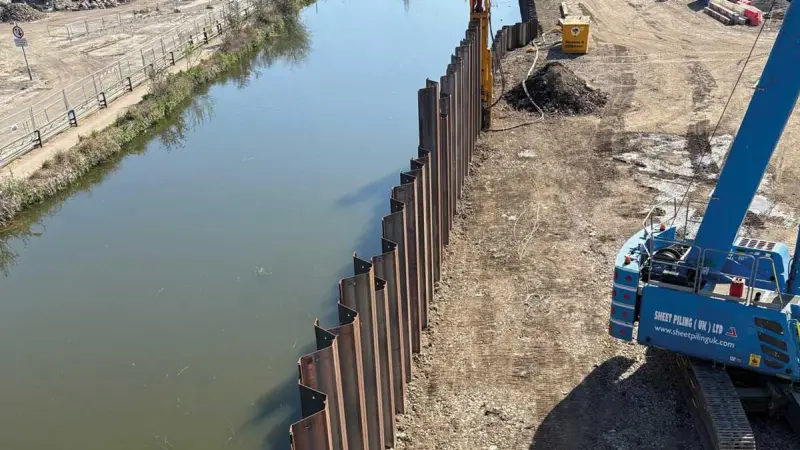
You are looking at a river that floods every year. The water rises, the banks erode, and nearby communities are at risk. You need a solution that works fast and lasts for decades.
Steel sheet piling systems1 are the ideal choice for flood control structures2. They provide a continuous, watertight barrier that can be installed quickly, resists high water pressures, and lasts for 50 years or more. Permanent flood walls, temporary barriers, and levee reinforcement all use steel sheet piles to protect communities from rising water.
](https://cnsteelplant.com/wp-content/uploads/2026/03/Article-Application-River-Embankment-5.webp)
I remember a flood control project in Southeast Asia where the river rose 3 meters in one day. The sheet pile wall we installed held back the water while concrete structures were being built. The community stayed dry. Let me walk you through how steel sheet piling systems work for flood control.
Sheet pile for flood control
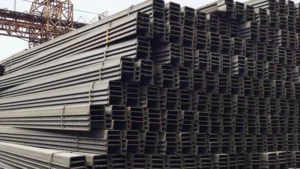
Sheet piles are used in flood control structures to create continuous barriers that prevent water from overtopping or seeping through the ground.
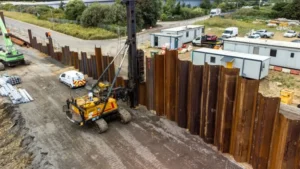
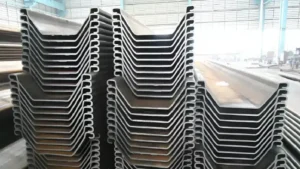
Sheet piles for flood control are driven into the ground to form a continuous, watertight wall. They can be used as permanent flood walls, temporary barriers during flood events, or as cut-off walls within existing levees. The Larssen interlock system1 provides excellent water tightness, making sheet piles ideal for flood protection applications.
](https://cnsteelplant.com/wp-content/uploads/2026/03/Article-Application-River-Embankment-3.webp)
Types of Flood Control Structures
Let me explain the different ways sheet piles are used for flood control.
Permanent Flood Walls2
Permanent flood walls are installed along rivers, coastlines, or around communities to provide year-round protection.
- Design: Sheet piles driven to depth with a concrete capping beam
- Height: Typically 3-8 meters above ground
- Foundation: Piles embedded into stable soil below scour depth
- Advantages: Permanent protection, low maintenance
- Life: 50-100 years with proper corrosion protection
Temporary Flood Barriers3
Temporary barriers are installed before flood season and removed after.
- Design: Sheet piles driven for the season, extracted when not needed
- Height: Typically 2-5 meters
- Advantages: Reusable, lower initial cost
- Life: Multiple uses with proper handling
Levee Reinforcement4
Sheet piles driven through existing levees to prevent seepage and strengthen the structure.
- Design: Cut-off wall driven vertically through the levee core
- Function: Stops water from seeping through the levee
- Advantages: Strengthens existing levees without rebuilding
Flood Control Design Considerations
| Factor | Consideration |
|---|---|
| Design flood level | Determines wall height |
| Flood duration | Affects seepage and stability |
| Soil conditions | Affects embedment depth |
| Scour potential | Riverbed erosion over time |
| Access | Equipment needs to reach site |
| Environmental | Impact on river ecology |
Design Example: Permanent Flood Wall
- Design flood level: 4.5 m above ground
- Freeboard: 0.5 m
- Wall height: 5.0 m
- Soil: Sand, φ = 32°
- Required embedment: 5.5 m (cantilever wall)
- Total pile length: 10.5 m
- Section: U 400 x 125-13 (S = 1,590 cm³/m)
My Experience
For a flood control project in Southeast Asia, we installed a permanent flood wall using U 400 x 125-13 piles. The wall was 5 m high and protected a community that had flooded several times. The piles were driven in 2 weeks, and the wall has prevented flooding for 5 years.
Arcelormittal Piling Handbook
The ArcelorMittal Piling Handbook is the definitive reference for steel sheet pile design, including comprehensive guidance on flood control structures1.
The ArcelorMittal Piling Handbook covers sheet pile types2, properties, design methods3, installation, and applications. For flood control, it provides detailed guidance on permanent flood walls, temporary barriers, and levee reinforcement. The handbook includes worked examples, design charts, and corrosion protection recommendations4.
](https://cnsteelplant.com/wp-content/uploads/2026/03/Article-Application-River-Embankment-2.webp)
Key Sections of the Piling Handbook
Let me summarize the most important sections for flood control applications.
Chapter 1: Introduction to Sheet Piling
- History and development
- Types of sheet piles (U, Z, straight web)
- Interlock systems (Larssen, ball-and-socket)
- Steel grades (S270GP, S355GP, S430GP)
Chapter 2: Sheet Pile Properties
- Section properties tables
- Dimensions and weights
- Section modulus and moment of inertia
- Tolerances
Chapter 3: Design Methods
- Earth pressure theory (Rankine, Coulomb)
- Water pressure considerations
- Surcharge loads
- Seismic design
Chapter 4: Flood Control Applications
- Permanent flood walls
- Temporary flood barriers
- Levee reinforcement
- Cut-off walls
- Worked examples for each application
Chapter 5: Installation
- Driving equipment (vibratory, impact, press-in)
- Guide frames and templates
- Interlock care
- Hard driving conditions
Chapter 6: Corrosion Protection
- Corrosion mechanisms in freshwater and saltwater
- Corrosion allowance
- Protective coatings
- Cathodic protection
Chapter 7: Worked Examples
- Cantilever flood wall design
- Anchored flood wall design
- Levee cut-off wall design
- Temporary barrier design
Flood Control Guidance in the Handbook
| Application | Recommended Pile Type | Design Method |
|---|---|---|
| Permanent flood wall (moderate height) | U-type | Cantilever |
| Permanent flood wall (tall) | Z-type or combination | Anchored |
| Levee reinforcement | U-type | Cut-off wall |
| Temporary barrier | Cold-formed or U-type | Cantilever |
My Experience
I have used the ArcelorMittal Piling Handbook on many flood control projects. The worked examples are clear and follow standard practice. For the riverbank project, we used the handbook to verify our cantilever wall design and corrosion protection approach.
ArcelorMittal sheet piles
ArcelorMittal is the world’s leading manufacturer of steel sheet piles, offering a complete range of U-type, Z-type, and straight web sections for flood control1 applications.
ArcelorMittal sheet piles include the PU series2 (U-type with Larssen interlocks), the AZ series3 (Z-type with ball-and-socket interlocks), and straight web sections for cellular cofferdams. For flood control1, the PU series2 is most common for permanent walls, while the AZ series3 is used for taller walls requiring higher strength.
](https://cnsteelplant.com/wp-content/uploads/2026/03/Article-Application-River-Embankment-1.webp)
ArcelorMittal Product Range for Flood Control
Let me explain the ArcelorMittal products best suited for flood control1.
PU Series (U-Type Sheet Piles)
The PU series2 is the standard for flood control1 walls. Features:
- Symmetric profile, easy to install
- Larssen ball-and-socket interlock for water tightness
- Width: 400 mm to 600 mm
- Heights: 100 mm to 210 mm
- Steel grades: S270GP, S355GP, S430GP
| Section | Width (mm) | Height (mm) | Thickness (mm) | Weight (kg/m) | S (cm³/m) |
|---|---|---|---|---|---|
| PU 400 x 125 | 400 | 125 | 13.0 | 60.0 | 1,590 |
| PU 400 x 170 | 400 | 170 | 15.5 | 76.1 | 2,470 |
| PU 600 x 180 | 600 | 180 | 13.4 | 81.6 | 3,820 |
| PU 600 x 210 | 600 | 210 | 18.0 | 106.2 | 5,730 |
AZ Series (Z-Type Sheet Piles)
The AZ series3 is used for taller flood walls requiring higher strength. Features:
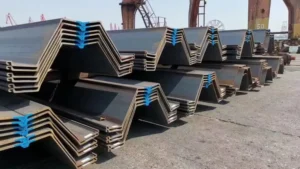
- Asymmetric profile, higher structural efficiency
- Ball-and-socket interlock
- Width: 630-670 mm
- Heights: 260-529 mm
- Steel grades: S355GP, S430GP
| Section | Width (mm) | Height (mm) | Thickness (mm) | Weight (kg/m) | S (cm³/m) |
|---|---|---|---|---|---|
| AZ 18 | 670 | 345 | 9.0 | 75.0 | 1,800 |
| AZ 26 | 670 | 396 | 13.0 | 109.0 | 2,600 |
| AZ 34 | 670 | 444 | 17.0 | 143.0 | 3,400 |
| AZ 42 | 670 | 487 | 21.0 | 177.0 | 4,200 |
Steel Grades for Flood Control
| Grade | Yield (MPa) | Best Use |
|---|---|---|
| S270GP | 270 | Moderate flood walls, freshwater |
| S355GP | 355 | Permanent flood walls, deeper embedment |
| S430GP | 430 | Tall flood walls, heavy loads |
Corrosion Protection Options
- Standard carbon steel with corrosion allowance (freshwater)
- Marine grade steel (brackish water)
- Fusion-bonded epoxy coating (aggressive environments)
My Experience
For the riverbank protection project, we used PU 400 x 125-13 piles. The section provided ample strength for the 6 m wall. For a larger flood control1 project with 8 m walls, we used PU 400 x 170-15.5 piles.
Conclusion
Steel sheet piling systems1 are the ideal solution for flood control structures. U-type piles with Larssen interlocks provide water tightness and stability for permanent flood walls. The ArcelorMittal Piling Handbook2 provides comprehensive design guidance. Use PU series for moderate heights and AZ series for taller walls.
-
Discover how Steel sheet piling systems can effectively manage flood risks and enhance structural integrity. ↩ ↩ ↩ ↩ ↩ ↩ ↩ ↩ ↩
-
Explore the ArcelorMittal Piling Handbook for expert insights on designing effective flood control structures. ↩ ↩ ↩ ↩ ↩ ↩ ↩
-
Discover the advantages of the AZ series for taller flood walls and its structural efficiency. ↩ ↩ ↩ ↩ ↩
-
Explore effective corrosion protection methods to enhance the longevity and durability of steel structures in various environments. ↩ ↩