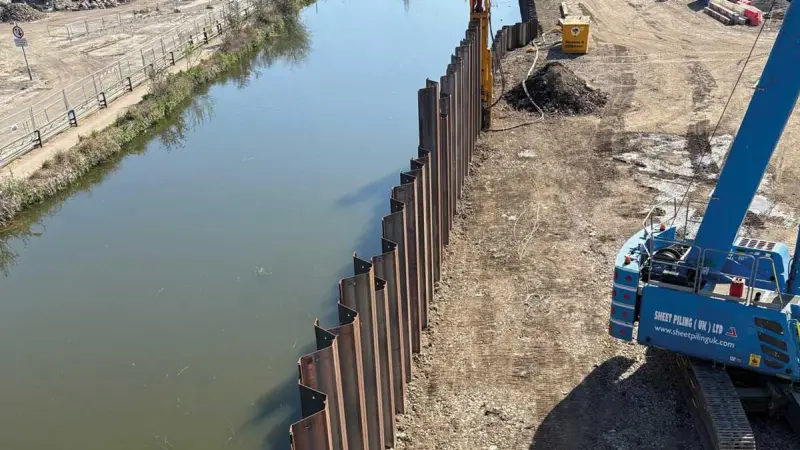
You are designing a seawall, a port quay, or a marine bulkhead. The water is salt, the waves are constant, and the structure must last for decades. Choosing the wrong steel grade can mean corrosion failure in 20 years instead of 50.
The best steel grade for marine sheet piles is ASTM A6901, which contains copper, nickel, and phosphorus to form a protective patina that reduces corrosion by about 50% compared to standard carbon steel. For maximum service life, A690 is often combined with cathodic protection2.
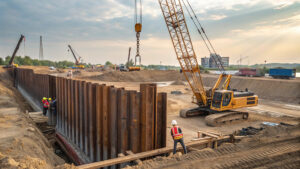
](https://cnsteelplant.com/wp-content/uploads/2026/03/Article-Application-Port-4.webp)
I remember a project in the Middle East where the client chose standard carbon steel to save money upfront. Ten years later, the piles had thinned significantly. The cost to add cathodic protection2 after the fact was three times what it would have been during construction. That experience taught me that the right grade from the start is always cheaper in the long run.
What is the best steel for the marine environment?
The marine environment is one of the harshest conditions for steel structures. Saltwater, waves, and marine life all contribute to corrosion.
The best steel for marine sheet piles1 is ASTM A6902, a high-strength low-alloy steel specifically formulated for seawater exposure. It contains copper, nickel, and phosphorus that form a dense, adherent rust layer that slows further corrosion. For structures requiring maximum longevity, A690 is used with cathodic protection3.
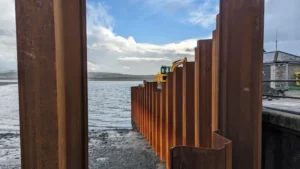
](https://cnsteelplant.com/wp-content/uploads/2026/03/Article-Application-Port-3.webp)
Why ASTM A6902 Is the Marine Standard
Let me explain what makes A690 special.
The Alloying Elements
ASTM A6902 has a carefully controlled chemistry:
- Copper (Cu): 0.20-0.50% – promotes formation of protective rust layer
- Nickel (Ni): 0.20-0.50% – improves corrosion resistance4 and toughness
- Phosphorus (P): 0.07-0.12% – enhances atmospheric corrosion resistance4
These elements work together to create a patina that is different from ordinary rust. Ordinary rust is porous and flakes off, exposing fresh metal to continue corroding. The patina on A690 is dense, tightly adherent, and stays on the surface, acting as a barrier.
Corrosion Rate
In seawater immersion, standard carbon steel (A328) corrodes at about 0.10 mm per year. ASTM A6902 corrodes at about 0.05 mm per year in the same conditions. That is a 50% reduction.
For a 50-year design life:
- Standard carbon steel needs 5 mm corrosion allowance
- A690 needs only 2.5 mm corrosion allowance
This reduces the required steel thickness and weight, partially offsetting the higher cost of the alloy.
Mechanical Properties
A690 has a minimum yield strength of 345 MPa (50 ksi) and minimum tensile strength of 485 MPa (70 ksi). This matches the high-strength A572 Grade 50, so you get both strength and corrosion resistance4 in one grade.
Limitations
A690 is not immune to corrosion. In splash zones where the steel is alternately wet and dry, corrosion rates can be higher. In very aggressive environments, cathodic protection3 is still recommended.
Alternatives
If A690 is not available, other options include:
- Standard carbon steel with cathodic protection3
- Standard carbon steel with heavy coatings
- Stainless steel (very expensive)
- Steel with protective wrap systems
But for most marine sheet pile applications, A690 is the industry standard for good reason.
What grade steel is used for sheet piles?
Sheet piles come in several grades. The right one depends on the environment and structural requirements.
Sheet piles are manufactured in several steel grades. The most common are ASTM A328 (standard carbon, 240 MPa yield), ASTM A572 Grade 501 (high-strength, 345 MPa yield), and ASTM A6902 (marine grade, 345 MPa yield with corrosion resistance). European projects use EN 10248 grades S270GP, S355GP, and S430GP.
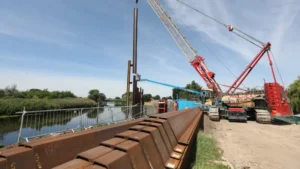
](https://cnsteelplant.com/wp-content/uploads/2026/03/Article-Application-Port-2.webp)
Complete Grade Reference
Let me give you a detailed reference for sheet pile grades.
ASTM A328 (Standard Carbon)
- Yield strength: 240 MPa (35 ksi) minimum
- Tensile strength: 410 MPa (60 ksi) minimum
- Typical use: General retaining, temporary works, freshwater applications
- Corrosion resistance: Standard carbon steel
- Cost: Lowest
- Availability: Widely available
ASTM A572 Grade 501 (High-Strength)
- Yield strength: 345 MPa (50 ksi) minimum
- Tensile strength: 450 MPa (65 ksi) minimum
- Typical use: Deep excavations, heavy loads, where weight savings matter
- Corrosion resistance: Slightly better than A328 due to copper content
- Cost: Moderate
- Availability: Widely available
- Yield strength: 345 MPa (50 ksi) minimum
- Tensile strength: 485 MPa (70 ksi) minimum
- Typical use: Ports, harbors, seawalls, marine terminals
- Corrosion resistance: 50% better than carbon steel in seawater
- Cost: Higher
- Availability: Readily available for marine projects
- S270GP: 270 MPa yield – equivalent to A328
- S355GP: 355 MPa yield – higher strength grade
- S430GP: 430 MPa yield – high-strength for deep walls
Higher Strength Options4
Some mills offer grades up to S460 or S500 for extreme depths. These are less common and may require special ordering.
Selection Guide
| Environment | Recommended Grade |
|---|---|
| Freshwater, temporary | A328 / S270GP |
| Freshwater, permanent | A328 with coating |
| Brackish water | A572 Gr50 with protection |
| Seawater, splash zone | A690 with cathodic protection |
| Seawater, submerged | A690 or A328 with cathodic protection |
| Deep excavation, heavy loads | A572 Gr50 / S355GP |
What is the difference between U type and Z type sheet piles1?
In marine applications, the choice between U and Z profiles affects both structural performance and corrosion management2.
U type sheet piles3 have interlocks at the neutral axis and are symmetric, making them easier to install in curved alignments. Z type sheet piles1 have interlocks at the outer flanges and offer higher structural efficiency4, meaning less steel weight for the same bending strength. For marine walls, both are used, with Z piles often preferred for deeper water applications.
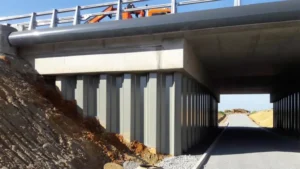
](https://cnsteelplant.com/wp-content/uploads/2026/03/Article-Application-Port-1.webp)
Comparing U and Z for Marine Use
Let me explain how the choice affects marine applications.
U Type in Marine Environments
U piles are widely used for marine walls, especially in moderate water depths up to about 10 meters. They offer several advantages:
- Symmetric shape makes them easier to follow curved alignments, common in harbor layouts
- Larssen interlocks provide good water tightness
- More forgiving installation, which is valuable in marine conditions
- Proven track record over 100 years of use
For the riverbank project in Southeast Asia, we used U piles. The wall followed the river curve, and the moderate depth made U piles the right choice.
Z Type in Marine Environments
Z piles are often preferred for deeper water applications:
- Higher structural efficiency4 means less steel weight for the same strength
- Wider sections (often 630-700 mm) mean fewer piles to drive
- Ball-and-socket interlocks in modern Z piles provide good performance
- Better suited for anchored walls in deep water
For deepwater ports, Z piles are common. The Middle East port project used Z piles for the main quay wall.
Corrosion Considerations
Both types face the same corrosion challenges. The interlock area is critical in both. For marine applications:
- A690 grade is available in both U and Z profiles
- The interlock area can trap water and accelerate corrosion
- Cathodic protection must cover the entire wall surface, regardless of profile
Comparison for Marine Use
| Feature | U Type | Z Type |
|---|---|---|
| Typical water depth | Moderate (under 10m) | Deep (over 10m) |
| Structural efficiency | Good | Excellent |
| Curved alignments | Excellent | Difficult |
| Wall straightness | Good | Excellent |
| Installation complexity | Simpler | More complex |
| Corrosion management | Same as Z | Same as U |
| Availability in A690 | Yes | Yes |
My Experience
For the riverbank project, U piles were right. For the deepwater port, Z piles were right. There is no single answer—it depends on water depth, wall alignment, and installation constraints.
What metal is best for marine use?
Beyond steel grades, engineers sometimes consider other metals for marine applications. Each has its place.
For sheet piling, the best metal is carbon steel with proper grade selection and protection. Stainless steel offers superior corrosion resistance but is prohibitively expensive. Aluminum1 is not strong enough for most piling applications. Titanium2 is excellent but far too costly for large-scale use.
](https://cnsteelplant.com/wp-content/uploads/2026/03/Article-Application-Port-3-1.webp)
Evaluating Metal Options
Let me compare the main metal options for marine structures.
- Corrosion resistance: Good with protection
- Strength: Excellent (345-430 MPa yield)
- Cost: Low to moderate
- Availability: Excellent
- Fabrication: Excellent weldability
- Track record: 100+ years of marine use
- Verdict: The standard choice for sheet piling
Stainless Steel (316, 2205 Duplex)4
- Corrosion resistance: Excellent in immersion
- Strength: Good (200-500 MPa depending on grade)
- Cost: Very high (3-5× carbon steel)
- Availability: Limited for sheet pile profiles
- Fabrication: More difficult, special procedures
- Track record: Used for small components, not large piles
- Verdict: Not economical for sheet piling
- Corrosion resistance: Good with proper alloy
- Strength: Low (typically 200-300 MPa)
- Cost: Moderate to high (2-3× carbon steel)
- Availability: Very limited for sheet pile profiles
- Fabrication: Welding requires special skills
- Track record: Used for light structures, not heavy piling
- Verdict: Not suitable for most piling applications
- Corrosion resistance: Excellent in all marine environments
- Strength: Excellent
- Cost: Extremely high (10-15× carbon steel)
- Availability: Very limited for sheet piles
- Fabrication: Very difficult
- Track record: Used for specialized components, not piles
- Verdict: Impractical for large-scale piling
Why Carbon Steel Wins
Despite corrosion concerns, carbon steel dominates marine piling because:
- It has the best strength-to-cost ratio
- Protection methods (cathodic protection, coatings) are proven and reliable
- It is readily available in all profile types
- It can be welded and fabricated with standard equipment
- It has a century-long track record
My Experience
In my years of supplying sheet piles, I have never supplied stainless steel, aluminum, or titanium piles. The cost would be astronomical. Carbon steel with proper grade selection and protection works for 50 years or more. That is why it remains the industry standard.
Conclusion
For marine sheet piles, ASTM A6901 is the best steel grade, offering 50% better corrosion resistance than standard carbon steel. Combine it with cathodic protection2 for maximum service life. Choose U or Z profile based on wall depth and alignment.
-
Explore this link to understand why ASTM A690 is the top choice for marine sheet piles, ensuring durability and corrosion resistance. ↩ ↩ ↩ ↩ ↩ ↩ ↩ ↩ ↩
-
Learn about cathodic protection and its critical role in extending the service life of marine structures, making it essential for your projects. ↩ ↩ ↩ ↩ ↩ ↩ ↩ ↩ ↩ ↩ ↩ ↩
-
Explore the advantages of Carbon Steel (ASTM A690) for marine use, including its strength, cost-effectiveness, and long track record. ↩ ↩ ↩ ↩ ↩ ↩
-
Learn why Stainless Steel (316, 2205 Duplex) is often too costly for marine sheet piling despite its excellent corrosion resistance. ↩ ↩ ↩ ↩ ↩ ↩ ↩