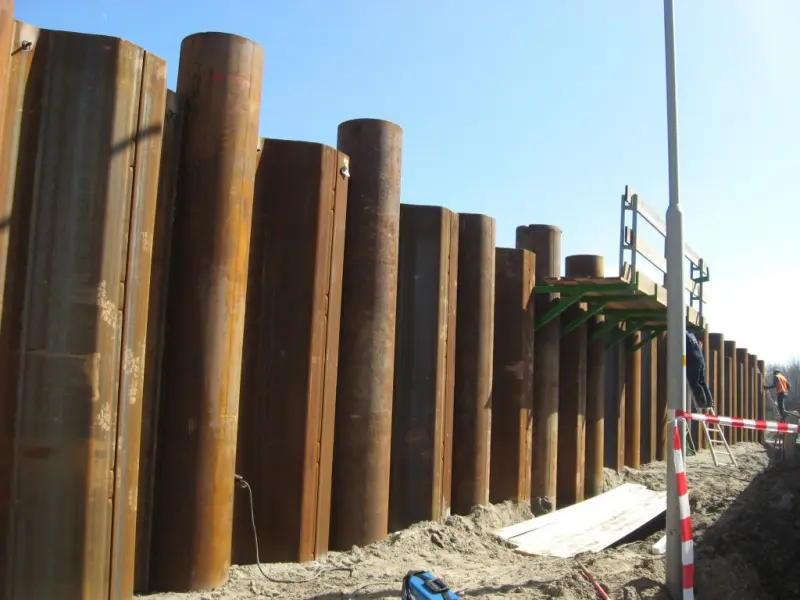
You are designing a deep foundation for a high-rise building. The loads are enormous. The geotechnical report shows dense soil layers. You need pipe piles that can handle the stress.
LSAW pipes1 generally have higher load bearing capacity than SSAW pipes2 for pile foundations. This is because LSAW pipes1 have a straight longitudinal weld that aligns with the direction of driving stress, thicker walls possible, and better resistance to buckling under compressive loads .
](https://cnsteelplant.com/wp-content/uploads/2026/03/Article-Application-City-5.webp)
I learned this lesson working with a structural engineer in Australia. He was designing foundations for a major bridge and needed piles that could take over 1,000 tons each. We ran the numbers for both pipe types. The LSAW option carried more load with the same wall thickness. Let me walk you through the engineering.
What is the difference between SSAW and LSAW pipes?
The manufacturing difference drives everything about load capacity.
The fundamental difference is the weld seam orientation1. SSAW pipes have a spiral weld that runs at an angle around the pipe. LSAW pipes have a straight longitudinal weld running parallel to the pipe axis. This affects how the pipe responds to compressive, tensile, and bending loads .
](https://cnsteelplant.com/wp-content/uploads/2026/03/Article-Application-City-3.webp)
How Weld Orientation Affects Load Capacity
Let me explain the mechanics.
SSAW Pipe Behavior
In a spiral welded pipe, the weld seam runs at an angle of about 30 to 60 degrees to the pipe axis . When you apply a compressive load2 along the pipe length, that load crosses the weld at an angle. The weld metal and the base metal have different properties. The heat-affected zone next to the weld also has altered properties.
Under compression, the spiral weld experiences both normal and shear stresses. The strength of the weld in this orientation is lower than the base metal strength. For critical applications, engineers must account for this reduction.
The spiral weld also creates a longer path for potential failure. The weld length is about 1.5 to 2 times the pipe length . More weld means more chance of defects.
LSAW Pipe Behavior
In a longitudinal welded pipe, the weld runs parallel to the pipe axis. When you apply compressive load2 along the length, the load is parallel to the weld. The weld experiences the same stress direction as the base metal.
This is a stronger configuration. The weld can be designed to match or exceed the base metal strength. For high-quality LSAW pipes, the weld strength is often 100% of the base metal strength.
Wall Thickness Capability
LSAW pipes can be made with much thicker walls3. SSAW pipes are limited by the thickness of steel coils, typically about 25 mm maximum . LSAW pipes use steel plates that can be 50 mm, 75 mm, or even thicker.
For high-load applications, thick walls are essential. A 50 mm wall LSAW pipe can carry twice the load of a 25 mm wall SSAW pipe of the same diameter.
Buckling Resistance
Pipe piles must resist buckling under compressive load2s, especially when driven through soft soil that provides little lateral support. Buckling resistance depends on the pipe’s moment of inertia and the yield strength of the steel.
LSAW pipes, especially those that are mechanically expanded after welding, have excellent dimensional accuracy. This improves buckling resistance4. The straight weld also maintains the pipe’s circular shape better than a spiral weld under high compression.
What is the difference between HSAW1 and LSAW2 pipes?
HSAW1 is another name for spiral welded pipe. Understanding this helps you read specifications correctly.
HSAW1 and LSAW2 pipes differ in the same way as SSAW and LSAW2. HSAW1 (Helical Submerged Arc Welding) is the same product as SSAW (Spiral Submerged Arc Welding). The weld seam runs in a helix around the pipe. LSAW2 has a straight longitudinal seam .
](https://cnsteelplant.com/wp-content/uploads/2026/03/Article-Application-City-2.webp)
Load Capacity Implications3
Let me explain what this means for your foundation design.
HSAW1/SSAW Load Characteristics
The helical weld in HSAW1 pipes creates anisotropic properties. The pipe is not equally strong in all directions. The longitudinal strength is lower than the circumferential strength.
For pile foundations, the critical load direction is longitudinal. The pile must carry the building weight down to the bearing layer. This is a compressive load along the pipe axis. The helical weld reduces the effective strength in this direction.
LSAW2 Load Characteristics
LSAW2 pipes have more uniform properties. The longitudinal strength equals or exceeds the circumferential strength. This matches the loading pattern for piles.
Design Factors4
Engineers use design factors to account for weld effects. For HSAW1 pipes, the weld factor may be lower than for LSAW2 pipes. This means you need more steel to achieve the same design capacity.
Comparison Table
| Feature | HSAW1/SSAW Pipe | LSAW2 Pipe |
|---|---|---|
| Weld orientation | Helical (angle) | Longitudinal (parallel) |
| Longitudinal strength | Lower | Higher |
| Wall thickness limit | ~25 mm | 50 mm+ |
| Weld length | 1.5-2 × pipe length | 1 × pipe length |
| Dimensional precision | Good | Excellent |
| Design factor (typical) | 0.85-0.95 | 0.95-1.0 |
My Experience
For a high-rise foundation in Dubai, the structural engineer specified a design factor of 0.9 for HSAW1 pipes and 1.0 for LSAW2. This meant that for the same nominal strength, HSAW1 pipes needed 11% more steel to achieve the same design capacity. LSAW2 was more efficient despite the higher unit cost.
Which is stronger, solid steel rod1 or hollow steel pipe2?
This question comes up when engineers compare different pile options. The answer depends on what you mean by stronger.
For the same weight per meter, a hollow steel pipe2 is significantly stronger than a solid steel rod1 in bending and as a column. For the same outside diameter, a solid rod is stronger but much heavier. For pile foundations, hollow pipes are almost always the better choice .
](https://cnsteelplant.com/wp-content/uploads/2026/03/Article-application-6.webp)
The Engineering of Hollow Sections
Let me explain why hollow works better.
Same Weight Comparison
Steel weighs the same regardless of shape. If you have 100 kg per meter to work with, you can make a solid rod of a certain diameter, or you can make a hollow pipe of larger diameter using the same 100 kg.
The moment of inertia3, which controls bending strength, increases with the fourth power of the diameter. A hollow pipe with the same weight will have a much larger diameter and therefore much higher bending strength.
For example, a solid 200 mm diameter rod has a certain moment of inertia3. A hollow pipe with the same weight might be 400 mm in diameter with a thin wall. The moment of inertia3 could be 5 to 10 times higher.
Same Diameter Comparison
If you compare a solid rod and a hollow pipe with the same outside diameter, the solid rod has more steel and is stronger in every way. But it is also much heavier. For a 400 mm diameter, a solid rod might weigh 1,000 kg/m, while a hollow pipe might weigh 200 kg/m.
For foundation applications, weight matters. Heavier piles cost more to transport and handle. They require larger cranes. They impose higher loads on the soil just from their own weight.
Column Buckling
For piles acting as columns, the critical load depends on the moment of inertia3 and the length. A hollow pipe with a larger diameter has much higher buckling resistance than a solid rod of the same weight. The steel is placed far from the center where it does the most work.
Driving Considerations
Hollow pipes are easier to drive. The open end allows soil to enter during driving, reducing resistance. After driving, the soil plug inside adds capacity. Solid rods must displace all the soil, requiring much more driving energy.
Practical Example
Consider a 30-meter pile required to carry 500 tons.
- Solid rod option: 300 mm diameter, weight 550 kg/m, total weight 16.5 tons. Requires huge driving force. Difficult to handle.
- Hollow pipe option: 600 mm diameter, 20 mm wall, weight 290 kg/m, total weight 8.7 tons. Much easier to handle and drive. Higher bending strength. Lower cost.
The hollow pipe is clearly the better engineering solution.
What is the difference between DSAW and LSAW pipes1?
You may see the term DSAW in specifications. It is closely related to LSAW.
DSAW stands for Double Submerged Arc Welding2. LSAW pipes1 are almost always manufactured using the DSAW process. The terms are often used interchangeably, though DSAW technically describes the welding method while LSAW describes the seam orientation .
](https://cnsteelplant.com/wp-content/uploads/2026/03/Article-images-8.webp)
Understanding the Terminology
Let me clarify the relationship.
DSAW Defined
Double Submerged Arc Welding2 means the weld is made from both the inside and outside of the pipe. The pipe is welded first from one side, then from the other. This ensures full penetration and high weld quality3.
The "submerged" part means the arc is submerged under a layer of granular flux that protects the weld from contamination.
LSAW and DSAW
Most LSAW pipes1 are manufactured using the DSAW process. The longitudinal seam is welded first from the inside, then from the outside. This produces a high-quality weld with complete fusion.
Some people use DSAW as a synonym for LSAW, especially in North America. But technically, DSAW describes the welding method, while LSAW describes the seam orientation.
Other Applications
DSAW is also used for spiral welded pipes. SSAW pipes are typically welded using the submerged arc process from both sides as well. So both LSAW and SSAW pipes can be DSAW.
Load Capacity Implications
The double welding process improves weld quality3 for both pipe types. Full penetration welds have higher strength and better fatigue resistance4. For pile foundations subject to dynamic driving loads, this matters.
Comparison Summary
| Term | Meaning | Relationship |
|---|---|---|
| LSAW | Longitudinal seam orientation | Describes where the seam is |
| SSAW | Spiral seam orientation | Describes where the seam is |
| DSAW | Double submerged arc welding | Describes how the weld is made |
| LSAW + DSAW | Longitudinal seam, double welded | Most common combination |
| SSAW + DSAW | Spiral seam, double welded | Also common |
My Experience
When I specify pipes for critical piling projects, I always require DSAW regardless of whether we use LSAW or SSAW. The double weld ensures full penetration and higher reliability. For the bridge project in Australia, we specified LSAW with DSAW and required 100% ultrasonic testing of the welds.
Conclusion
LSAW pipes1 offer higher load capacity for demanding piling applications due to stronger weld orientation, thicker walls, and better buckling resistance. SSAW pipes2 are economical for moderate conditions. Choose based on your specific loads and driving conditions.
-
Explore the benefits of LSAW pipes to understand their superior load capacity and suitability for demanding conditions. ↩ ↩ ↩ ↩ ↩ ↩ ↩ ↩ ↩ ↩ ↩ ↩ ↩ ↩ ↩ ↩ ↩ ↩ ↩
-
Learn about SSAW pipes and how they provide economical solutions for moderate piling applications. ↩ ↩ ↩ ↩ ↩ ↩ ↩ ↩ ↩ ↩ ↩ ↩ ↩ ↩ ↩ ↩ ↩ ↩ ↩
-
Discover the importance of weld quality in ensuring the strength and reliability of pipes. ↩ ↩ ↩ ↩ ↩ ↩ ↩ ↩
-
Understand how fatigue resistance impacts the longevity and safety of welded structures. ↩ ↩ ↩