You are designing a retaining wall. The soil report is on your desk, and the client wants a cost-effective solution. The choice between U and Z piles is staring at you.
Engineers should choose U type sheet piles1 for curved walls2, moderate depths under 10 meters, temporary works, sites with less experienced installation crews, and projects where water tightness is critical. U piles are also preferred when the wall needs to interlock from multiple directions.
](https://cnsteelplant.com/wp-content/uploads/2026/03/Article-application-7.webp)
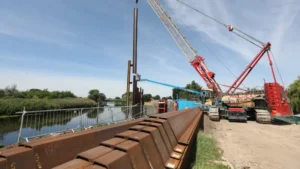
I remember a project in Southeast Asia where the river curved like a snake. The contractor asked me for advice. I told him U piles were the right choice. They followed the curve perfectly and the installation went smoothly. Let me walk you through when U piles make sense based on real experience.
What is the difference between U type and Z type sheet piles?
Before we talk about when to use U piles1, you need to understand what makes them different from Z piles2.
The main difference is the position of the interlocks3. U piles1 have interlocks3 at the neutral axis, near the center of the section. This makes them symmetric and forgiving during installation. Z piles2 have interlocks3 at the outer flanges, which gives them higher strength for the same weight.
](https://cnsteelplant.com/wp-content/uploads/2026/03/Article-Application-Port-1.webp)
Key Characteristics of U Piles
Let me explain what makes U piles1 special.
Symmetric Shape
U piles1 look the same from both sides. You can rotate them 180 degrees and they still interlock. This symmetry is a huge advantage on site. The crane operator does not need to worry about orientation. The crew can grab any pile and drive it.
Interlock Position
The interlocks3 sit at the tips of the flanges, right on the neutral axis. In engineering terms, the neutral axis is the line through the cross-section that experiences no bending stress. Putting the interlocks3 here means they see less stress during driving and under load.
Proven History
U piles1 with the Larssen interlock have been used for over 100 years. The design is proven. Engineers trust it. Contractors know how to install it.
Width Range
Standard U piles1 come in widths from 400 mm to 750 mm. The 400 mm width is a global standard that works with most equipment and accessories.
Water Tightness
The Larssen interlock on U piles1 creates a tight seal. When soil pressure pushes the wall, the interlocks3 compress and become even tighter. This makes U piles1 excellent for cofferdams and water control structures4.
Installation Behavior
U piles1 are forgiving. If the pile tilts slightly during driving, the interlocks3 still work. This reduces the risk of declutching, where the interlocks3 separate and the wall loses continuity.
When to use sheet piles?
Sheet piles are not the right solution for every job. You need to know when they make sense.
Use sheet piles when you need to retain soil or water for excavations, waterfront structures1, slope stabilization2, or underground construction. They are ideal for temporary works where speed matters, permanent walls where space is limited, and projects requiring water tightness.
](https://cnsteelplant.com/wp-content/uploads/2026/03/Article-application-6.webp)
Common Applications for Sheet Piles
Let me list the situations where sheet piles are the best choice.
Deep Excavations
When you dig a hole for a basement or foundation, the soil wants to collapse inward. Sheet piles create a stable wall that holds the soil back. Workers can dig safely inside the enclosed area.
Waterfront Structures
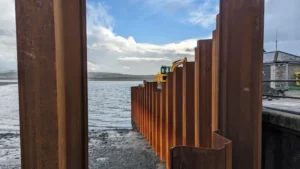
Ports, harbors, and canals need walls that resist water pressure and wave action. Sheet piles create durable seawalls and quay walls. The riverbank project in Southeast Asia is a perfect example.
Cofferdams
When you need to build something in water, you first build a cofferdam. Sheet piles form a watertight enclosure. You pump the water out and work in the dry area inside.
Flood Protection
Levees and flood walls often use sheet piles as a core. They prevent water from seeping through or under the barrier.
Slope Stabilization
Hillsides and embankments can slide. Sheet piles driven into the slope act as a barrier that stops the movement.
Cut-off Walls
Landfills and contaminated sites need barriers to stop groundwater from spreading pollution. Sheet piles create a low-permeability cut-off wall.
Tunnel Construction
When tunnels go under roads or rivers, sheet piles support the excavation at the entrance and exit points.
Bridge Abutments
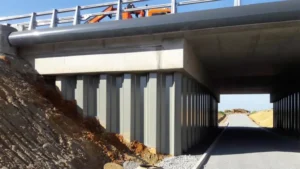
The ends of bridges need support. Sheet piles hold the soil behind the abutment and protect it from erosion.
What are the key factors to consider when selecting the appropriate type of pile for a given project?
Choosing the wrong pile can cost you time and money. You need a systematic way to decide.
The key factors are wall height, soil conditions, installation access, project duration, water tightness requirements, and budget. For U piles specifically, you also need to consider whether the wall is curved and how experienced your installation crew is.
](https://cnsteelplant.com/wp-content/uploads/2026/03/Article-images-3.webp)
Decision Framework for Pile Selection
Let me walk you through the factors I consider when helping clients choose.
Wall Height1
For walls under 10 meters, U piles are usually sufficient. Their strength matches the demands of moderate depths. For walls over 10 meters, Z piles become more attractive because they offer higher strength without excessive weight.
Soil Conditions2
Soft soils are easy to drive in. Any pile works. Hard soils or soils with obstructions require piles that can withstand driving stresses. U piles with thick webs handle hard driving well.
Installation Access3
Tight urban sites may limit equipment size. Lighter U piles are easier to handle with smaller cranes. Remote sites may prefer U piles because they are more forgiving if something goes wrong.
Project Duration
Temporary projects benefit from U piles because they are easy to extract and reuse. The riverbank project was permanent, but U piles still worked because the depth was moderate.
Water Tightness
If you need a watertight wall, U piles with Larssen interlocks are proven. The interlocks seal under soil pressure. For high water pressure, you may need sealants, but U piles are a solid starting point.
Wall Geometry
Curved walls demand U piles. Their symmetry allows them to follow radius curves smoothly. Z piles are designed for straight walls and struggle with curves.
Crew Experience
If your crew is new to sheet piling, choose U piles. They are forgiving. Mistakes in alignment are less likely to cause declutching. Experienced crews can handle Z piles, but U piles reduce risk.
Budget4
For moderate depths, U piles are cost-competitive. For deep walls, Z piles may save steel weight and overall cost. Always calculate total installed cost, not just material price.
My Experience
In Southeast Asia, the riverbank project checked all the boxes for U piles. Moderate depth, curved alignment, good soil, and a crew with moderate experience. U piles were the right call.
What are the 5 types of piles?
When you look at foundation options, you see many types. Understanding them helps you choose.
The five main types of piles based on function and material are end-bearing piles, friction piles, sheet piles, anchor piles, and combination piles. Sheet piles are one of these five, and U piles are a specific category within sheet piles.
](https://cnsteelplant.com/wp-content/uploads/2026/03/Article-Application-City-2.webp)
Complete Guide to Pile Types
Let me explain each type so you understand where U sheet piles fit.
1. End-Bearing Piles1
These piles transfer load through weak soil to strong rock or dense soil below. The bottom of the pile bears on the hard layer. Think of them as columns standing on bedrock.
- Common materials: Concrete, steel H-pipes, timber
- Used for: Heavy buildings, bridges, towers
2. Friction Piles2
These piles transfer load through friction along their sides. The soil grips the pile and holds it up. They do not need to reach bedrock.
- Common materials: Concrete, steel, timber
- Used for: Buildings on deep soft soil, where bedrock is too deep
3. Sheet Piles3
These are not load-bearing piles. They are retaining walls. Their job is to hold back soil or water, not to support vertical loads.
- Common materials: Steel, vinyl, timber, concrete
- Used for: Excavations, seawalls, cofferdams, flood walls
- U piles are one type of steel sheet pile
4. Anchor Piles4
These piles resist uplift or tension forces. They are pulled, not pushed. Often used with sheet piles to hold them in place.
- Common materials: Steel, concrete
- Used for: Tied-back walls, moorings, tension foundations
5. Combination Piles
These combine bearing and sheet pile functions. Sometimes called king piles or soldier piles. They are driven first, then sheet piles are installed between them.
- Common materials: Steel H-piles with sheet piles between
- Used for: Deep excavations, heavy retaining walls
Where U Piles Fit
U sheet piles are in category 3. They are retaining walls. They do not carry building loads. They hold soil back so other piles or foundations can be built safely.
Real Example
For a deep basement in Australia, the design used all five types. End-bearing H-piles for the building columns. Sheet piles (U type) for the temporary excavation wall. Anchor piles to tie the sheet piles back. Combination piles at the corners. Each type did its specific job.
Conclusion
U type sheet piles1 are the right choice for curved walls, moderate depths, temporary works, and projects where installation simplicity2 matters most. Let the site conditions guide your decision.
-
Explore this link to understand how U type sheet piles can enhance your construction projects with their unique advantages. ↩ ↩ ↩ ↩ ↩ ↩ ↩ ↩ ↩ ↩ ↩ ↩ ↩ ↩
-
Discover why installation simplicity is crucial for project efficiency and cost-effectiveness in construction. ↩ ↩ ↩ ↩ ↩ ↩ ↩
-
Discover the various applications of Sheet Piles, including their role in retaining walls and excavations. ↩ ↩ ↩ ↩ ↩ ↩ ↩ ↩ ↩ ↩
-
Find out how Anchor Piles resist uplift forces and their significance in foundation stability. ↩ ↩ ↩