How Do You Buy Steel Sheet Piles from China? A Complete Buyer’s Guide
Buying the wrong piles or the wrong supplier can sink your budget fast. I have seen both happen, and most of it is avoidable with the right process.
To buy steel sheet piles from China, confirm your section and grade, vet the supplier, agree on Incoterms and payment terms, arrange third-party inspection, and book shipment. A clear contract plus SGS inspection removes most risks for overseas buyers.
I run export sales at a factory in Liaocheng, Shandong, and I talk with contractors and steel distributors every week. Most of them ask the same five or six questions: What can Chinese mills actually make? How do I know the supplier is real? Who pays for what? In this guide, I will walk through the whole buying journey step by step, using what I see on real orders every month.
Why Do Buyers Choose Steel Sheet Piles from China?
Many buyers pay far too much locally because they never checked the factory option. One distributor told me his local quote was double our price for the same section.
Buyers choose China for competitive factory prices, a wide range of hot-rolled and cold-formed sections, flexible minimum order quantities, and proven export experience to the Middle East, Australia, Africa, and the Americas.
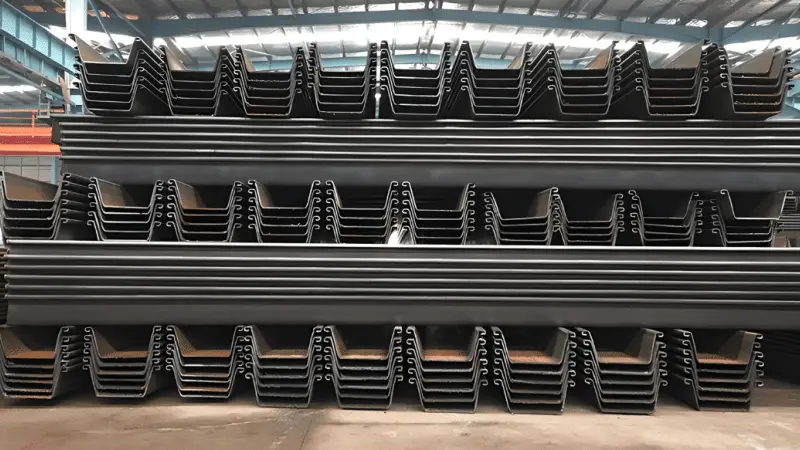
On the surface, the answer is price. But price alone never explains why contractors reorder from the same Chinese mills for years. The deeper reason is capacity and range. Chinese steel mills produce an enormous volume of sheet piling sections, from small U-type walls to heavy Z-type and straight-web profiles. When a tender demands a section that a local mill cannot roll, a Chinese factory usually can. You can see how wide the range is in our overview of types of steel sheet piles.
What Makes the Price Advantage Real, and Where Does It Disappear?
I will be honest about the math, because buyers trust suppliers who show it. Labor and energy costs in China are lower, and rolling mills run at a scale that spreads fixed costs over more tons. A local fabricator buying small lots cannot match that. This is the core reason behind the cost factors in steel sheet pile projects that I explain in another post.
But the price advantage disappears when logistics and quality risk are ignored. Sea freight from a Chinese port to the Gulf or to West Africa is not free, and a rejected batch costs far more than the discount. My rule for buyers is simple: compare landed cost, not ex-works price. Add freight, duty, port charges, and inland haulage on both sides before you decide. In most cases China still wins, especially for orders above one or two containers, but you should always run the numbers yourself. Price is only one cell in the table.
| Factor | Local supplier | Chinese factory (export) |
|---|---|---|
| Base price per ton | Higher | Lower |
| Section range | Limited | Wide, incl. OEM sections |
| MOQ | Varies | Flexible, wholesale only |
| Lead time | Short for stock | 15–30 days production + freight |
| Quality control | On-site visit easy | Needs inspection plan (SGS, video) |
Which Types and Grades Can You Order from a Chinese Mill?
Some buyers assume Chinese mills only make simple U sections. That belief is years out of date, and it costs them better options.
Chinese mills supply U-type, Z-type, Ω-type, straight-web, flat, hat, and box sections, in grades like Q235B, Q355B, S355GP, S430GP, and ASTM equivalents, with cold-formed and hot-rolled options for most projects.
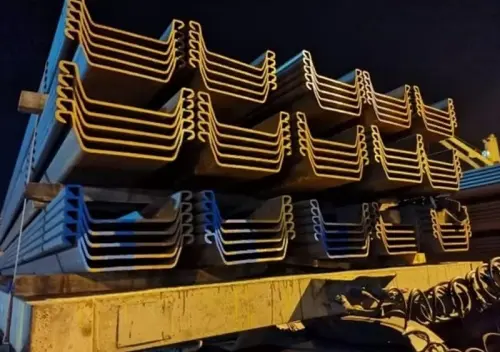
Let me start with the sections. U-type sheet piles remain the workhorse for riverbank and excavation walls. Z-type piles give better section modulus for deep walls and ports. Straight-web piles handle circular cell structures, and the special shapes cover niche uses. Our guide on steel sheet pile interlock types explains how the interlock choice changes wall performance. On grades, Chinese mills roll Q235B and Q355B as standard, and they can produce to S355GP, S430GP, or ASTM A572 and A690 equivalents when the order calls for it. Our article on common steel grades for sheet piles compares them in detail.
Hot-Rolled or Cold-Formed: Which One Should Your Order Use?
This choice confuses buyers more than any other, so let me make it simple. Hot-rolled piles have thicker corners, tighter tolerances, and better interlock durability for hard driving. Cold-formed piles cost less and work well in easy soils or temporary walls. For a permanent marine wall driven into dense sand, I always recommend hot-rolled. For a shallow trench support used once, cold-formed saves money with no real risk.
The catch is tolerances. Cold-formed sections vary more in width and interlock fit, so ask the factory for their tolerance table before you sign. A good supplier sends it without being asked twice. A bad one goes quiet, and that silence is your answer. Also check wall thickness at the pan, not just at the corners, because some cold-formed profiles thin out where bending stress is highest. We cover this trade-off in depth in our post on hot-rolled vs cold-formed sheet piles.
| Item | Hot-rolled | Cold-formed |
|---|---|---|
| Corner thickness | Enhanced | Uniform, thinner |
| Tolerance | Tight | Wider |
| Driving resistance | High | Moderate |
| Best use | Permanent, marine, hard soil | Temporary, easy soil |
| Relative cost | Higher | Lower |
How Do You Check a Chinese Supplier Before You Pay?
Fraud in this trade is rare, but slow failure is not. Buyers who skip verification usually lose time, not deposits.
Verify a supplier through business licenses, factory video calls, mill certificates, past export records, and a small trial order. Never release a large deposit before you have seen the production line and test reports.
Start with paperwork. A real factory has a business license, an export license, and ISO 9001 certification. Ask for the mill’s ISO certificate and check the scope matches steel products. Then move to the factory itself. I invite every serious buyer to a live video walk-through of our rolling and stacking lines, and I expect other honest factories to accept the same request. A trader will hesitate or show you someone else’s workshop. That difference tells you a lot. Our full checklist lives in the post on certifications for steel sheet pile export projects.
What Should a Proper Verification Checklist Contain?
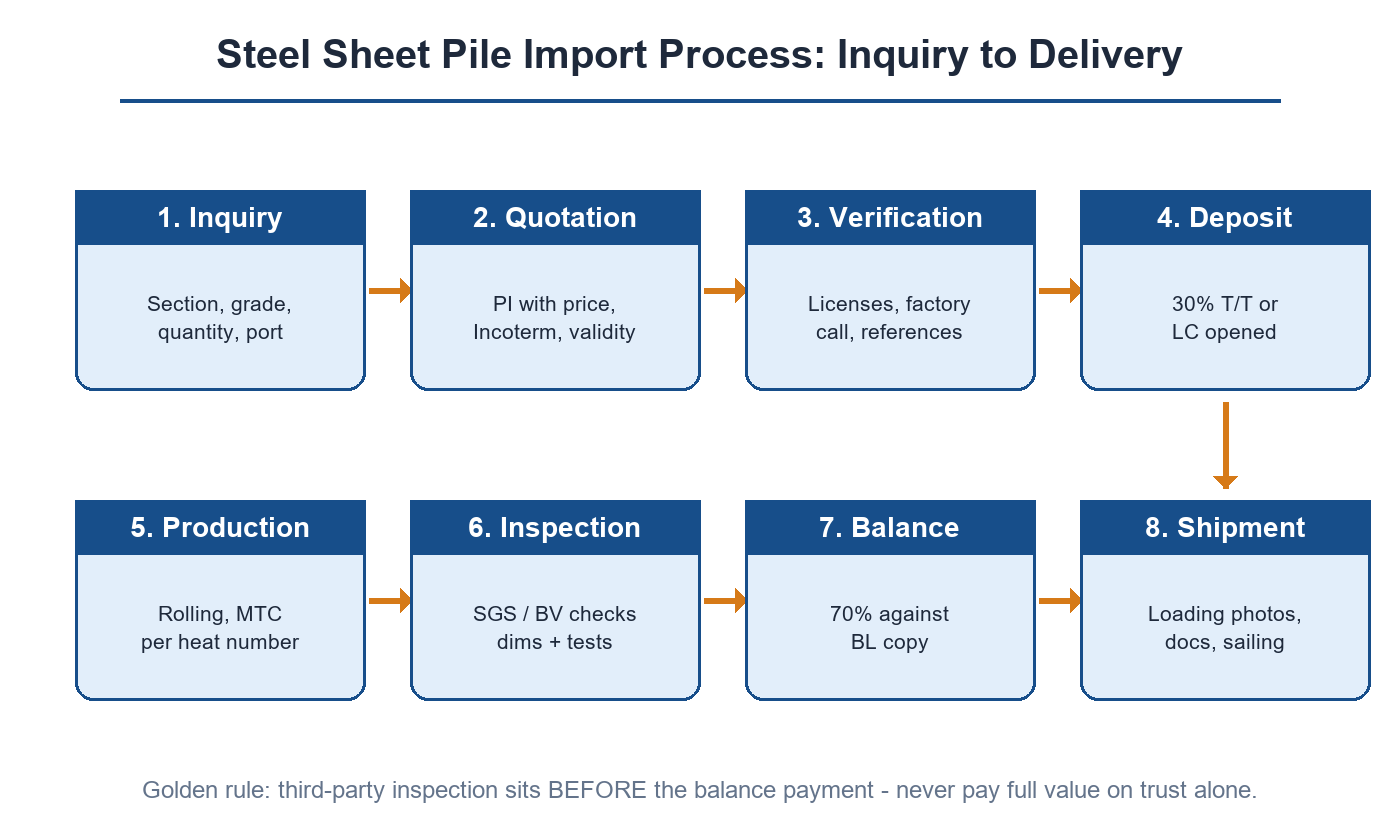
Here is the checklist I would use if I were the buyer. First, license and ISO documents, checked against the company name on the quotation. Second, a video call showing the production line, the yard, and the packing area in one continuous shot. Third, mill test certificates from recent batches, ideally with heat numbers you can match. Fourth, export references: bill of lading copies or photos from past shipments to your region. Fifth, a trial order or a third-party inspection before mass production.
That last point deserves its own emphasis. SGS, BV, or TUV inspection is cheap compared to the value of a full order. We welcome SGS inspectors at the factory before loading, and I tell buyers to make it a contract clause, not a favor. The certified report gives you independent yield strength, chemical composition, and dimension data. You can read how we handle this in our quality standards and inspection workflow. A supplier who resists inspection is telling you something, so listen.
| Verification step | What you get | Red flag if missing |
|---|---|---|
| Business + export license | Legal entity proof | Name mismatch with quote |
| Factory video call | Real production capacity | Refusal or borrowed footage |
| Mill certificates (MTC) | Heat-level quality data | Scanned, unverifiable PDFs |
| Export references | Track record | No shipment proof |
| Third-party inspection | Independent test results | “Not necessary” excuses |
Which Incoterms Should You Use: FOB, CIF, or DDP?
Buyers often pick an Incoterm by habit, not by need. The wrong choice either doubles your paperwork or hands the supplier cost control.
FOB suits buyers with their own freight forwarders, CIF bundles freight and insurance into one price, and DDP adds customs clearance at destination. Most first-time buyers start with CIF for simplicity or FOB for control.
Incoterms are just three-letter rules that split cost and risk between seller and buyer. Under FOB, we deliver the goods on the vessel at a Chinese port, and from that rail your risk starts. You book the ship, you buy the insurance, you control the schedule. Under CIF, we do those three things and invoice them inside the unit price. Under DDP, we even clear customs at your port, which needs a local import partner and is rare in this trade. For most contractors, CIF is the smooth start. For trading companies who live on freight margins, FOB wins.
How Do You Calculate the True Landed Cost per Ton?
Landed cost is the number that should drive your decision, so let me break one down. Take a typical order of 60 tons of Z-type piles shipped to Jebel Ali. The FOB value might sit around one number, sea freight adds a second, marine insurance a small third, destination port charges a fourth, and inland trucking from port to site the fifth. Duty depends on your country’s tariff code and any trade agreements. When I build this table with clients, many discover that freight swings the final cost by ten percent or more depending on season.
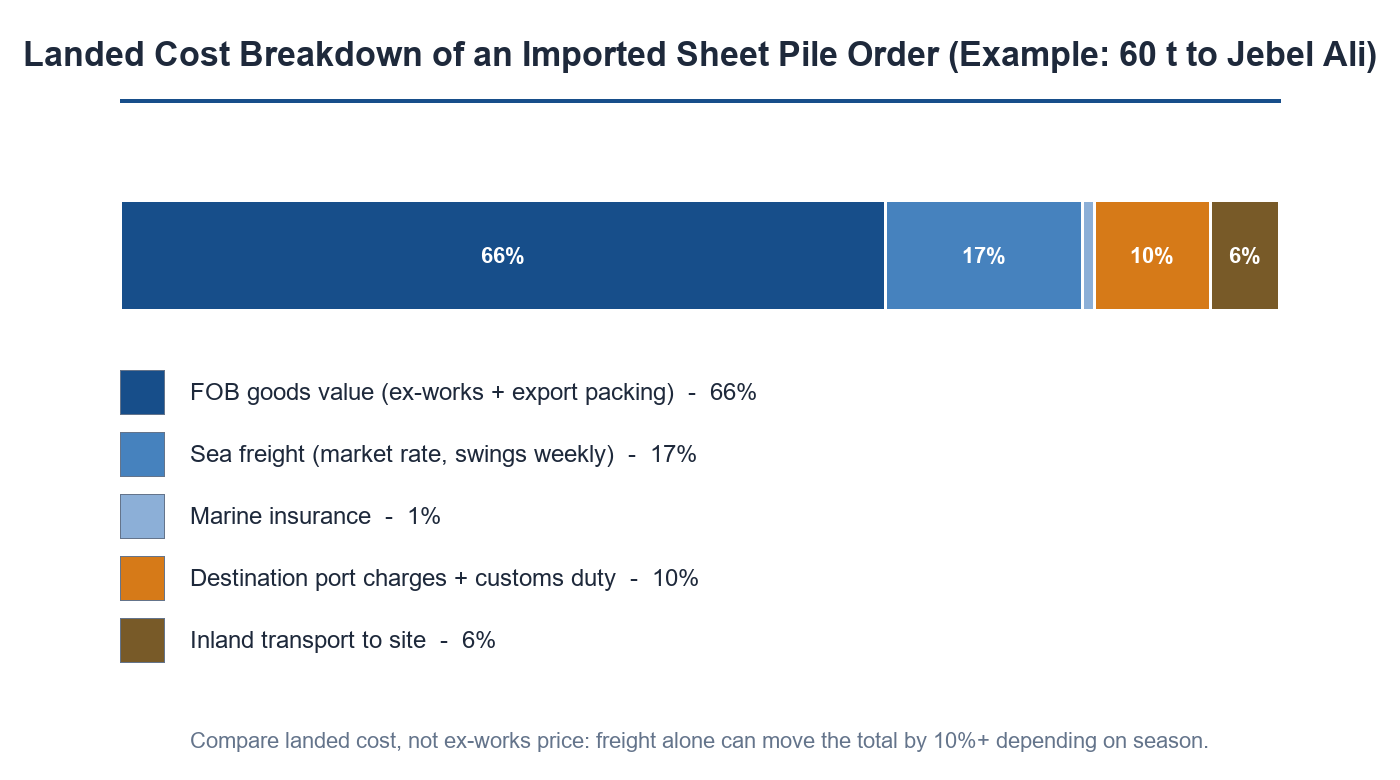
So my advice is to ask the supplier for a CIF quote and your forwarder for an FOB quote on the same volume, then compare. Also ask both for validity periods, because container rates move weekly. For a longer view on pricing behavior, our article on what affects steel sheet pile price covers the raw material side. The supplier who explains cost structure openly is usually the one whose invoice matches the quotation.
| Cost item | Paid under FOB | Paid under CIF | Notes |
|---|---|---|---|
| Goods + export packing | Buyer pays via supplier quote | Included | Same either way |
| China export customs | Supplier | Supplier | Always seller side |
| Sea freight | Buyer’s forwarder | Supplier | Market rate varies |
| Marine insurance | Buyer | Supplier | About 0.2–0.4% of value |
| Destination port + duty | Buyer | Buyer | Check local tariff code |
| Inland transport to site | Buyer | Buyer | Book early |
How Do Payment Terms and Quality Inspection Work?
Money rules scare new buyers the most. They should not, because the industry has settled patterns that protect both sides.
Standard terms are 30% deposit by T/T and 70% balance against the bill of lading copy. Larger buyers often use an irrevocable letter of credit. Quality is locked through mill certificates and pre-shipment SGS inspection.
The common cash pattern is a 30% deposit to start rolling and the 70% balance paid against a copy of the bill of lading after loading. This split protects us from buyers who vanish, and it protects you because the goods are already booked on a vessel before you pay the balance. Government and infrastructure projects often insist on a letter of credit, which adds bank fees but gives both sides a neutral referee. We accept LC at sight for suitable orders. What I refuse are terms that push all risk to one side, like full payment before production.
Where Should Inspection Sit in the Payment Timeline?
This is the detail that saves buyers real money, and it is easier than it sounds. Put the inspection before the balance payment whenever you can. The flow looks like this: production finishes, third-party inspectors visit the factory, they check dimensions, welds if any, interlock fit, and markings, and they witness tensile and chemical tests against the mill certificates. Only after the report comes back clean do you release the balance. Then we load and ship.
If your bank insists on LC at sight, the inspection still fits: the LC documents can include the inspection certificate, so payment triggers only after independent testing. Either way, you never pay the full value on trust alone. In my years at this desk, I have had exactly one batch fail an inspection, a wrong interlock tolerance on a cold-formed run. We re-rolled it at our cost and the client never lost a day. That is what the process is for. It is not about distrust; it is about making quality checks boring and predictable. Boring is good in this business.
| Payment method | Typical split | Buyer protection | Best for |
|---|---|---|---|
| T/T deposit + balance | 30% / 70% vs BL copy | Goods shipped before final payment | Most orders |
| Letter of credit at sight | 100% via bank | Bank verifies documents | Big / government tenders |
| Full prepayment | 100% upfront | None | Not recommended |
| D/P documents | Payment on documents | Moderate | Repeat trusted buyers |
What Happens During Packing, Shipping, and Customs?
The last stretch of the journey is where first-time buyers feel lost. It is actually the most standardized part.
Piles are bundled with steel strapping, loaded in containers or breakbulk, shipped under a bill of lading, and cleared with a packing list, commercial invoice, and certificates of origin and quality.
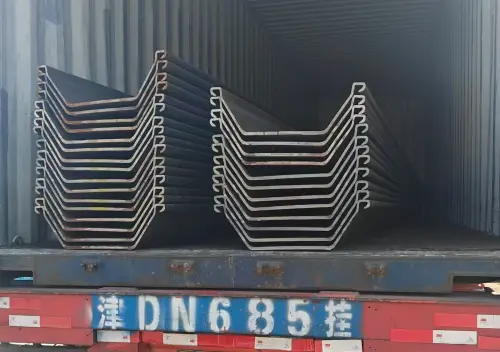
Packing comes first. We bundle piles in lifts with steel straps and wooden or steel supports, then load 20-foot or 40-foot containers for smaller sections, or breakbulk vessels for long, heavy profiles. Each bundle gets tags with section, grade, heat number, and bundle count, so your site crew can match bundles to the mill certificates without guessing. Photos of loading, strapping, and container sealing go to the buyer the same day. For long-term durability expectations after the piles arrive, our post on service life and durability of sheet piling is worth a read before you plan handling.
Which Documents Must Be Correct Before the Vessel Sails?
Documents decide whether your cargo waits at port or rolls to site, so treat them as seriously as the steel. The core set is five documents. The commercial invoice states value and terms. The packing list matches bundles to quantities. The bill of lading is the title document and must show the right consignee and notify party. The certificate of origin, often legalized or chamber-stamped, sets your duty rate. The mill test certificates tie every bundle to a heat number with chemical and mechanical results.
I check this set against the sales contract line by line before each shipment, because a one-letter mistake in a consignee name can hold cargo for weeks. Ask your supplier for document drafts before the vessel sails, not after. Every serious exporter does this as habit. And if your bank processes a letter of credit, forward the drafts to them too, because the bank checks documents with stricter eyes than any human clerk. Get this right and customs becomes a quiet Tuesday, not a crisis. That is the whole game: nothing dramatic, just discipline.
| Document | Issued by | Purpose |
|---|---|---|
| Commercial invoice | Supplier | Declares value and terms |
| Packing list | Supplier | Matches bundles and weights |
| Bill of lading | Shipping line | Title and transport proof |
| Certificate of origin | Chamber of commerce | Duty rate basis |
| Mill test certificates | Mill | Heat-level quality data |
My Take: What I Tell Every First-Time Buyer
Here is my honest view from the factory side. The buyers who succeed in China are not the toughest negotiators. They are the clearest communicators. The best orders I handle come from clients who send one drawing, one grade, one quantity, and one destination port, all in their first message. There is nothing to misunderstand, so nothing goes wrong.
The second thing I tell people is to buy the process, not the price. A supplier who volunteers tolerance tables, invites inspection, and sends loading photos without being asked will cost you less in total, even at a slightly higher unit price. I would rather lose an order than skip an inspection clause, because a single failed batch damages both of us more than a discount ever could. And start small: a trial container builds trust faster than any certificate. Once you have one clean shipment behind you, scale becomes easy, and we both stop worrying about paperwork and start talking about your next ten projects. Clear specs, staged payments, and third-party checks are not obstacles. They are the reason this trade works across ten thousand kilometers.
Conclusion
Buying steel sheet piles from China works best with clear specs, verified suppliers, staged payments, and pre-shipment inspection. Follow these steps and your first container will not be your last.