How Are Steel Sheet Piles Used in Bridge Foundation and Pier Construction?
Bridge foundations often sit in soft riverbed soils or tidal zones where water and loose material threaten every cubic meter of excavation. I have watched crews fight slurry walls, dump riprap, and still lose shape in the hole. Steel sheet piles give us a faster, reusable wall that keeps the water out and the soil in place while we build the pier below.
Steel sheet piles are interlocking steel sections driven into the ground to form temporary cofferdams and permanent retaining walls around bridge piers, creating a dry, stable workspace for foundation construction.
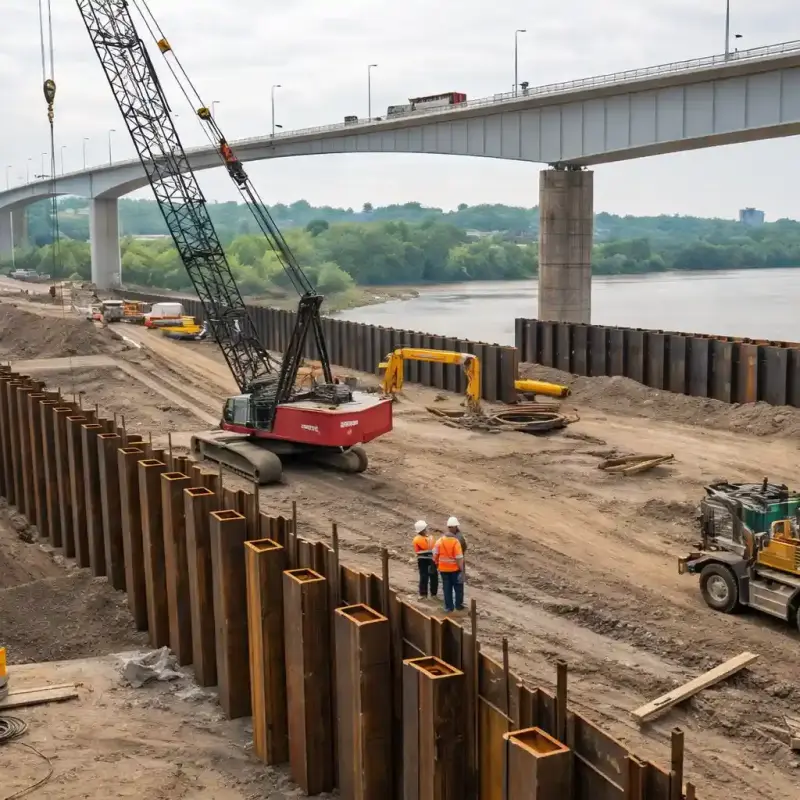
In this article, I will walk through the real decisions we make when we supply sheet piling for bridge projects. You will see which profiles fit piers, how crews drive them without disturbing an existing bridge, and what determines whether the cofferdam stays dry for months or fails on the first spring tide.
Why Do Bridge Piers Need Sheet Pile Cofferdams?
A bridge pier is only as good as the soil it stands on, and most rivers do not hand us dry bedrock at the surface. We usually meet mud, loose sand, or water-bearing gravel that collapses the moment we start digging.
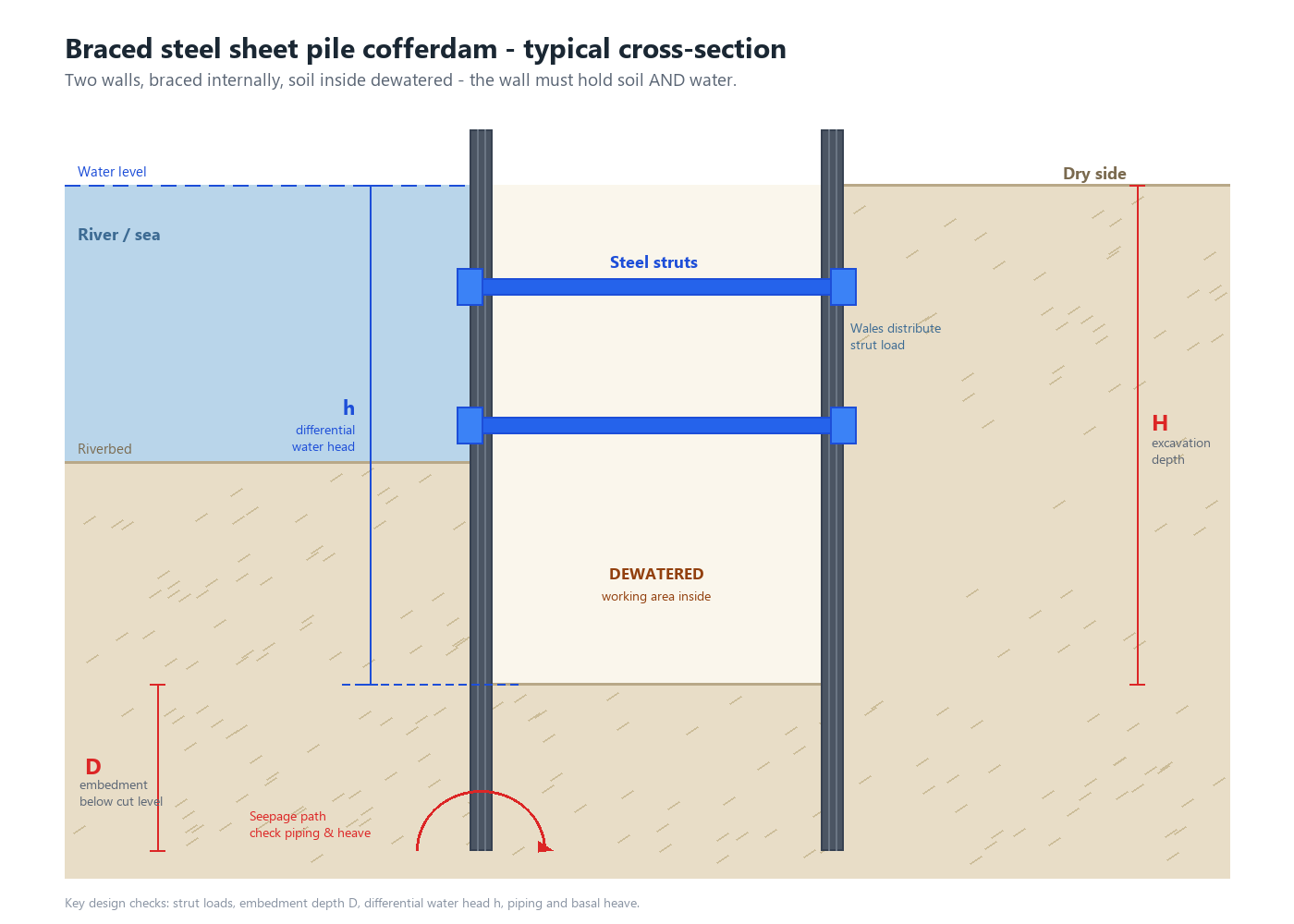
A sheet pile cofferdam is a temporary watertight cell driven around the pier footprint so workers can dewater the area and pour footings in the dry.
Choosing the Right Cofferdam Shape
I have supplied sheet piles for circular, rectangular, and double-wall cofferdams on bridge sites from Southeast Asia to the Middle East. Each shape solves a different problem. A circular cell handles inward water pressure evenly and uses fewer corner pieces, which makes it my first choice for deep piers in wide rivers. A rectangular cell fits tight piers near existing abutments, but the corners need careful sealing or the cofferdam weeps. A double-wall cofferdam gives us the biggest dry working area for massive pier caps, though it eats more steel and takes longer to drive.
The table below shows how I normally compare them:
| Cofferdam Shape | Best For | Steel Usage | Sealing Risk | Typical Pier Depth |
|---|---|---|---|---|
| Circular | Deep piers in open water | Moderate | Low | 8–18 m |
| Rectangular | Tight spaces near existing structures | Low to moderate | Medium | 5–12 m |
| Double-wall | Large pier caps, heavy equipment access | High | Low | 10–25 m |
Once the cofferdam is driven, the crew installs waler beams and internal struts before pumping. I have seen people skip the bracing and try to dewater first; the wall buckles inward within minutes. The sequence matters: drive, cut the top to level, weld or bolt the waler frame, install the corner struts, then start the pumps slowly. Dewatering too fast can pull a clay plug and cause piping failure at the toe. We usually recommend leaving a sump in one corner and running it continuously because a dry cofferdam is only safe when the groundwater is controlled, not just removed once.
In our factory near Liaocheng, Shandong, we often cut custom interlock angles for rectangular cofferdams because the standard rolled corner does not always match the pier geometry. SGS inspection is included so the contractor receives mill certificates and interlock tightness reports before the steel ships. I always remind clients that a cofferdam is not just a fence; it is a structural ring that resists hydrostatic pressure, soil collapse, and accidental impact from barges or piling rigs. For more detail, read our earlier post on using steel sheet piles for cofferdams and deep excavations.
Which Sheet Pile Profiles Work Best for Bridge Piers?
Not every sheet pile profile handles the loads around a bridge pier the same way. The profile must resist the lateral earth pressure from the cofferdam wall and also take the point loads from waler beams, struts, and bracing frames.
U-type and Z-type steel sheet piles are the most common choices for bridge piers because their interlocks transfer lateral loads efficiently and their wide profile gives a high section modulus per meter of wall.
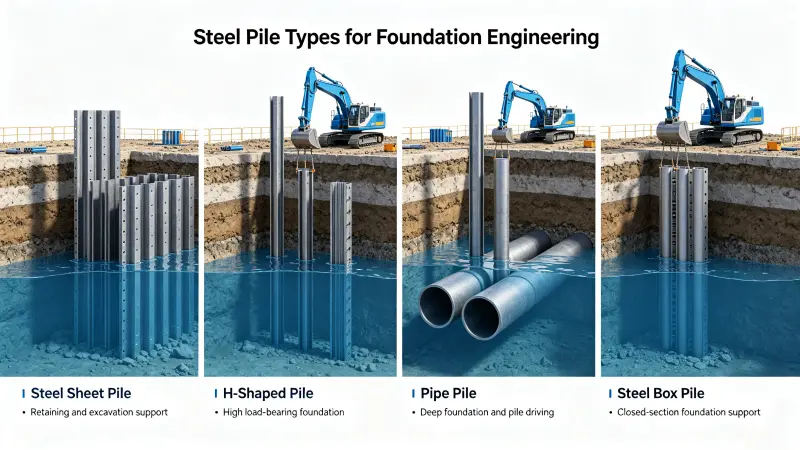
U-Type vs. Z-Type for Pier Work
I usually start with U-type piles when the cofferdam is circular or the water depth is moderate. The symmetric shape makes interlock alignment forgiving during driving, which matters when a crane barge is rocking in river currents. Z-type piles win when we need a high section modulus with less steel weight. Their shifted interlock creates a deeper wall section, so one Z-pile can replace two lighter U-piles in some designs.
Ω-type and straight-web piles appear on bridge projects too, but in different roles. Ω-type interlocks seal better, so we see them when the cofferdam must stay bone-dry for underwater concrete pours. Straight-web piles are the heavy-duty choice for cellular cofferdams and deep marine cells where tensile forces across the interlock dominate the design.
| Profile | Interlock Strength | Water Sealing | Best Pier Use | Common Steel Grades |
|---|---|---|---|---|
| U-type | Good | Good | Circular cofferdams, moderate depth | Q235, Q355, S355 |
| Z-type | Very good | Good | Deep walls needing high section modulus | Q355, S355, S430 |
| Ω-type | Excellent | Excellent | Watertight cofferdams, underwater concrete | S355, S430 |
| Straight-web | Excellent tensile | Moderate | Cellular cofferdams, heavy loads | S355, S390 |
Interlock tolerance is another detail that matters on bridge piers. A loose interlock lets water through; an overtight one can jam the next panel during driving. We ship piles with larssen or thumb-and-finger interlocks depending on the design, and we always send a sample pair for the contractor to check on site before the full lot arrives. When the project needs a fully watertight ring, we can supply piles with interlocks pre-greased or fitted with factory-applied sealant. The small extra cost beats the cost of diving to fix a leak after the cofferdam is dewatered.
One mistake I see repeatedly is choosing a profile based only on price per ton. A Z-pile might cost more per meter, but if it lets the engineer reduce the number of waler levels, the total installed cost drops. That is why our sales team asks for the geotechnical report and the pier drawing before we quote. We do not sell retail; we support contractors who need the right steel, not the cheapest steel. If you want a deeper comparison of profile behavior, our interlock types guide explains how each system transfers shear and water pressure.
How Is Sheet Pile Driving Controlled Near Existing Bridges?
Driving sheet piles next to an active bridge deck or an existing pier is not the same as driving them in an open field. Vibration, noise, and horizontal ground displacement can damage nearby structures, utilities, and even the bridge you are trying to extend.
A vibratory hammer with real-time pitch and depth monitoring is the preferred driving method near existing bridges because it reduces ground vibrations and allows operators to stop instantly if alignment drifts.
Vibratory vs. Impact Driving in Sensitive Areas
On most bridge piers I support, we use a vibratory hammer to sink the piles through the upper loose layers, then switch to a hydraulic impact hammer only for the last few meters into dense sand or weathered rock. Vibratory driving is fast and keeps vibration velocity low, but it can loosen the soil around the pile if overdone. Impact driving gives better penetration in refusal conditions, yet each blow sends shock waves that travel through the ground.
The key control points are verticality, interlock engagement, and toe elevation. I tell every contractor the same thing: check verticality every two meters with a total station or inclinometer. If the first panel leans, every panel after it leans more, and the waler holes will not line up. Interlock engagement matters because a single disengaged tooth can turn into a water jet path under hydrostatic pressure. Toe elevation matters because the pile must reach the design cut-off level before excavation starts.
| Driving Method | Speed | Vibration Level | Best Soil | Monitoring Priority |
|---|---|---|---|---|
| Vibratory | Fast | Low to moderate | Loose sand, silt, soft clay | Verticality, interlock, toe level |
| Hydraulic impact | Moderate | High | Dense sand, gravel, weathered rock | Peak particle velocity, alignment |
| Press-in / silent | Slow | Very low | Urban or seismic zones | Load capacity, verticality |
I also tell clients to set up vibration monitors on the existing bridge abutment and nearby utilities before the first pile moves. Most city codes limit peak particle velocity to 5 mm/s for sensitive structures, but I prefer a project-specific threshold set by the engineer. Noise is a second concern in urban piers. A fully suspended vibratory hammer is much quieter than impact driving, and it reduces the risk of complaints that shut the site down. In dense urban settings, a silent press-in rig or pre-auguring can cut vibration to near zero, although the production rate drops.
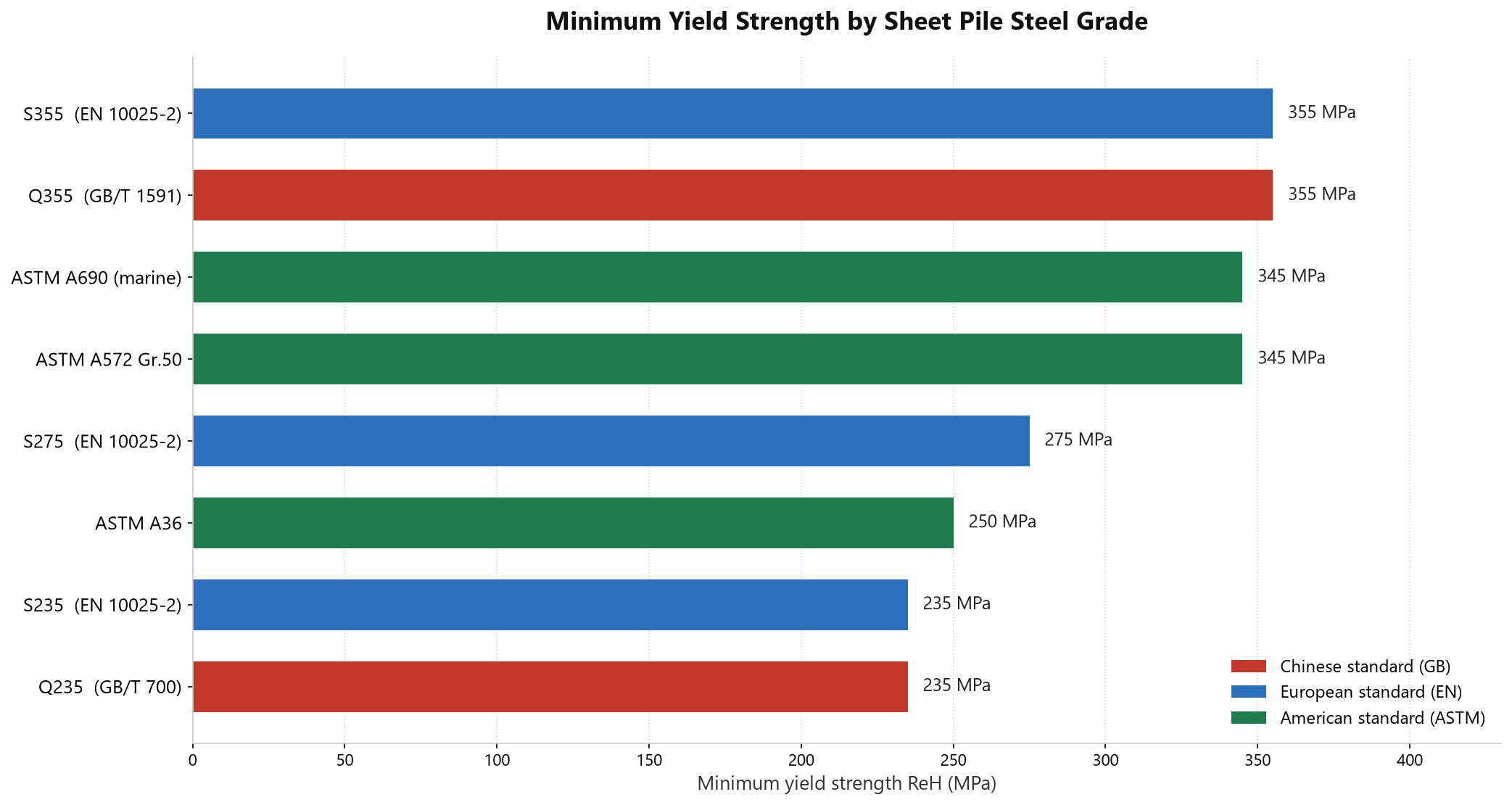
In earthquake-prone areas like parts of Pakistan or the Middle East, we sometimes specify a heavier grade or longer embedment so the cofferdam wall behaves as a ductile retaining system rather than a brittle barrier. Our steel grades guide explains how Q355 and S355 compare in yield strength and toughness. For a broader view of marine applications, see our post on steel sheet piles for port and harbor protection projects.
What Design Factors Keep a Pier Stable for Decades?
A bridge pier is a 50- to 100-year asset, so the sheet pile wall must survive long after the cofferdam is removed or repurposed. Design factors include embedment depth, wall stiffness, corrosion allowance, and the transition from temporary cofferdam to permanent support.
Long-term pier stability depends on embedment depth, wall stiffness, corrosion allowance, and whether the sheet pile wall remains in place as a permanent retaining structure or is fully extracted after footing completion.
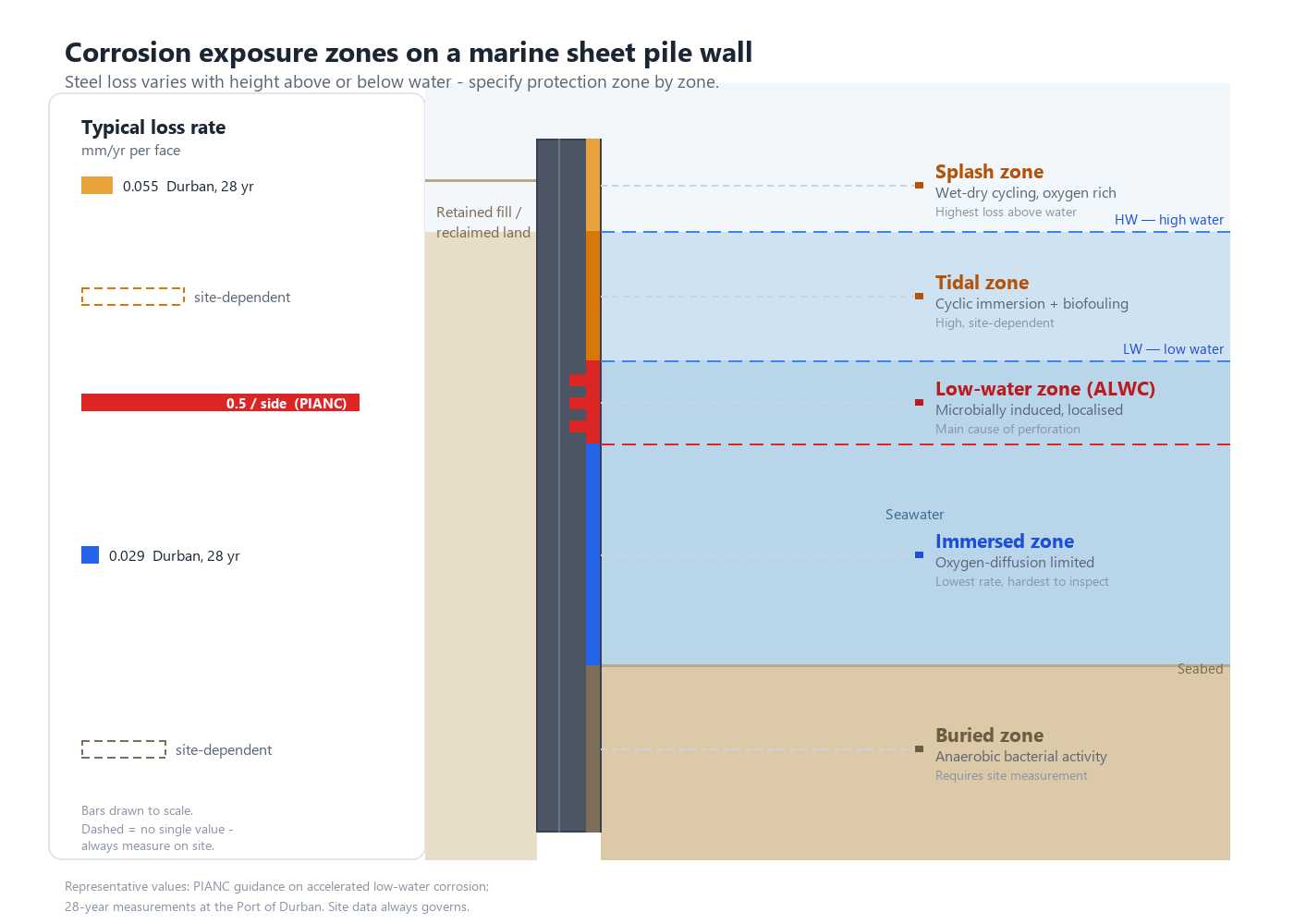
Corrosion and Steel Grade Decisions
Marine piers face the harshest corrosion environment I know. The splash zone, where waves and oxygen meet, eats steel faster than the fully submerged zone because of repeated wet-dry cycles. The atmospheric zone above high tide corrodes more slowly but still needs protection. We usually add a corrosion allowance to the design thickness and specify a corrosion-resistant steel like ASTM A690 for marine splash zones because its copper-nickel-phosphorus chemistry outlasts ordinary carbon steel.
For freshwater river piers, a high-quality coating system plus cathodic protection often suffices. I never recommend leaving bare carbon steel in a tidal environment without at least calculating the expected section loss over the design life. A wall that looks fine on day one can lose 10–15% of its section modulus in 20 years if we ignore corrosion.
| Zone | Exposure | Typical Corrosion Rate | Protection Approach |
|---|---|---|---|
| Atmospheric | Above high tide, salt spray | Low to moderate | Coating, inspection |
| Splash | Intermittent wetting | High | Corrosion-resistant steel, extra thickness |
| Tidal | Daily immersion cycles | Moderate to high | Coating + cathodic protection |
| Submerged | Constant water | Low to moderate | Cathodic protection, coal-tar epoxy |
Some bridge piers leave the sheet pile wall in place as a permanent scour protection ring or retaining wall. In that case, the design must account for the exposed life of the steel. A temporary cofferdam might be sized for two years, but a permanent wall needs corrosion allowances, coatings, and possibly cathodic protection for the full service life. I have seen projects extract the inner ring and leave an outer ring as a permanent cut-off wall. That approach saves steel and gives long-term protection.
Reusability is one of the quiet advantages of steel sheet piles. After the pier footing cures, the contractor can extract the inner cofferdam and move it to the next pier. I have supplied the same lot of piles for four or five bridge piers in sequence because the contractor planned the extraction carefully. The key is to avoid over-driving, use a proper extraction sequence that balances the wall, and repair interlock damage immediately. A pile that is bent at the toe may still work as a cut-off piece, but it will not drive straight on the next site.
When we ship sheet piles for bridge jobs, we pack them to avoid seawater contact during transit and we mark each pile with heat number and steel grade. That traceability helps the engineer match certificates to the actual wall section. Our mill in Liaocheng, Shandong can roll Q235, Q355, S355, and S390 grades with SGS inspection on request. OEM lengths and corner pieces are standard because no two bridge piers are exactly the same.
My View From the Factory Floor
After years of watching bridge projects move from inquiry to installation, I believe the biggest risk is not the steel itself; it is the mismatch between the cofferdam design and the real site conditions. Soil reports lie sometimes. Tide tables change. A contractor might win the job with a cheap pile that cannot handle the spring flood. That is why I push our clients to share the pier drawing, the geotechnical report, and the construction schedule before we finalize the bill of materials. We are a B2B supplier, not a hardware store, and our value is in helping engineers pick the right profile, grade, and length the first time. If a cofferdam fails mid-pour, the steel cost is the smallest part of the loss.
Conclusion
Steel sheet piles create dry, stable cofferdams around bridge piers. The right profile, method, and grade prevent costly failures.
Tags: steel sheet piles, bridge foundation, pier construction, sheet pile cofferdam, steel sheet pile supplier