Steel Sheet Pile Interlock Types and Their Performance Advantages?
A weak interlock is the silent killer of every sheet pile wall. I have watched water find its way through a badly matched joint and turn a dry cofferdam into a flood.
Steel sheet pile interlocks are the tongue-and-groove joints along the edges of each pile. They lock adjacent sheets together, transfer shear, keep water out, and decide how well the wall performs under load.
The interlock is not just a connection detail. In my view, it is the heart of the whole system. If you pick the wrong interlock for your soil or water pressure, the rest of the wall cannot save you. That is why I always ask our engineers in Liaocheng to confirm the interlock type before we quote a batch for export.
I have shipped piles to many countries, from Saudi Arabia to Australia, and the first technical question I get is always about the interlock. Contractors want to know if it will leak, if it will unlock during driving, and if it can be pulled out again at the end of the job. These are the right questions, because the interlock does three jobs at once: it keeps the wall together, it stops water, and it carries load.
What Are Steel Sheet Pile Interlocks and Why Do They Matter?
Have you ever driven a pile and heard the clack of a half-locked joint? That sound costs money.
Interlocks are the machined edges of a steel sheet pile that grip the next sheet. They create a continuous wall from many single pieces and must resist water, soil, and bending at the same time.
How Interlocks Transfer Loads
A sheet pile wall is only as good as the joints between the sheets. When earth pushes on one side, the load moves through the pile section and into the interlock. The interlock then passes that force to the next pile. If the joint is loose, the wall bows, leaks, or even fails.
| Load Type | What the Interlock Must Do | What Happens If It Fails |
|---|---|---|
| Bending | Share moment between adjacent sheets | Local bulging or cracking |
| Shear | Stop sheets from sliding past each other | Step-like deformation at joints |
| Water pressure | Form a seal against seepage | Wet excavation, boil, or piping |
| Driving stress | Stay closed under vibration or impact | Unlocking, misalignment, damage |
I have seen projects in the Middle East where the contractor saved money on interlock quality and lost twice as much on dewatering. That is a lesson I keep in mind when we pack containers for Iraq, Jordan, or the UAE. One project in Kuwait comes to mind. The contractor used a budget cold-formed pile with a loose box lock. After the first week of dewatering, the pumps could not keep up. They had to stop, install a sealant, and lose ten days. The saving on the pile price was gone before the wall was halfway complete.
The Connection to Wall Behavior
The steel sheet pile interlock types you choose change the way the whole wall behaves. A tight Larssen joint gives you stiffness. A thumb-and-finger clutch gives you flexibility for driving. A straight-web joint gives you strength in tension but less bending capacity. Each choice is a trade-off.
I often compare the interlock to the zipper on a jacket. One broken tooth and the whole zipper opens. One damaged clutch on a sheet pile can let water through, increase deflection, and make extraction harder. That is why our loading team pads the clutch ends before lifting, and why we reject any pile with a crushed or twisted interlock.
When I review a design, I look at the interlock first and the steel grade second. A Q355 pile with a poor interlock is like a strong chain with a weak link. The wall will fail where the load crosses from one sheet to the next. That is why the template drawings in our Liaocheng office always show the interlock tolerance next to the section modulus.
What Are the Main Steel Sheet Pile Interlock Types Used Today?
Not every site needs the same joint. After fifteen years of exporting piles, I still see engineers confuse the names.
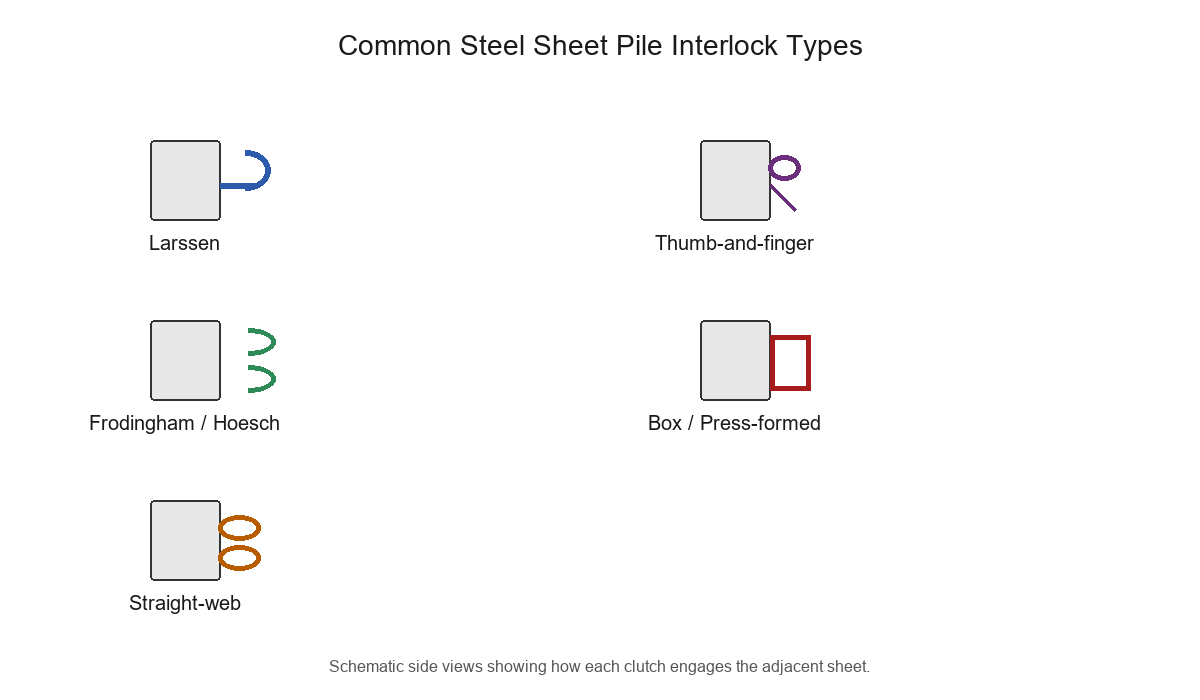
The most common interlock types are Larssen, Frodingham or Hoesch, straight-web, and thumb-and-finger or ball-and-socket clutches. Each profile was developed for a different soil, load, or water condition.
A Quick Profile Guide
| Interlock Type | Shape | Typical Use | Water Seal | Shear Transfer |
|---|---|---|---|---|
| Larssen | Hooked half-circle | General retaining walls, ports | Good | Good |
| Frodingham / Hoesch | Deep double-clutch | Heavy marine walls, cofferdams | Very good | Excellent |
| Straight-web | Flat bar loops | Cellular structures, tension walls | Moderate | Excellent in tension |
| Thumb-and-finger | Knuckle and socket | Z-type and U-type sections | Good | Good |
| Box / Press-formed | Crimped flat lock | Cold-formed sections | Moderate | Moderate |
Larssen interlocks are the classic choice for U-type steel sheet piles. They are easy to drive and redrive, which matters when you rent equipment by the day. Frodingham and Hoesch joints were built for harder marine work. Their deeper clutch gives a larger contact surface and better waterproofing performance.
Straight-web piles use a simpler loop-to-loop joint. They are not great at resisting bending on their own, but they shine in cellular cofferdams where the wall works mainly in tension. Thumb-and-finger clutches are common on Z-type steel sheet piles because they let the sheets sit flat in the stack and still interlock at the flange line.
Box or press-formed interlocks are usually found on cold-formed sections. They are cheaper and lighter, which makes them attractive for temporary works. But the crimped lock is shorter and has less contact area than a hot-rolled Larssen or Frodingham clutch. I only recommend these for low-head, short-life projects where the piles will not be reused many times.
The name of the interlock also changes by region. In Europe, Larssen is the common name. In North America, you may hear “PS” or “PZ” clutches. In Japan, some mills use a “thumb and finger” or “clutch ball” shape. The geometry is similar even when the name is different. What matters is the contact length, the gap tolerance, and the steel grade around the clutch.
How Does Each Interlock Perform in Water Sealing?
Water is the real test. Soil loads are slow and visible. Water finds the smallest gap and waits.
Frodingham and Hoesch interlocks give the best water seal because their deep double-clutch leaves a long path for seepage. Larssen and thumb-and-finger joints perform well for most jobs but may need a sealant in high-head conditions.
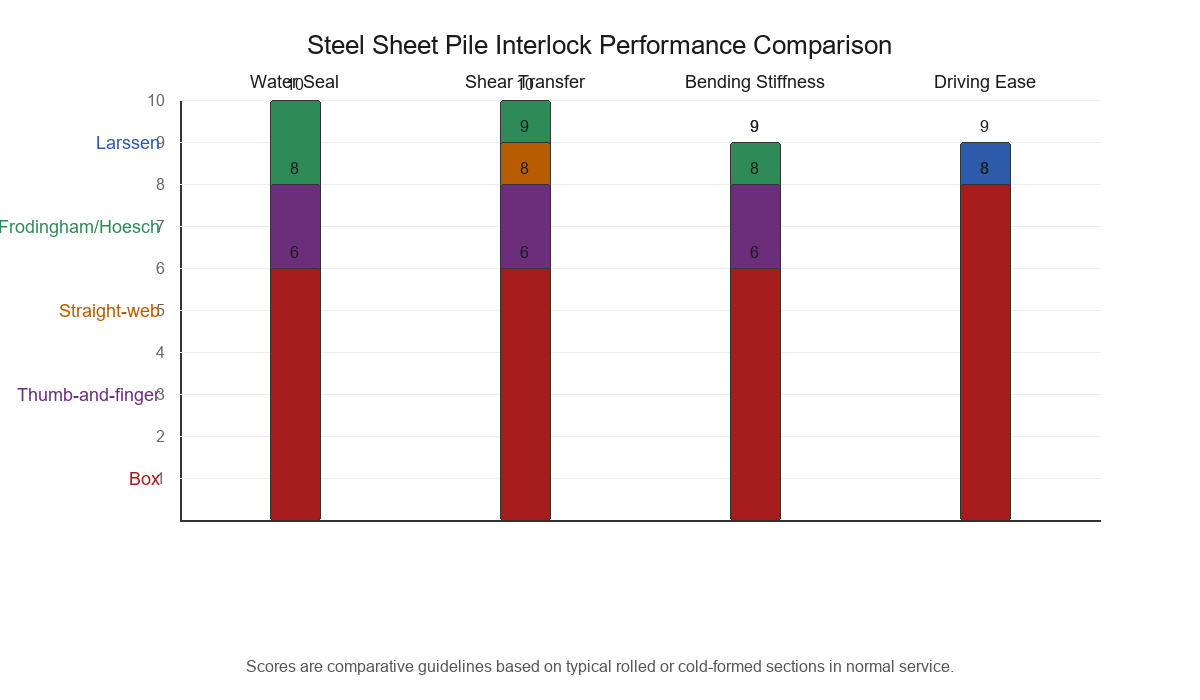
Sealing Factors to Compare
| Factor | Larssen | Frodingham/Hoesch | Straight-web | Thumb-and-finger |
|---|---|---|---|---|
| Natural gap | Small | Very small | Larger | Small |
| Path length for water | Medium | Long | Short-medium | Medium |
| Need for sealant | Sometimes | Rarely | Often | Sometimes |
| Ease of redriving | Good | Moderate | Moderate | Good |
The table above is a starting point, not a guarantee. A Larssen joint in perfect condition seals well. The same joint on a pile with a bent clutch seals badly. That is why I always tell our SGS team to inspect the interlock as carefully as the web and flange thickness.
In our factory checks, I ask the SGS inspector to look at three things on the interlock: straightness, surface finish, and freedom from cracks. A rough surface lets water creep even when the gap looks closed. A cracked clutch will never seal, no matter how tight the soil is. We also measure the clutch opening with a go/no-go gauge. If the opening is too wide, the joint will be loose even before the first pile is driven.
Another point that buyers forget is corrosion. In the splash zone, the interlock loses thickness faster than the main web because water and oxygen sit in the crevice. A deep Frodingham clutch gives you more corrosion allowance than a shallow box lock. For marine projects in the Gulf, I usually add a small extra thickness to the interlock area or specify a protective coating.
For marine projects in the Gulf or along the Australian coast, I usually push clients toward Frodingham-style or high-quality Larssen joints with a sealant. If the wall is only in soft ground above the water table, a standard Larssen joint is enough. In a recent port job in Pakistan, the consultant specified a hydrophilic sealant inside the Larssen clutch because the tidal range was large. That small detail saved the contractor from running extra pumps around the clock.
How Does Each Interlock Handle Shear and Bending?
Driving is one load case. The finished wall is another. You must check both.
Frodingham and straight-web interlocks transfer shear best because their geometry resists sliding between sheets. Larssen and thumb-and-finger joints are easier to drive and redrive, but they can open slightly under high differential water or earth pressure.
Bending vs Shear Performance
| Interlock Type | Bending Stiffness | Shear Resistance | Best Application |
|---|---|---|---|
| Larssen | High | Good | Retaining walls, riverbanks |
| Frodingham/Hoesch | High | Very high | Quay walls, heavy marine |
| Straight-web | Low | Very high in tension | Cellular cofferdams |
| Thumb-and-finger | High | Good | Z-type wall systems |
I want to be clear about one thing. The interlock does not replace the pile section modulus. A strong joint with a weak section is still a weak wall. That is why our steel grades guide pairs Q355 or S355 with interlocks that match the design moment.
When I talk to contractors in Saudi Arabia or Kuwait, I remind them that high passive earth pressure needs both section strength and joint stiffness. The interlock is where the moment jumps from one sheet to the next. If that jump is soft, the wall deflects more than the calculation assumes. I always tell clients to ask for the interlock moment of inertia or the joint stiffness factor if the wall is more than a few meters deep. Most hand calculations assume a perfect connection. In the field, the connection is never perfect.
Which Steel Sheet Pile Interlock Should You Choose for Your Project?
This is the question every buyer asks. My answer is always the same: start with the load, then look at the soil, then check the water.
Choose Frodingham or Hoesch interlocks for marine walls and deep cofferdams. Choose Larssen interlocks for general retaining walls and riverbanks. Choose straight-web interlocks for cellular structures where tension governs.
Decision Checklist
| Project Condition | Recommended Interlock | Why |
|---|---|---|
| High water head, salt water | Frodingham / Hoesch | Best seal and corrosion allowance |
| Soft clay, deep excavation | Larssen with sealant | Easy driving, good moment capacity |
| Cellular cofferdam, ring fill | Straight-web | High tensile capacity around cells |
| Tight budget, temporary wall | Cold-formed box lock | Lower cost, shorter service life |
| Repeated reuse of piles | Larssen or thumb-and-finger | Easier to extract and redrive |
Our mill in Shandong can produce U-type, Z-type, straight-web, and custom interlock profiles. We do not keep every size in stock, but our lead time for OEM interlock tooling is usually shorter than most overseas mills. That matters for contractors in Pakistan or Africa who cannot wait three months. We also support SGS inspection before loading, so the client can verify the interlock dimensions and surface quality before the container leaves the yard.
Price is always part of the decision, but I warn buyers not to compare pile prices without comparing interlock quality. A cheaper pile with a loose box lock can cost more in dewatering, rework, and delays than a hot-rolled pile with a tight Larssen or Frodingham joint. When I quote a project, I separate the section price from the interlock tolerance class so the client knows what they are paying for.
My View on Interlock Selection
I have seen too many specifications copy the same interlock drawing from one job to the next. That is lazy engineering. The interlock should match the soil report, the water table, and the expected service life. A hot-rolled Larssen pile in Q355 steel with a clean interlock will outperform a cold-formed pile with a fancy profile in bad soil.
One more thing: always ask for the interlock tolerance report. At cnsteelplant.com, we check width, twist, and clutch opening before we release a shipment. Small mills skip this step. When the piles arrive on your quay and the clutches do not fit, the whole schedule stops.
If you are not sure which interlock fits your project, send us the wall design and soil data. Our engineers will match the profile and the interlock type to your load case. We have done this for projects in North America, South America, Africa, and the Middle East. The same steel grade can behave very differently depending on the interlock geometry. Getting that match right is the cheapest insurance you can buy for a sheet pile wall.
Conclusion
The right interlock turns single steel sheets into one solid wall. Match it to water pressure, soil load, and service life, and your sheet pile project will stay dry and straight.