I have seen entire communities devastated by floods. I have watched the water rise and destroy roads, homes, and businesses. The problem is only getting worse with climate change. We need strong, reliable solutions to protect people and property.
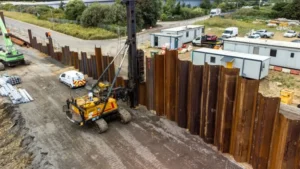
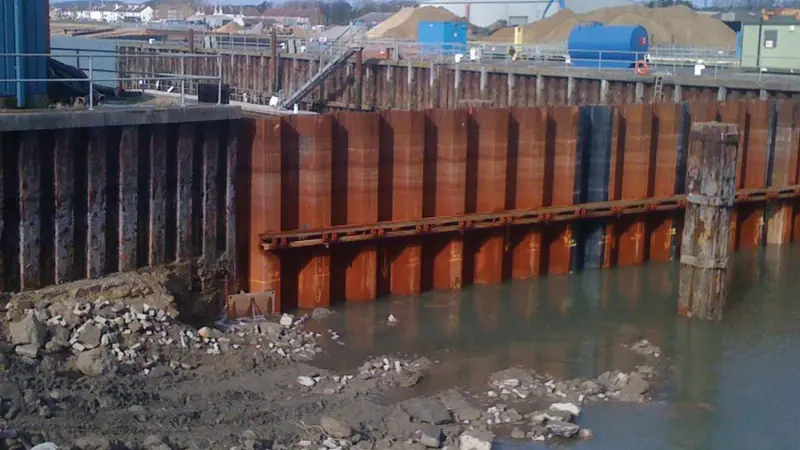
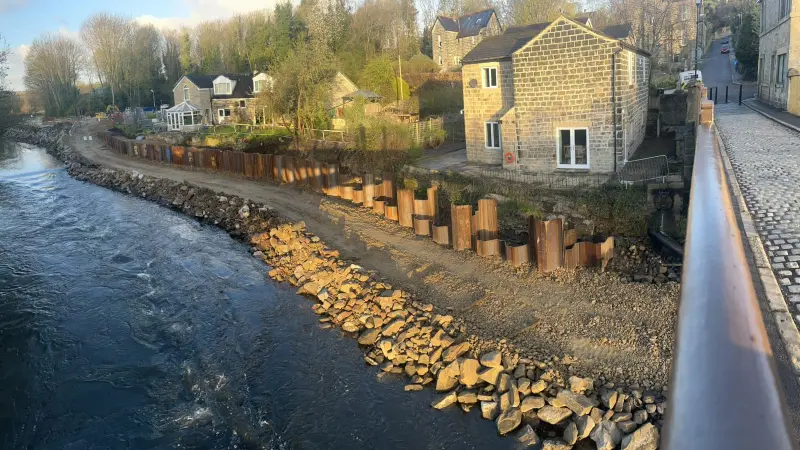
Steel sheet piles are ideal for flood control systems because they are strong, watertight, and fast to install. They are used to build dykes, flood walls, and embankments. They can seal existing structures or create new barriers. Their flexibility and ductility make them especially effective in high-seismic areas.
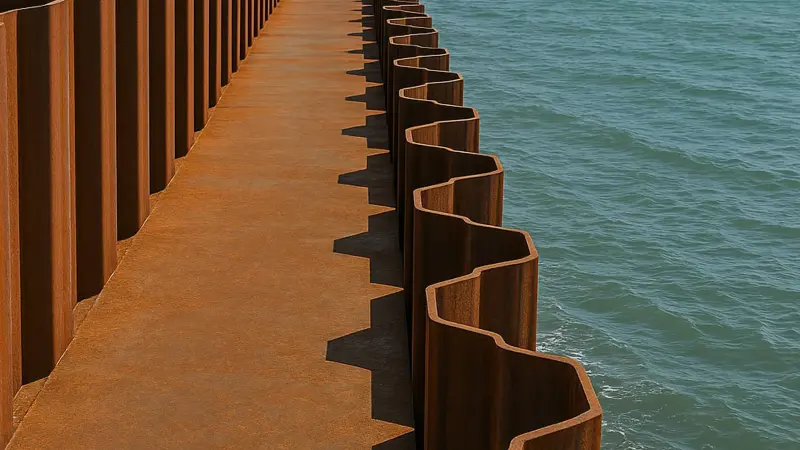
I have worked with steel sheet piles for years. I have supplied them for flood protection projects in Southeast Asia and other regions. I have seen how well they perform in stopping water and stabilizing banks. Let me walk you through why they are the preferred solution for flood control.
For official guidelines and case studies, see the ArcelorMittal: Steel Solutions for Flood Control Systems, the Steel Piling Solutions: How Do Sheet Piles Prevent Flooding?, and the SheetPilingUK: Using Sheet Piles to Defend Against Flooding.
Why Are Steel Sheet Piles Used in Flood Control Systems?
I often get this question from project managers who are evaluating different flood defence options. The answer is simple: sheet piles offer a combination of benefits that no other material can match. They are fast to install, highly durable, and extremely effective at stopping water.
Steel sheet piles are used in flood control systems because they are impervious to water, they can be installed quickly, and they provide both watertightness and structural stability. They are used to build new flood walls and to reinforce existing embankments. The natural deposition of soil in the interlocks often provides sufficient watertightness without additional sealing.
The Key Benefits
Let me explain the main reasons why sheet piles are the preferred choice for flood defence.
Watertightness
Steel sheet piles are completely impervious to water [web:198]. The steel itself does not let water through. The only potential path for water is through the interlocks between adjacent piles. For most flood defence applications, the natural shape of the Larssen interlock provides high seepage resistance without any additional sealing [web:198]. This is a critical feature for flood barriers.
Speed of Installation
Sheet piles can be installed quickly, even in remote or challenging locations [web:198][web:203]. In an emergency, they can be driven just before the flood arrives. Self-propelled high frequency vibrators and hydraulic machines are used for installation, which causes minimal environmental damage [web:203].
Cost-Effectiveness
Steel sheet pile flood defence systems are among the most cost-effective solutions available. They can result in savings of up to 40% compared to other methods [web:198]. The speed of installation also reduces project costs.
Flexibility and Ductility
Steel is a flexible and ductile material [web:198]. This is a major advantage in flood control systems. The wall can accommodate potential soil displacement while maintaining full resistance [web:198]. This makes it suitable for use in high-seismic areas, as the steel can bend without breaking.
Space Efficiency
In urban areas where space is limited, sheet piles can form freestanding floodwalls with a very small footprint [web:198]. This is a huge advantage over traditional flood embankments, which require a much larger area.
Real-World Examples
The Waterford Flood Defence Scheme in Ireland is a perfect example. The project involved constructing nearly two kilometers of continuous steel sheet pile flood defences to protect the city from a 1:200-year flood event [web:198]. The project used heavy-duty AZ-series piles for the deeper sections and PU 32-1 piles for the shallower sections, with a total of 3,141 tonnes of steel sheet piles supplied [web:198].
What Type of Steel Sheet Piles Is Best for Flood Protection?
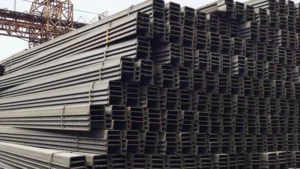
I hear this question from many engineers. The answer depends on the specific conditions of the site. The water depth, soil type, and required wall height all play a role. The two most common types are U-shaped and Z-shaped piles.
The choice of sheet pile type depends on the ground conditions and the required embedment depth. For deep flood walls with high water pressure, heavy-duty Z-type piles offer the highest bending resistance. For shallower walls, U-type piles are often sufficient. The AZ-series piles from ArcelorMittal are widely used in flood protection projects.
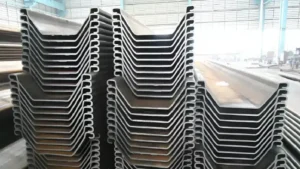
U-Type Piles (Larssen)
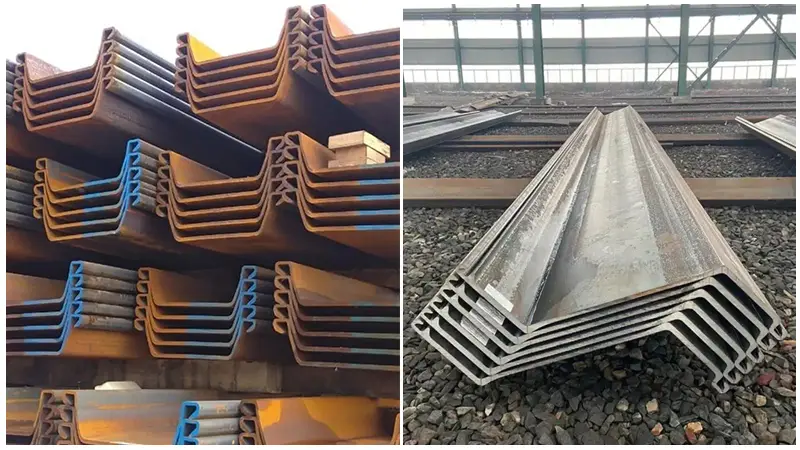
U-type piles have a U-shaped cross-section. The interlocks that connect the piles are located at the center of the section.
Advantages
The U-shape makes them convenient to install. They are easier to handle and drive into the ground. They are the most common type for general applications.
Best Use
U-type piles are often used for smaller flood defence structures. They are suitable for dykes and riverbank protection in shallower water.
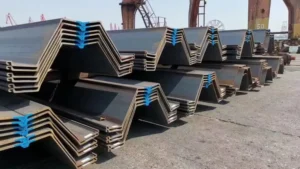
Z-Type Piles
Z-type piles have a Z-shaped cross-section. The interlocks are located at the outer edges of the section.
Advantages
Z-type piles offer the highest bending resistance for the same weight [web:202]. This makes them the most efficient type of sheet pile available. They are particularly effective for cantilever walls and deeper embedment [web:202].
Best Use
Z-type piles are used for deep flood walls where the water pressure and bending moments are high. In the Waterford project, AZ 52-700N, AZ 48-700N, AZ 44-700N, and AZ 42-700N piles were used for the deeper Western Defences [web:202].
Selection Guide
| Factor | Recommendation |
|---|---|
| Shallow Flood Wall | U-type piles are usually sufficient |
| Deep Flood Wall (>24m embedment) | Z-type piles (AZ-series) are the better choice |
| High Water Pressure | Z-type piles offer superior bending resistance |
| Cantilever Wall | Z-type piles are commonly used for cantilever systems |
| Standard Embankment | U-type piles are a cost-effective solution |
For more on Z-piles, see the HERMEQ: Z Sheet Piles for Ground Support and the Sheet-Pile LLC: Z-Pile HR® Systems.
How Deep Should Steel Sheet Piles Be Installed for Flood Control?
This is a critical design question. The embedment depth determines how well the wall will perform and how long it will last. The depth is not a fixed number. It depends on the soil conditions and the water pressure.
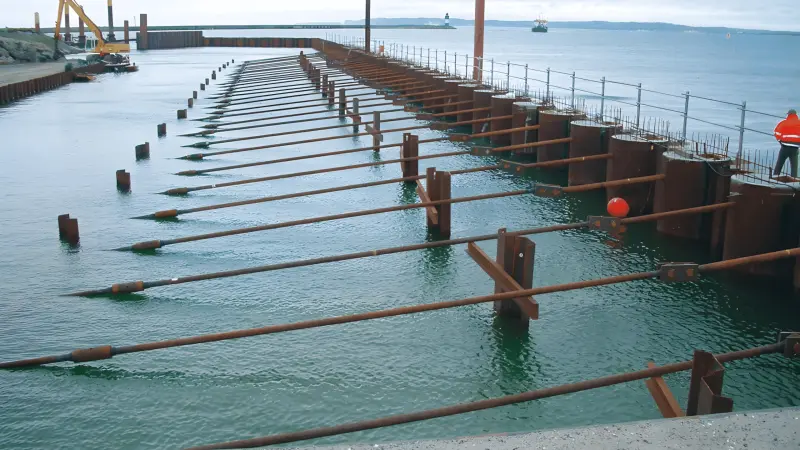
The embedment depth for flood control sheet piles must be sufficient to resist the water pressure and provide stability. In challenging ground conditions, pile lengths can exceed 24 meters. The toe must penetrate through soft deposits and anchor into dense, stable layers.
Factors Determining Embedment Depth
Soil Conditions
The type of soil is the most important factor. In soft alluvial deposits, the piles must go much deeper to reach stable ground. In the Waterford project, the Western Defences required toe levels as deep as –20.5 m AOD to penetrate through soft layers and anchor into dense glacial deposits [web:202]. This required pile lengths exceeding 24 meters.
Water Pressure
Higher water pressure requires a deeper embedment. The wall must be embedded deep enough to resist the lateral forces from the water.
Design Flood Level
The design flood level determines the required crest height of the wall. The embedment depth is then calculated based on the wall height and the soil conditions.
Stability Requirements
The wall must be stable against overturning and sliding. This requires a sufficient embedment depth to provide passive soil resistance.
Typical Embedment Depths
| Application | Typical Embedment Depth |
|---|---|
| Small Dyke | 5-10 meters |
| Urban Flood Wall | 10-15 meters |
| Deep Flood Defence (e.g. Waterford) | 24+ meters [web:202] |
How Long Do Steel Sheet Pile Flood Control Systems Last?
This is the most important question for any infrastructure project. The design life determines the investment value. The answer depends on the environment and the level of protection.
The design life of a steel sheet pile flood control system can be up to 120 years [web:198]. In inland freshwater environments, the lifespan can reach 75-100 years. In harsh marine environments, the lifespan may drop to 20-30 years without additional protection [web:198].
Lifespan in Different Environments
Inland Freshwater
In non-aggressive inland environments, steel sheet piles can last a very long time. A design life of 100 years is achievable. The corrosion rate is low because the water is not salty and the oxygen levels are moderate.
Marine Environments
The lifespan in saltwater is shorter. The tidal and splash zones are the most aggressive areas. Without protective measures, the structure may only last 20 to 30 years [web:198].
With Corrosion Protection
Corrosion protection is essential for a long life in harsh environments. Protective coatings, cathodic protection, and the use of corrosion-resistant steel grades can extend the life by 20 to 30 years [web:198].
Real-World Data
In a project in the UK, the new flood defence wall had a specified 100-year design life [web:198]. In another project, a 120-year design life was achieved for steel sheet pile retaining walls [web:198].
Corrosion Protection Measures
| Protection Method | Effectiveness |
|---|---|
| Sacrificial Thickness | Most cost-effective, adds steel reserve [web:198] |
| Protective Coatings | Reduces corrosion rates by up to 40% [web:198] |
| Cathodic Protection | Extends pile life by 20-30 years [web:198] |
| AMLoCor Steel Grade | Reduces corrosion by factor of 3-5 in immersion zones [web:198] |
A Real-World Example
The Deptford Creek flood defence project on the Thames in London specified a 100-year design life for the new wall [web:198]. The project used AZ 41-700 sheet piles and incorporated a static reserve of steel thickness to achieve the design life [web:198]. No surface treatment was applied because the design included the sacrificial thickness.
For more on corrosion protection in flood defence, see the ArcelorMittal: Sheet Pile Usage in Flood Protection.
Conclusion
Steel sheet piles are the ideal solution for flood control systems because they offer watertightness, strength, and durability. The best type depends on the specific site conditions, with Z-type piles used for deep, high-load applications. With proper design and protection, these systems can last up to 120 years.
For more on steel projects in flood defence, see the Construct Steel: Steel Sheet Piling Plays a Key Role in Flood Defence.