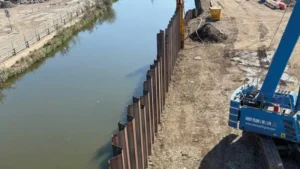
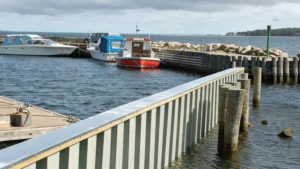
You are designing a new harbor, a shipping terminal, or a marina. The water is deep, the ships are heavy, and the wall must hold back tons of soil for decades. Which pile profile should you choose?
For harbor structures, U type sheet piles1 are preferred for moderate depths, curved alignments, and simpler installation. Z type sheet piles2 are preferred for deep water, straight walls, and projects where structural efficiency saves steel weight. Both are used in ports worldwide, with the choice depending on site conditions.
](https://cnsteelplant.com/wp-content/uploads/2026/03/Article-Application-Port-3.webp)
I have supplied sheet piles for harbors across the Middle East, Southeast Asia, and Africa. Each project had its own conditions. Some needed the simplicity of U piles for curved berths. Others required the efficiency of Z piles for deepwater terminals. Let me share what I have learned about choosing between them.
What is the difference between Z pile and U pile?
Before you can choose, you need to understand the fundamental differences between these two profiles.
The main difference between Z and U piles1 is the position of the interlocks2 and the resulting structural efficiency3. U piles1 have interlocks2 at the neutral axis, making them symmetric and forgiving to install. Z piles4 have interlocks2 at the outer flanges, which gives them a higher section modulus per kilogram of steel, meaning they are more structurally efficient.
](https://cnsteelplant.com/wp-content/uploads/2026/03/Article-Application-Port-1.webp)
How the Differences Apply to Harbors
Let me explain what these differences mean for harbor construction.
U Pile Characteristics
U piles1 are symmetric and have been used for over a century. Their interlocks2 are at the neutral axis—the line through the cross-section that experiences no bending stress. This design has several implications for harbor work:
- Symmetry allows easy installation in curved alignments, which is common in harbor layouts
- The Larssen interlock provides good water tightness, important for waterfront structures
- Installation is more forgiving, valuable in marine conditions where waves and currents complicate work
- Available in marine grades like ASTM A690
For the riverbank project in Southeast Asia, we used U piles1 because the wall followed the river curve and the depth was moderate.
Z Pile Characteristics
Z piles4 have interlocks2 at the outer flanges, far from the neutral axis. This pushes steel to where it does the most work. For harbor structures:
- Higher strength per kilogram means lighter piles for the same wall height
- Wider sections (often 630-700 mm) mean fewer piles to drive, speeding installation
- Modern Z piles4 use ball-and-socket interlocks2 that perform well in deep water
- More efficient for anchored walls in deep water
For a deepwater port in the Middle East, we used Z piles4. The wall was 18 meters high, straight, and required maximum structural efficiency3.
Comparison for Harbors
| Feature | U Type | Z Type |
|---|---|---|
| Best water depth | Moderate (under 10m) | Deep (10m+) |
| Curved alignments | Excellent | Difficult |
| Straight walls | Good | Excellent |
| Installation complexity | Simpler | More skill required |
| Steel efficiency | Good | Excellent |
| Interlock water tightness | Good (Larssen) | Good (ball-and-socket) |
| Typical width | 400-600 mm | 630-700 mm |
What are the three types of piling?
When you design a harbor, you may use different types of piles for different parts of the facility.
The three main types of piling are sheet piles1 (retaining walls), bearing piles2 (load support), and anchor piles3 (tension resistance). In a typical harbor, all three work together: sheet piles1 form the quay wall4, bearing piles2 support the deck and crane rails, and anchor piles3 hold the sheet pile wall in place.
](https://cnsteelplant.com/wp-content/uploads/2026/03/Article-Application-Port-3-1.webp)
How Each Type Is Used in Harbors
Let me explain how these three types come together in a harbor structure.
Sheet Piles
Sheet piles are the primary wall. They hold back the soil and create the vertical face of the quay. They are driven to a depth that provides stability against the lateral pressure of the retained soil and water.
In harbors, sheet piles1 are typically:
- U type for moderate depths and curved berths
- Z type for deep water and straight walls
- Driven to embedment depths of 0.5 to 1 times the exposed height
- Often combined with anchors to allow deeper water
Bearing Piles
Bearing piles carry vertical loads. They support the wharf deck, crane rails, and other structures behind the sheet pile wall.
In harbors, bearing piles2 are typically:
- Steel pipe piles (LSAW or SSAW) or concrete piles
- Driven to rock or to achieve required friction capacity
- Located behind the sheet pile wall, not through it
- Designed to carry heavy crane loads and ship berthing forces
Anchor Piles
Anchor piles provide lateral support to the sheet pile wall. Without anchors, the wall would need much deeper embedment or would be limited in height.
In harbors, anchor piles3 are typically:
- Driven at an angle (raked piles) or vertical with tie rods
- Connected to the sheet pile wall by steel tie rods
- Located behind the wall, often 10-20 meters back
- Essential for walls over 5-6 meters high
How They Work Together
A typical harbor quay wall4:
- Sheet piles are driven to form the face
- Anchor piles are driven behind the wall
- Tie rods connect the anchor piles3 to the sheet pile wall
- Bearing piles are driven behind the anchor system
- A concrete deck is built over the bearing piles2
- Crane rails and mooring hardware are installed
My Experience
For the Middle East port, we used Z sheet piles1 for the quay wall4, steel pipe bearing piles2 for the crane rails, and raked anchor piles3 with tie rods to hold the wall. All three types worked together to create a structure that has handled 50-foot container ships for years.
What is the difference between ZZ1 and AZ sheet piles?
In harbor projects, you may see specifications calling for AZ or ZZ1 piles. These terms refer to specific Z pile product lines.
AZ and ZZ1 are both Z-shaped sheet piles, but AZ is a specific product line from ArcelorMittal with the interlock positioned on the neutral axis for better driving performance2. ZZ1 is an older term sometimes used generically for Z piles. For harbor structures, AZ piles are preferred because of their proven performance and standardized properties.
](https://cnsteelplant.com/wp-content/uploads/2026/03/Article-Application-Port-2.webp)
Understanding the Terminology for Harbors
Let me clarify what these terms mean for harbor design.
AZ Series3
AZ piles are manufactured by ArcelorMittal and are the market leader in Europe, the Middle East, and much of Asia. Key features:
- Interlock positioned on the neutral axis, protecting it during driving
- Larssen-type interlock design for water tightness
- Wide range of sections from AZ 12 to AZ 50
- Section modulus from 1,200 to 5,000 cm³ per meter of wall
- Available in marine grade steel4 (ASTM A690 equivalent)
The number in AZ indicates the section modulus. AZ 18 has 1,800 cm³/m, suitable for moderate depths. AZ 26 has 2,600 cm³/m, for deeper water.
What About ZZ1?
ZZ1 is an older designation. In the past, ZZ1 referred to Z-shaped piles with double symmetry. Today, when you see ZZ1 in a specification, it might mean:
- Any Z pile (generic reference)
- An older section no longer commonly rolled
- A misunderstanding of the AZ designation
For harbor projects, specifying AZ ensures you get a standardized, proven product with known properties.
Comparison for Harbor Use
| Feature | AZ Series3 | Generic ZZ1 |
|---|---|---|
| Interlock position | Neutral axis | Outer flanges |
| Driving performance | Excellent | Variable |
| Standardization | Consistent | Varies by manufacturer |
| Water tightness | Good (Larssen) | Variable |
| Marine grade available | Yes | Possibly |
| Engineering data | Comprehensive | Variable |
My Experience
For the Middle East port, the specification called for AZ 26 piles. That gave us exactly what we needed: a high-strength Z pile with proven performance in deep water. If the specification had said "ZZ1," we would have needed clarification to ensure we supplied the right product.
What is the difference between a PZ and a PZC sheet pile?
In North American harbor projects, you may see PZ and PZC designations. These are Z piles from American manufacturers.
PZ and PZC are both Z-shaped sheet pile designations used in North America. PZ refers to older Z pile sections with hook-and-grip interlocks. PZC is a newer series from Gerdau Ameristeel featuring wider sections and ball-and-socket interlock1s for better driving performance2 and water tightness.
](https://cnsteelplant.com/wp-content/uploads/2026/03/Article-Application-Port-4.webp)
Understanding North American Z Piles for Harbors
Let me explain what these designations mean for harbor work.
PZ Series
PZ sections have been used in North America for decades. They feature hook-and-grip interlocks. Key characteristics:
- Proven track record in many harbor projects
- Available in various weights and sizes
- Hook-and-grip interlocks require careful alignment
- Water tightness may require sealants
PZC Series3
PZC is a modern redesign by Gerdau Ameristeel. The "C" stands for "cold" or "combination," but the key feature is the ball-and-socket interlock1. Advantages for harbor work:
- Ball-and-socket interlock is more forgiving during driving
- Wider sections (27.88 or 25.00 inches) mean fewer piles
- Better water tightness without sealants
- Designed for hard driving conditions
- Available in marine grades4
Comparison for Harbor Use
| Feature | PZ Series | PZC Series3 |
|---|---|---|
| Interlock type | Hook and grip | Ball and socket |
| Driving ease | Good | Excellent |
| Water tightness | Good with sealants | Better self-sealing |
| Width | Varies | 25-28 inches |
| Marine grade | Available | Available |
| Track record | Decades | Modern, growing |
Which to Choose for Harbors
For new harbor construction, PZC sections are often preferred because:
- The ball-and-socket interlock1 handles driving stresses better
- Wider sections reduce the number of piles
- Better water tightness reduces maintenance
- Modern design matches current engineering practice
PZ sections remain a good choice for replacement work or when matching existing piles.
My Experience
I have supplied both PZ and PZC for North American projects. For a marina project in the US, the engineer specified PZC because the site had hard driving conditions and the contractor wanted the more forgiving interlock. The installation went smoothly with no declutching issues.
Conclusion
For harbor structures, choose U piles1 for curved alignments and moderate depths. Choose Z piles (AZ or PZC)2 for deep water and straight walls. Both have proven track records in marine environments.
-
Explore this link to understand the advantages and applications of U piles in marine environments. ↩ ↩ ↩ ↩ ↩ ↩ ↩ ↩ ↩ ↩ ↩ ↩ ↩ ↩ ↩ ↩ ↩ ↩ ↩ ↩ ↩ ↩ ↩
-
Learn about Z piles and their effectiveness in deep water applications, enhancing your knowledge of marine construction. ↩ ↩ ↩ ↩ ↩ ↩ ↩ ↩ ↩ ↩ ↩ ↩ ↩ ↩ ↩
-
Explore the benefits of PZC Series sheet piles for modern harbor projects, including improved water tightness and driving performance. ↩ ↩ ↩ ↩ ↩ ↩ ↩ ↩ ↩ ↩ ↩
-
Understand the importance of marine grades in sheet piles for durability and performance in harsh environments. ↩ ↩ ↩ ↩ ↩ ↩ ↩ ↩ ↩