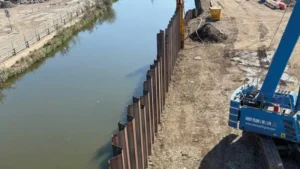
You are designing a deep foundation for a bridge or a marine terminal. The geotechnical report shows dense soil and high loads. Now you need to choose the right steel pipe.
Neither SSAW1 nor LSAW2 pipe is universally better for pile foundations. SSAW1 (spiral weld) pipe is the economical workhorse for most projects with moderate driving conditions. LSAW2 (longitudinal weld) pipe is the heavy-duty solution for extreme loads, thick walls, and challenging driving conditions where maximum reliability is required [citation:1].
](https://cnsteelplant.com/wp-content/uploads/2026/03/Article-application-1.webp)
I learned this distinction working with a client in the Middle East who needed pipe piles for a major port expansion. The engineer specified LSAW2 for the main berth and SSAW1 for the access trestle. Both were right for their specific jobs. Let me walk you through what I have learned about these two pipe types.
What is the difference between SSAW and LSAW pipes?
The names sound similar, but the manufacturing processes and resulting pipe characteristics are quite different.
The fundamental difference between SSAW and LSAW pipes is the orientation of the weld seam. LSAW pipes have a straight longitudinal seam running parallel to the pipe axis. SSAW pipes have a helical (spiral) seam that wraps around the pipe at an angle [citation:2]. This difference affects everything from manufacturing flexibility to performance.
](https://cnsteelplant.com/wp-content/uploads/2026/03/Article-application-2.webp)
Manufacturing Process Comparison
Let me explain how each pipe is made.
LSAW Pipe Manufacturing
LSAW stands for Longitudinal Submerged Arc Welding1. The process starts with a flat steel plate. This plate is cut to the exact width needed for the final pipe diameter. Then it goes through a forming process—either UOE, JCOE, or press bending—that shapes the plate into a cylinder [citation:2].
The formed cylinder has a single longitudinal seam. This seam is welded using submerged arc welding, both inside and outside the pipe. After welding, the pipe is often mechanically expanded to achieve precise dimensions and reduce residual stresses.
LSAW pipes typically range from 16 inches to 60 inches in diameter, with wall thicknesses up to 40 mm or more [citation:2][citation:5].
SSAW Pipe Manufacturing
SSAW stands for Spiral Submerged Arc Welding2. This process uses a steel coil, not plates. The coil is unwound and fed into a forming machine at a specific angle. As the steel strip moves forward, it spirals into a tube shape [citation:7].
The spiral seam is welded continuously as the pipe forms. Like LSAW, welding is done both inside and outside. Because the process is continuous, SSAW pipes can be made in very long lengths—up to 64 meters or more [citation:7].
SSAW pipes can achieve very large diameters, up to 120 inches or more, but wall thickness is typically limited to about 25 mm [citation:2].
Key Differences Table
| Feature | LSAW Pipe | SSAW Pipe |
|---|---|---|
| Raw material | Discrete steel plates | Continuous steel coil |
| Weld orientation | Straight (parallel to axis) | Helical (spiral angle) |
| Diameter range | 16" to 60" typical | 16" to 120"+ |
| Wall thickness | Up to 40 mm+ | Up to 25 mm typical |
| Length capability | Limited by plate (12-18m) | Continuous (up to 64m+) |
| Production speed | Slower (discrete plates) | Faster (continuous) |
| Cost per meter | Higher (30-50% premium) | Lower |
| Dimensional precision | Excellent (expanded after weld) | Good |
What is the difference between HSAW1 and LSAW2 pipes?
You will also see the term HSAW1. This is essentially the same as SSAW, just with a different letter.
HSAW1 and LSAW2 pipes differ in the same way as SSAW and LSAW2. HSAW1 (Helical Submerged Arc Welding) is another name for spiral welded pipe, also called SSAW. The weld seam runs in a helix around the pipe, while LSAW2 has a straight longitudinal seam [citation:3].
](https://cnsteelplant.com/wp-content/uploads/2026/03/Article-application-3.webp)
Understanding the Terminology
Let me clear up the naming confusion.
HSAW1 = SSAW
Different manufacturers and regions use different terms. HSAW1 and SSAW refer to the same product—spiral welded pipe. The "H" stands for Helical, and the "S" stands for Spiral. Both describe the same helical weld seam [citation:3][citation:7].
Production Characteristics
HSAW1/SSAW pipes are made by forming a steel strip into a spiral and welding the seam. The weld seam length is much longer than LSAW2—typically 1.5 to 2 times the length of the pipe [citation:3]. This means more weld length and potentially more areas that could have defects.
The production rate for HSAW1 is about 2 meters per minute, while LSAW2 produces about 4 meters per minute [citation:3]. But because HSAW1 uses continuous coils, it can make longer pipes.
Heat Affected Zone
The heat affected zone (HAZ) in HSAW1 pipes is larger than in LSAW2 pipes [citation:3]. This is the area around the weld where the steel properties change due to heating. A larger HAZ can affect the pipe’s mechanical properties.
Which One to Choose
For piling applications, both HSAW1 and LSAW2 are used. The choice depends on the specific requirements. LSAW2 is preferred for thick walls and high-stress applications. HSAW1 is often chosen for large diameters and long lengths where cost is a primary concern.
Which is stronger, solid steel rod1 or hollow steel pipe?
This question comes up when engineers compare different pile options. The answer depends on how you measure strength.
For the same outside diameter, a solid steel rod1 is stronger and stiffer than a hollow pipe2 in tension, compression, and bending [citation:4]. But for the same weight, a hollow pipe2 is much stronger and stiffer because the material is placed farther from the center where it does more work [citation:4][citation:8].
[^2] under bending](https://placehold.co/600x400 "Solid Rod vs Hollow Pipe Stress Distribution")](https://cnsteelplant.com/wp-content/uploads/2026/03/Article-application-6.webp)
The Engineering Explanation
Let me explain this with basic mechanics.
Same Diameter Comparison
If you take a solid steel rod1 and a hollow pipe2 with the same outside diameter, the solid rod has more steel. More steel means more strength. The cross-sectional area is larger, and the moment of inertia3 is higher. For any loading condition—tension, compression, or bending—the solid rod will carry more load before failing [citation:4].
Same Weight Comparison
But here is where it gets interesting. If you take a solid rod and a hollow pipe2 with the same weight per meter, the hollow pipe2 must have a larger diameter. Because the steel is spread out over a bigger circle, the moment of inertia3 increases dramatically. For bending and torsion, the hollow pipe2 becomes much stronger even though it uses the same amount of material [citation:8].
Why This Matters for Piles
In pile foundations4, we care about bending strength. Piles must resist lateral loads from soil and water. The moment of inertia3 is the key property. A hollow pipe2 pile can achieve a high moment of inertia3 with less steel than a solid rod of the same weight.
The equation for moment of inertia3 of a hollow pipe2 is proportional to (OD⁴ – ID⁴). The outer diameter (OD) has a huge effect. Doubling the diameter increases the moment of inertia3 by 16 times [citation:4]. This is why pipe piles are so efficient.
Real Application
This is why bones are hollow. Nature figured out millions of years ago that placing material away from the center creates strong, lightweight structures [citation:4]. The same principle applies to steel pipe piles. We use hollow sections because they give us the most strength for the least weight.
What are the uses of LSAW pipes1?
LSAW pipes1 serve many purposes, but they are especially valuable for demanding foundation applications.
LSAW pipes1 are used for high-pressure pipelines2, offshore structures, marine terminals3, bridge foundations, and piling in challenging soil conditions. They are preferred when projects require thick walls, high strength, and reliable performance under extreme loads [citation:1][citation:5][citation:9].
](https://cnsteelplant.com/wp-content/uploads/2026/03/Article-Application-City-3.webp)
Primary Applications for LSAW Pipes
Let me list the main uses based on what I see in the industry.
1. Pile Foundations for Major Structures
LSAW pipes1 are excellent for deep foundations. They can be driven into hard soils without buckling. The thick walls resist damage from boulders or dense layers. For bridges, high-rise buildings, and industrial facilities, LSAW pipe piles provide reliable support [citation:1].
The governing standard for piling is ASTM A252. LSAW pipes1 manufactured to this standard, typically Grade 2 (35 ksi yield) or Grade 3 (45 ksi yield), are widely used for structural foundations [citation:1].
2. Marine and Offshore Construction
Offshore platforms, wind turbine foundations, and marine terminals3 face extreme conditions. Waves, currents, and ice loads require piles with high strength and durability. LSAW pipes1 with thick walls and high-grade steel meet these demands [citation:1][citation:5].
Submarine pipelines per DNV-ST-F101 often use LSAW because of the stringent requirements for offshore service [citation:2].
3. High-Pressure Pipelines
For oil and gas transmission, LSAW pipes1 are the preferred choice. They handle high internal pressures and can be made in high-strength grades like API 5L X70 [citation:5]. The straight weld seam is easier to inspect with ultrasonic and radiographic methods, ensuring quality [citation:10].
4. Sour Service Applications
When pipelines carry fluids with hydrogen sulfide (sour service), material quality is critical. LSAW pipes1 can be manufactured to meet NACE MR0175/ISO 15156 requirements for sour service [citation:2].
5. Large-Diameter Water Mains
Municipal water supply systems often use LSAW pipes1 for large-diameter transmission mains. They can be lined with cement mortar or epoxy for corrosion protection and to maintain water quality [citation:1][citation:5].
6. Structural Applications
Beyond piling, LSAW pipes1 serve as structural columns, truss members, and supports for buildings and bridges. Their dimensional accuracy makes them easy to fabricate and erect [citation:5].
When to Choose LSAW for Piling
Based on industry guidance, here is when LSAW makes sense for pile foundations [citation:1]:
| Condition | Why LSAW is Preferred |
|---|---|
| Hard driving conditions | Thick walls resist damage from boulders and dense layers |
| High structural loads | Heavy-wall sections provide high axial and lateral capacity |
| Deepwater marine terminals3 | Extreme loads demand maximum reliability |
| Offshore wind foundations | Dynamic loads from waves and turbines require robust piles |
| Sensitive structures | Bridges and critical facilities need proven performance |
My Experience
For a major bridge project in Australia, the engineer specified LSAW pipe piles. The geotechnical report showed very dense sand layers and some rock fragments. The contractor worried about pile damage during driving. LSAW pipes1 with 30 mm wall thickness drove successfully without any buckling. That is why LSAW was the right choice.
Conclusion
SSAW pipes1 are the economical choice for most piling projects. LSAW pipes2 are the heavy-duty solution for extreme conditions. Choose based on your specific driving conditions, loads, and budget.
-
Explore the benefits of SSAW pipes to understand why they are a cost-effective choice for your piling needs. ↩ ↩ ↩ ↩ ↩ ↩ ↩ ↩ ↩ ↩ ↩ ↩ ↩ ↩ ↩ ↩ ↩ ↩ ↩ ↩ ↩ ↩ ↩ ↩ ↩ ↩ ↩ ↩ ↩ ↩ ↩
-
Learn about LSAW pipes and their suitability for extreme conditions to make informed decisions for your projects. ↩ ↩ ↩ ↩ ↩ ↩ ↩ ↩ ↩ ↩ ↩ ↩ ↩ ↩ ↩ ↩ ↩ ↩ ↩ ↩ ↩ ↩ ↩
-
Discover the unique challenges marine terminals encounter and how LSAW pipes can address them. ↩ ↩ ↩ ↩ ↩ ↩ ↩ ↩ ↩
-
Discover the best materials for pile foundations, focusing on their strength and efficiency in various conditions. ↩